


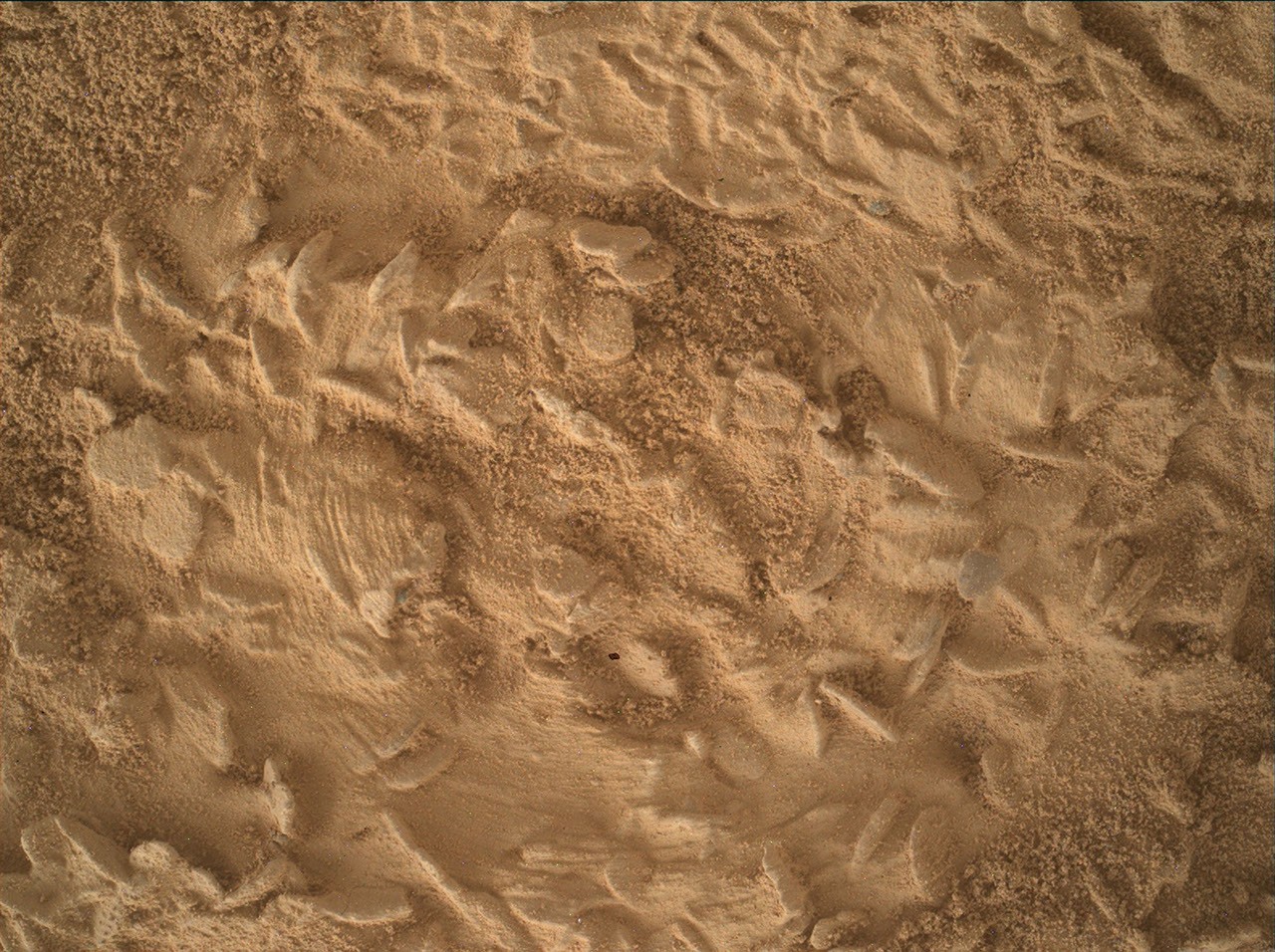
NASA’s Curiosity rover has begun another training campaign near the Chiuchiu mining area after completing work at Basque Lakes. The newly identified Nazca site contains abundant “disc-and-needle”-shaped formations that may reveal how minerals crystallized or were later replaced, while planned observations will examine their three-dimensional structure and composition. Curiosity will also study a layered rock, image Phobos to investigate Martian clouds, and continue monitoring the planet’s environment.
Written by Lucy Lim, planetary scientist at NASA Goddard Space Flight Center
Earth Plan Date: Friday, October 16, 2026
Investigating the Nazca formations
Following the Basque Lakes training campaign, Curiosity returned for another training campaign a few meters from the Chiuchiu mining area. “Chiu Chiu” itself was not a suitable drilling target, but blocks immediately beyond it appeared much more promising, so the rover’s team selected them as a drive target during Monday’s planning.
While serving as the Geology and Mineralogy Science theme lead for Friday’s plan, I reviewed close-up images of the adjacent block taken after the drive. Our team was delighted to see that it was filled with “disc-and-needle”-shaped masses similar to those at Chiu Chiu. We quickly approved the science activities and began preparing for excavation at the newly named Nazca site.
One leading hypothesis is that the “disk-and-needle” texture formed during crystal growth, through a process known as crystal morphology. Minerals tend to grow into characteristic shapes determined by their microscopic crystal structures, much like salt crystals grown in a kitchen or classroom science experiment.
The relatively large crystal forms at Nazca and Chiuchiu could provide clues about the temperature at which they formed and the availability of salts and liquids. However, the minerals’ current composition may not be the same as their original composition. A mineral crystal can later be replaced by another mineral while retaining its original shape. The resulting mineral is called a “pseudomorph”: it has the shape of the original mineral but a different composition and molecular structure.
Creating detailed 3D models
Before the drill preload tests, the team planned specialized observations to characterize the crystalline morphology in greater detail. The Mars Hand Lens Imager (MAHLI) will perform a Quantitative Relief Model (QRM) observation, which consists of five overlapping images taken from slightly different positions. Combining the images allows scientists to construct detailed three-dimensional relief models.
MAHLI will also double the number of steps in its focusing mechanism, adding an extra frame for the highest-resolution imaging. Together, these observations should improve the resolution of the three-dimensional models of the crystalline structures.
Examining composition below the surface
ChemCam’s laser-induced breakdown spectroscopy (LIBS) instrument will conduct “depth profile” experiments on Toucan, a nearby target rich in crystalline forms. The experiment is designed to obtain compositional information from layers slightly deeper inside the rock.
During a typical observation, LIBS fires 150 laser shots across a five-point raster, with 30 shots at each point. For this experiment, all 150 shots will be directed at the same location. Each laser shot vaporizes a very small amount of rock to create a plasma, so concentrating the shots in one place should allow the laser to penetrate about five times deeper than it does during a typical 30-shot point observation.
This may reveal whether the composition inside the exposed crystal form differs from the composition at the surface. Possible explanations include the surface’s exposure to the modern Martian environment and the conditions under which the crystalline form originally developed, making the experiment worthwhile.
LIBS, the Dust Removal Tool (DRT), and the Alpha Particle X-ray Spectrometer (APXS) will also examine the Nazca target before preload testing. These measurements are intended to characterize its surface composition as thoroughly as possible before drilling. A third LIBS observation will target Condor, a nearby block with a finely layered texture.
Observing Phobos and Martian clouds
The rover team will continue monitoring the modern Martian environment as the twilight cloud season begins. The plan includes nighttime imaging of Phobos, the larger and brighter of Mars’ two moons.
Imaging Phobos and the surrounding sky when the moon is full shows how sunlight is reflected from Phobos and scattered by the Martian atmosphere. These observations can help estimate the size of particles in Mars’ clouds. Solar observations may provide similar measurements, but Phobos observations can measure cloud-particle sizes late at night.
The observations are also expected to help measure carbon dioxide (CO2) at high altitudes, where it contributes to cloud formation.
Source: science.nasa.gov