


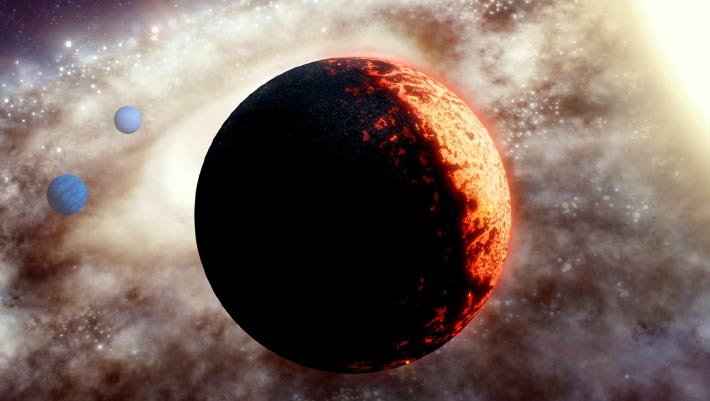
New observations from the NASA/ESA/CSA James Webb Space Telescope suggest that TOI-561b, a rocky exoplanet that completes an orbit in just over 10 hours, may still possess a substantial, highly reflective atmosphere despite receiving intense radiation from its parent star. The findings challenge the theory that worlds this heavily irradiated should have lost their atmospheres billions of years ago.
An ancient planetary system
TOI-561 is a bright star about 280.5 light-years away in the constellation Sextans. Also known as TYC 243-1528-1, the star is about 10 billion years old and has approximately 80% of the Sun’s mass and size.
The system contains at least three transiting planets, known as TOI-561b, TOI-561c and TOI-561d. It is among the oldest and most metal-poor planetary systems discovered in the Milky Way.
TOI-561b, the innermost planet, is a so-called super-Earth with an orbital period of just 0.44 days, or slightly more than 10 hours. It is about 1.4 times wider than Earth and has 2.2 times Earth’s mass, giving it an unusually low density of approximately 4.3 grams per cubic centimeter.
According to prevailing theory, a world exposed to this level of radiation should have lost a substantial atmosphere long ago.
“Our discovery challenges current theory,” said Dr Anjali Piett, an astronomer at the University of Birmingham. “Severely irradiated rocky planets like TOI-561b likely lost their atmospheres billions of years ago.”
“On the contrary, there is evidence that the atmosphere remains significant today,” Piett said.
“This raises big questions about whether the planet started out with an unusually large supply of gas, or whether the oceans of lava covering the surface act as planet-wide volcanoes, constantly feeding the atmosphere.”
Tracking the planet’s changing brightness
Using Webb’s NIRSpec instrument, Piett and colleagues tracked TOI-561b’s brightness during four eclipses and three transits. They used these observations to construct a phase curve, which shows how the planet’s brightness changes as it travels around its star.
The researchers also modeled variations in the star’s light caused by granulation, the movement of convective cells across its surface. By separating the stellar signal from the planetary signal, they obtained an emission spectrum for the planet’s dayside.
The dayside temperature is approximately 2,050 kelvins, substantially lower than the roughly 3,200 kelvins expected from dark, bare rock with no heat transport.
To explain the observed brightness, the astronomers compared their measurements with computer simulations of the planet’s climate. The simulations suggest that clouds made of silicate minerals, including silicon dioxide and magnesium silicate, may form on the dayside and act like sunscreen.
“We measured how the planet’s brightness and heat changed throughout its orbit,” said Professor Lisa Dunn, an astronomer at the University of Waterloo in Ontario.
“This technique, known as phase curving, revealed that the planet reflects a large amount of light from the star, and that heat is redistributed around the planet rather than just on the sunlit side. Together, these points to the presence of an atmosphere.”
Questions about the atmosphere’s origin
“The next big question we will try to answer is whether TOI-561b’s atmosphere is similar to Venus or an extreme version of Io,” Dunn said.
“Using Webb to observe the planet at longer wavelengths could provide insights and help explain how such a hot planet has maintained an atmosphere for billions of years.”
The team’s findings will appear in The Astronomical Journal.
Samuel Boucher et al.. 2026. “Highly reflective atmosphere of lava world TOI-561b revealed by JWST/NIRSpec phase curve.” The Astronomical Journal 172, 239. doi: 10.3847/1538-3881/ae9763
Source: www.sci.news