


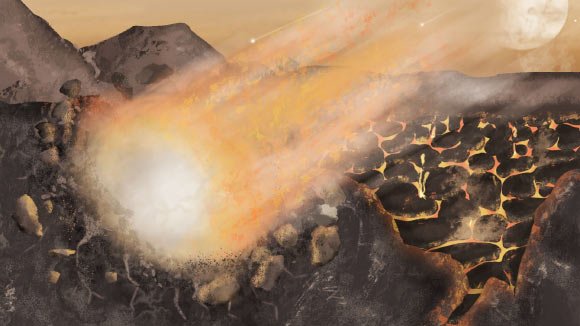
A study led by the University of Cambridge challenges the long-held idea that comets helped seed life on Earth. Computer simulations suggest that comet impacts would rarely have delivered hydrogen cyanide—the chemical concentrations needed for some proposed prebiotic reactions—safely to the planet’s surface.
“Historically, scientists thought that comets were important for the origin of life on Earth because they carried molecules including carbon and nitrogen. These giant cosmic snowballs were therefore like ‘get-out-of-jail-free cards’ that brought the planet all the molecules it needed to generate life,” said lead author Dr Richard Anslow, a researcher at the Institute of Astronomy at the University of Cambridge.
“It’s a bit of a romantic idea, but our results show that it’s very unlikely.”
Testing cometary delivery of hydrogen cyanide
Anslow and his colleagues used computer simulations to investigate whether comets striking the early Earth could have supplied hydrogen cyanide (HCN). The molecule plays a central role in several proposed pathways for producing the building blocks of life.
Laboratory experiments have shown that sufficiently concentrated HCN can contribute to the synthesis of sugars, lipids and components of genetic material. Comets contain HCN and other organic compounds that could serve as raw materials for life.
However, delivering those molecules intact to a planet’s surface is difficult. Small comets can break apart in the atmosphere, while the extreme temperatures produced by high-speed impacts can destroy organic molecules that survive the descent.
To assess how often comets might overcome these obstacles, the researchers modeled the evolution of short-period comets and their impacts on Earth. The simulations included atmospheric entry, impact velocity and the survival of HCN during and after impact.
The results suggest that successful delivery would be extremely rare. In 100,000 simulations of comet impacts on Earth, 54% recorded no impact that delivered HCN at concentrations considered sufficient for prebiotic chemistry.
“It really has to be a one-in-a-million event, because not only does it have to hit at the right speed and the right angle, but everything has to happen from that point forward in terms of concentration and speed at which the chemical origins of life proceed,” Anslow said.
“We can’t rule out with certainty that something like that happened. But it seems like a very rare event. A one-off fluke at best.”
Mars may have been more favorable
The scientists also compared comet impacts on Earth, Mars and Venus. Their simulations showed that Mars would have been more favorable for delivering concentrated HCN.
The main reason is that Mars has weaker gravity and a thinner atmosphere, allowing more comets to reach the surface without losing their chemical cargo.
Under the model’s assumptions, Mars experienced far more successful deliveries than Earth or Venus.
“Of course, we’re not saying this definitely happened on Mars, but it does suggest that it’s less likely that it happened on Earth than on Mars,” Anslow said.
“Or, the other option, which is probably more likely, is that it didn’t happen on either planet.”
The study was published in Scientific Reports.
RJ Anslow et al. 2026. “Comets impact unexpected paths to the origins of life on Earth.” Scientific Reports 16, 31688. Study. doi: 10.1038/s41598-026-74214-y
Source: www.sci.news