


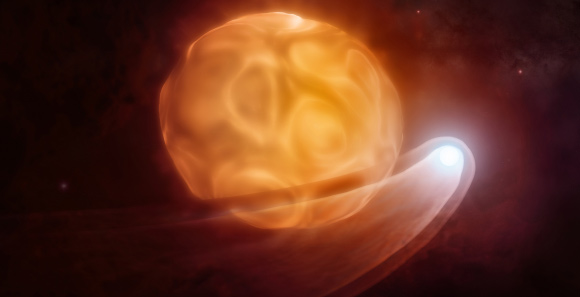
New observations from the National Science Foundation’s Karl G. Jansky Very Large Array (VLA) and the Atacama Large Millimeter/submillimeter Array (ALMA) indicate that Betelgeuse’s outer atmosphere is returning toward its typical state after the star’s dramatic 2019–2020 dimming. The data also show changes in the star’s shape that are consistent with effects from its recently identified companion, Siwala, which may orbit within Betelgeuse’s extended atmosphere.
An artist’s illustration shows the smaller, hotter companion star Siwala creating a wake in Betelgeuse’s outer atmosphere as it orbits the red supergiant. Image credit: NSF/AUI/NRAO/M. Weiss.
Betelgeuse’s atmosphere is recovering
Betelgeuse, also known as HD 39801 and Alpha Orionis, is the second-brightest star in the constellation Orion. The red supergiant is about 8 million years old and lies approximately 724 light-years from Earth.
With a radius about 1,400 times that of the Sun, Betelgeuse is one of the largest known stars. It is also among the brightest, emitting more light than 100,000 Suns.
In 2019 and 2020, the star underwent its most dramatic dimming in more than a century. This event, known as the Great Attenuation, has since been attributed to the ejection of material from its surface.
Dr. Lynn Matthews of MIT’s Haystack Observatory and colleagues used the VLA and ALMA to image Betelgeuse at seven radio frequencies between 2021 and 2026.
“It was the combination of great data from VLA and ALMA that led to the compelling results here,” Matthews said. “The fact that we can actually use these facilities to unravel the disks of nearby stars is amazing.”
VLA observations from August 2019, shortly before the Great Attenuation, showed that Betelgeuse’s atmosphere was at its coldest observed temperature in 30 years at 44 GHz.
More recent VLA measurements show that the star’s brightness temperatures are returning to typical values at both 22 and 44 GHz. At 22 GHz, the peak temperature is approximately 3,500 K, close to the temperature of the star’s photosphere.
This peak now appears at a slightly larger radius than in earlier observations: about 2.7 times the star’s radius, compared with approximately 2.5 times the radius in studies conducted before 2016. The astronomers say this is consistent with a change in the density structure of Betelgeuse’s atmosphere, although they cannot establish that the change was caused by the major dimming event.
Because higher radio frequencies probe deeper layers, ALMA observations helped the researchers map temperatures from the outer atmosphere toward the star’s interior. The brightness temperature steadily declined from about 3,500 K at 2.7 stellar radii to approximately 2,220 K at 1.2 stellar radii. This confirms the lowest-temperature region between Betelgeuse’s visible surface and its hotter chromosphere.
Possible effects of a close companion
Betelgeuse has long been known to show a fluctuation period of about 2,100 days. Two independent studies recently attributed this cycle to a companion star, Siwala, which may orbit within Betelgeuse’s extended atmosphere.
Matthews and her co-authors did not detect the companion directly. Instead, they examined its possible influence on Betelgeuse’s shape.
Radio images show that Betelgeuse is almost circular, with an ellipticity of less than 10% in every observed band. However, when the researchers combined their measurements with three earlier observations and plotted ellipticity against the companion’s predicted orbital phase, they found that the ellipticity was greatest when the companion was farthest from Betelgeuse. It approached zero when the companion passed in front of or behind the star.
The pattern suggests that the companion could be disturbing the atmosphere near the region where Betelgeuse’s stellar wind is expelled.
“This companion star orbits so close to the star that it’s actually passing through our atmosphere,” Matthews said. “Like a jet boat crashing through a lake, a small star can leave a wake in its path as it cuts through the atmosphere.”
“And as new spatially resolved observations of Betelgeuse show, Siwala’s presence produces observable effects,” she added.
The findings were published in The Astronomical Journal.
L. D. Matthews et al.. 2026. “New spatially resolved observations of Betelgeuse with VLA and ALMA: Evidence for atmospheric perturbations from close associates.” The Astronomical Journal 172, 184. doi:10.3847/1538-3881/ae953d
Source: www.sci.news