


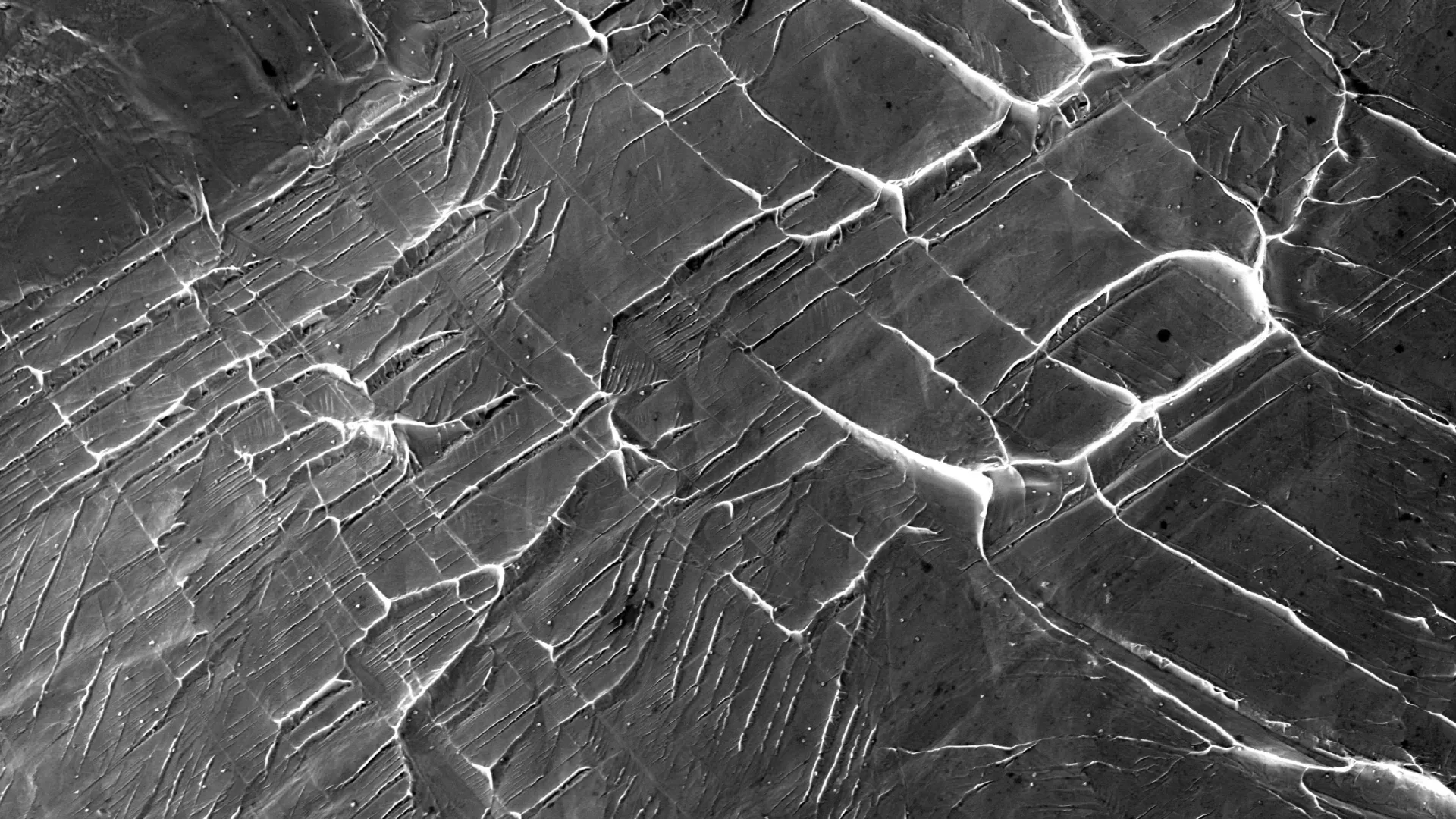
Scientists have identified a nanoscale mechanism that allows two experimental niobium-titanium alloys to resist cracking at 20 kelvin, or −253 °C (−424 °F). The finding challenges the long-held view that body-centered cubic metals inevitably become brittle in extreme cold and could guide the development of tougher materials for energy, transport and aerospace systems exposed to cryogenic conditions.
The research, published on October 14 in Nature, was conducted by an international team from the University of California, Berkeley, Lawrence Berkeley National Laboratory and the University of Oxford, along with researchers from several other institutions.
Why extreme cold can make metals brittle
Cooling a metal generally makes it stronger, but it can also make the material more brittle. Instead of bending under pressure, some metals become more likely to crack or break.
This issue is especially important for body-centered cubic metals, a class that includes iron, tungsten and chromium. In these metals, atoms are arranged in a particular crystal structure that can make them susceptible to brittle fracture at very low temperatures. Near absolute zero, small cracks that might normally be absorbed through deformation can instead expand and trigger a sudden fracture.
The two experimental niobium-titanium alloys behaved differently. Even after being cooled to −253 °C, both retained a strong ability to resist damage, with no measurable increase in brittle behavior at the lowest temperatures tested.
The researchers attribute this performance to a different way of responding to stress. When conventional deformation mechanisms become difficult to use, the alloys activate another microscopic process that helps prevent cracks from spreading.
A hidden mechanism for preventing cracks
Under normal conditions, body-centered cubic metals change shape through the movement of defects in their crystal structure. These defects, known as dislocations, allow layers of atoms to move relative to one another and help the material absorb stress without breaking.
As the temperature falls, however, dislocations become more difficult to move. With fewer ways to accommodate the forces concentrated around a crack, the metal becomes more likely to fail.
The researchers observed that the new alloys can instead undergo a nanoscale process called twinning. In this process, small regions of the crystal rearrange into mirror-image patterns, alongside local changes in the crystal structure known as phase transformations.
When these newly formed regions meet the boundaries between neighboring crystals, they create localized stress concentrations. Those concentrations generate additional defects, giving the material new opportunities to deform rather than crack.
The researchers compare the process with a road network finding alternative routes when its usual roads are blocked by ice. As extreme cold makes conventional deformation more difficult, the newly formed crystal structures provide other pathways for the material to respond to stress.
By creating these routes, the alloys can continue absorbing forces around a potential failure point instead of breaking suddenly.
Implications for cryogenic materials
The findings point to a new strategy for designing structural metals that can withstand very low temperatures. Such materials could be useful in energy systems, transportation and aerospace engineering, where components may face severe thermal conditions.
Corresponding author Professor Dong Liu of the Oxford University School of Engineering said: “For decades, the ductile-to-brittle transition has been thought to be a fundamental limitation of body-centered cubic metals. We were surprised that these alloys maintain remarkable damage resistance even at 20 Kelvin. By elucidating how twinning and phase transformation work together to generate plasticity before conventional dislocation motion, we identified a new path for designing body-centered cubic metals that can operate in cryogenic environments.”
This class of material could be useful for components exposed to extremely high and low temperatures within a single application.
The discovery also changes how scientists may need to understand the causes of brittleness in metals. Previous explanations have focused largely on how easily existing dislocations can move through a material. The new results indicate that the ability to generate new dislocations may be equally important.
Lead author Dr David Cook, who was then at the University of California, Berkeley, and is now at the University of Cambridge, said: “Our results suggest that we need to change our thinking about what governs the transition to brittleness in these metals. Traditionally, the focus has been on how easily pre-existing dislocations can move through the metal, but now the focus is on how easily pre-existing dislocations can move through the metal. It appears that the ability to generate new dislocations may also be important. Using these insights, we may be able to engineer the underlying microstructural conditions that allow the material to create its own routes and remain ductile even at extreme temperatures.”
Testing the alloys at −253 °C
To study the alloys under cryogenic conditions, the team conducted experiments with the Engin-X instrument at the ISIS Neutron and Muon Source in Oxfordshire.
Gaseous helium was used to cool a metal sample to about −253 °C. A testing machine then stretched the sample by pulling it from both ends while a neutron beam irradiated the material.
This setup allowed the researchers to measure the forces the metal could withstand and determine how far it could stretch before breaking. Neutron measurements also provided information about changes occurring inside the material as it deformed.
After the tests, the researchers examined the samples with powerful electron microscopes. The microscopes revealed extremely small structural changes, including changes around cracks, helping explain the alloys’ unusual resistance to damage.
Atom probe analysis was used to determine how individual elements were distributed throughout the alloys. The team combined those measurements with computer modeling to establish how the different microscopic processes worked together to prevent brittle fracture.
The result provides more than an explanation for the behavior of these two experimental alloys. It identifies a potentially useful design strategy for creating metals that can remain tough when traditional deformation mechanisms fail, potentially opening new possibilities for technologies that must operate in extreme cold.
Researchers involved in the international collaboration came from the University of California, Berkeley; Lawrence Berkeley National Laboratory; the University of Oxford; the University of Bristol; the ISIS Neutron and Muon Source and the Science and Technology Facilities Council; the University of California, Irvine; Pacific Northwest National Laboratory; Texas A&M University; and Nanyang Technological University in Singapore.
Source: www.sciencedaily.com