


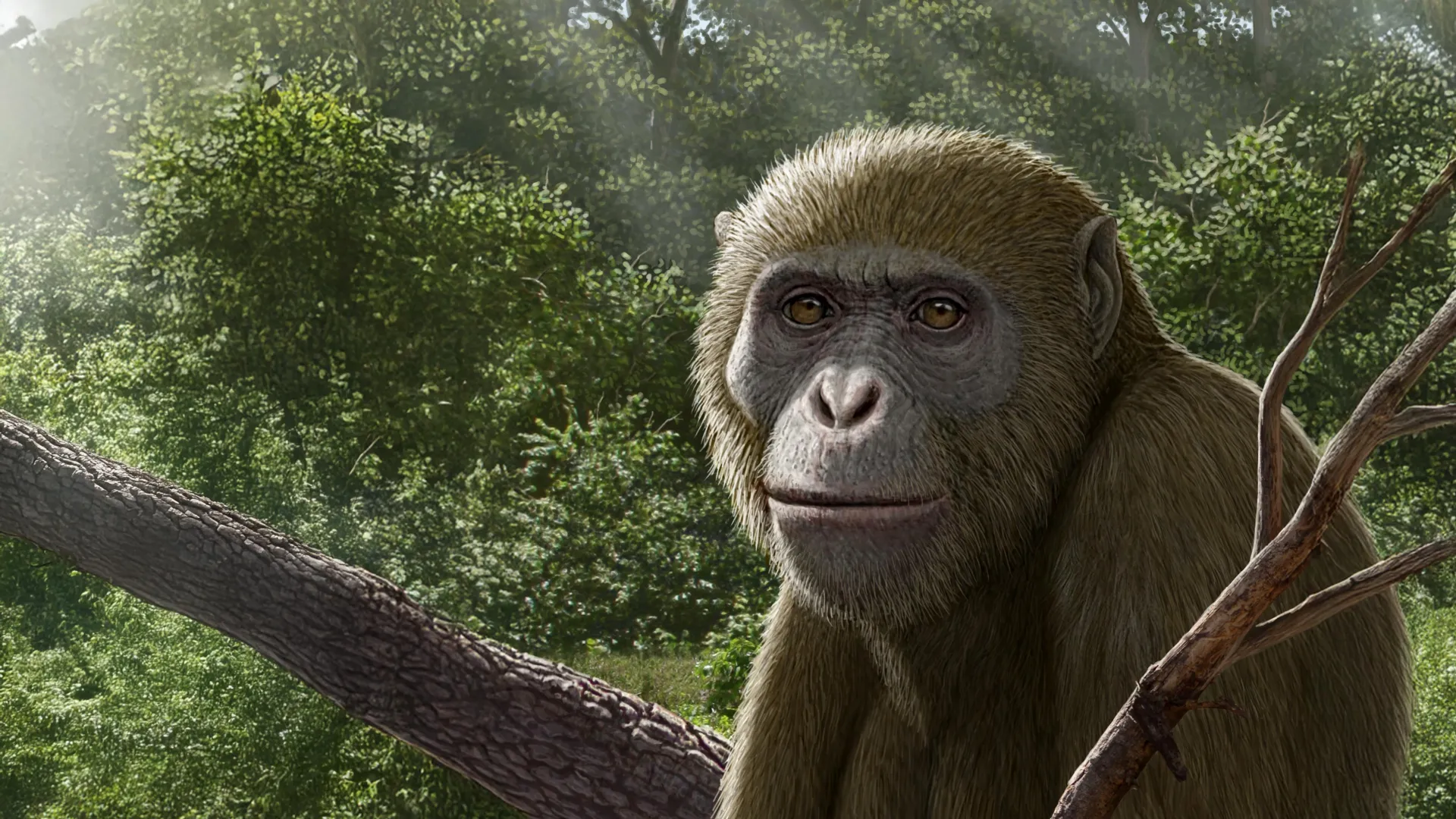
Fossils of an ancient ape discovered in northern Egypt are challenging the long-standing view that the ancestors of modern apes, including humans, evolved primarily in or around East Africa. The newly identified species Maslipithecus mograensis lived about 17 to 18 million years ago, and its remains may help connect the previously separate fossil records of Africa and Eurasia.
A missing piece of ape evolution
The fossils were found at Wadi Moghra in northern Egypt, making Maslipithecus mograensis the first definitive ape fossil discovered in North Africa. The species lived during the Early Miocene, a period from approximately 23 million to 16 million years ago when early ape lineages were diversifying and environments were changing significantly.
The discovery is described in a study published on March 26, 2026, by an international team from the Mansoura University Center for Vertebrate Paleontology in Egypt and the University of Southern California in the United States. The researchers’ findings suggest that North Africa and the Middle East may have played a central role in the emergence of the evolutionary lineage that eventually produced all modern apes.
For decades, scientists believed that early apes and their close relatives were concentrated mainly farther south in Africa. Fossils of ancient monkeys from the Early Miocene have been found in North Africa, but researchers had not found conclusive evidence of great apes from the same period.
That gap contributed to the prevailing theory of great ape evolution. Fossils of ancient apes have been discovered across Africa, Europe and Asia, but their evolutionary relationships and geographic origins remain debated.
“We spent five years looking for fossils of this kind, because when you look closely at the family tree of early apes, it becomes clear that something is missing, and North Africa is that missing piece,” said Hesham Salam, a paleontologist at Mansoura University and lead author of the study.
The finding is especially relevant to the origin of crown hominids, an evolutionary group that includes the last common ancestor of all modern apes and its descendants. The group includes gibbons, orangutans, gorillas, chimpanzees and humans. An incomplete geographic record of ancient fossils may have obscured when and where this group first appeared.
An 18-million-year-old ape with unusual teeth
The fossils were discovered during expeditions in 2023 and 2024 by researchers from the Salam Institute at Wadi Moghra, a well-known fossil site in northern Egypt.
The genus name Maslipithecus combines Masr (مصر), the Arabic word for Egypt, with pithekos, the Greek word for monkey. The species name, mograensis, refers to Wadi Moghra, where the fossils were found.
The recovered material consists only of part of the lower jaw, but it contains an unusual combination of anatomical features that distinguishes the animal from other apes of the same age.
The jaw is robust and bears very large canines and premolars. The chewing surfaces of the molars are rounded and covered with noticeable irregularities. These features provide clues about the foods available to the animal and how it processed them.
The researchers believe that Maslipithecus primarily ate fruit but had teeth capable of handling harder foods when necessary. This dietary flexibility may have helped it survive as seasonal changes became more pronounced in North Africa and Arabia.
“Together, they suggest Maslipithecus was tailored for versatility,” said Shoruk Al-Ashkar, a researcher at Mansoura University’s Center for Vertebrate Paleontology and a lead author of the study. “This study interprets its masticatory anatomy as evidence of a flexible diet, primarily fruit-based, with the ability to process hard foods such as nuts and seeds as needed. This flexibility would have been helpful for Maslipithecus to thrive during a period when climate change was creating more pronounced seasonality in North Africa and Arabia.”
Food availability may have varied throughout the year as seasonal differences intensified. Apes able to consume a wider range of foods would have been better equipped to cope with those fluctuations.
Evidence that challenges the ape family tree
The importance of Maslipithecus extends beyond its anatomy. When the researchers analyzed its position on the evolutionary family tree, they found that it appeared to be more closely related to modern apes than any other known ape from the Early Miocene of East Africa.
To investigate these relationships, the team used Bayesian statistical methods. These methods allow scientists to compare competing evolutionary scenarios and estimate how strongly the available evidence supports each one.
The researchers combined anatomical data from living and extinct great apes with genetic evidence from living species. They also incorporated the geological ages of fossil specimens to estimate when different evolutionary branches diverged.
By combining these lines of evidence, the team reconstructed relationships among ancient and modern apes and examined where their common ancestors may have lived. The results cast doubt on the long-held assumption that the evolutionary roots of all modern great apes were concentrated in or around East Africa.
Could North Africa have been a birthplace of modern apes?
Further analysis of the geographic distribution of ancient animals suggested that the common ancestor of all modern apes was most likely located in northern Africa and the Middle East.
The ancestors of this group are estimated to have lived during the Early Miocene, approximately 23 million to 16 million years ago. This was a crucial period in primate evolution, when early ape lineages were diversifying and their environments were undergoing major changes.
Geography may help explain why the region was important. Millions of years ago, Africa, Arabia and Asia were moving toward a new geological configuration. As the African and Arabian tectonic plates moved northward and approached the final stages of their collision with Asia, connections between the continents began to change.
Sea levels also rose and fell, periodically reducing the bodies of water that separated different regions. At certain points, these changes made it easier for animals to move between Africa and Eurasia.
North Africa and the Middle East therefore occupied a potentially important position in the migration and evolution of ancient mammals, including great apes. The discovery of Maslipithecus may help connect the previously separated African and Eurasian fossil records.
The findings suggest that apes were already diversifying in this region before new land connections allowed them to expand into Europe and Asia. Rather than being a peripheral location in great ape evolution, North Africa and the Middle East may have been an important center of evolutionary diversification.
Reconsidering where ancient ape ancestors lived
The discovery has prompted some researchers to reconsider ideas they had held throughout their careers.
Eric Seifert, a paleontologist at the University of Southern California and a co-author of the study, described how the evidence changed his view of great ape origins.
“Throughout my career, I have believed that the common ancestor of all modern apes likely lived in or around East Africa. However, this new discovery, and our new and novel analysis of hominid phylogeny and biogeography, strongly challenges that idea. And importantly, the likelihood of this scenario does not depend on Maslipithecus—but it’s very consistent with that,” Seifert said.
The researchers are not claiming that Maslipithecus was a direct ancestor of humans, or necessarily a direct ancestor of any modern ape. Instead, its position on the evolutionary tree provides evidence about the geographic origin of the broader ancestral lineage.
This distinction is important because humans emerged much later in evolutionary history. The Egyptian fossils provide clues about the early evolution of a distant ancestor shared by humans and other modern apes.
The results also suggest that the traditional focus on East African fossils may have provided an incomplete view of this much older evolutionary story.
More fossils could reveal Egypt’s evolutionary history
The discovery offers important new evidence, but scientists still have much to learn about Maslipithecus and the early history of modern apes.
Only part of the animal’s jaw has been recovered, leaving questions about its overall appearance, body size, movement and behavior unanswered. Additional fossils could provide a more complete picture of how the species lived and how it was related to other early apes.
The researchers believe that further exploration of North Africa and the Middle East may reveal more species and help determine when and where the major lineages of the modern ape family tree began to emerge.
For now, Maslipithecus mograensis is a reminder that even fundamental ideas about our distant evolutionary past can change when evidence is discovered in regions that have previously received little attention.
A jaw fossil preserved for nearly 18 million years may be helping scientists reconstruct a long-missing chapter in evolutionary history.
Source: www.sciencedaily.com