


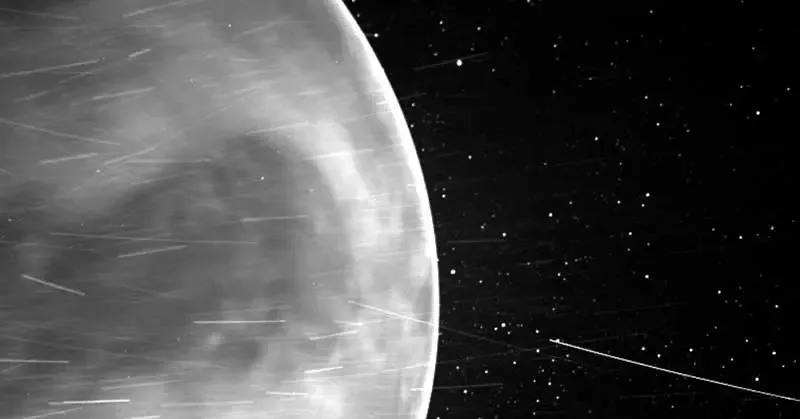
Did Venus Eat Its Moon? New Research Reveals How a Satellite Could Have Disappeared
Venus is almost Earth’s twin in mass, size, and structure, leading astronomers to question whether it may once have had a moon. While it is technically possible that Venus never formed a moon, scientists have developed several scenarios to explain how the planet could have lost one.
One previously proposed hypothesis suggested that Venus’s moon was destroyed in a collision with a massive celestial body. However, recent research from researchers at the University of California, Riverside suggests a different explanation. Rather than being annihilated by an external catastrophe, the moon may have been gradually pulled inward by Venus’s gravity and slow rotation before breaking apart and being engulfed by the planet.
“Venus didn’t need a catastrophe to get to what we can see today,” explains astrophysicist and lead author Stephen Cain in a press release. “It turns out that the planet’s own gravity and natural rotation rate combined to cause the moon to collapse on top of it.”
Why Venus Could Have Pulled Its Moon Inward
A planet’s rotation can cause a satellite to move either away from or toward it, depending on the planet’s rotational speed. This is why Earth’s Moon is not in danger of being swallowed. Earth rotates quickly by planetary standards, and the Moon is currently moving away from Earth at a rate of about 1.5 inches per year.
Venus, by contrast, rotates extraordinarily slowly. It takes 243 Earth days for Venus to complete one rotation. That is longer than the planet’s year, making Venus the slowest-rotating planet in the solar system. This slow rotation, combined with Venus’s gravity, means that a moon orbiting the planet could have been dragged inward rather than pushed outward.
Computer Simulations Model Venus’s Lost Moon
To test this possibility, Cain and his research team created a computer model that simulates gravitational interactions between celestial bodies. They first checked the model by reproducing the known evolution of Earth’s Moon. The researchers then varied several factors, including Venus’s rotation period and the mass of a hypothetical moon, which ranged from 0.01 to 10 times the mass of Earth’s natural satellite.
The simulations showed that a moon’s fate would depend on Venus’s rotation speed, the moon’s mass, and the shape of its orbit. Under many conditions, the satellite would spiral inward, eventually breaking apart under the influence of the planet’s gravity.
“When I made this discovery, I was shocked,” Cain recalls. “I knew the wide range of scenarios I was considering would lead to different outcomes, but everything went in pretty much the same direction.”
In some simulations, the moon survived for as long as 4.5 billion years. These cases involved artificially accelerating Venus’s rotation to once every 10 to 12 hours and giving the moon a mass comparable to Earth’s Moon. However, that is only an exploration of the model. Given Venus’s current extremely slow rotation, such a scenario is considered highly unlikely.
Could Venus Still Hide Evidence of a Moon?
The research does not prove that Venus once had a moon, and finding physical evidence of one would be difficult. Venus’s surface is geologically young, with its craters indicating that the upper layer of rock is only a few hundred million years old. Although Venus formed alongside the rest of the solar system about 4.6 billion years ago, extensive volcanic and tectonic activity has substantially altered its surface.
If evidence of a former moon exists, it may be buried deep underground. Seismological surveys that have penetrated far beneath Earth’s surface have provided clues about the Moon’s formation, including an unusual structure associated with a massive impact. Similar measurements on Venus could potentially reveal traces of a moon that was gradually absorbed by the planet.
Source: www.wired.com