


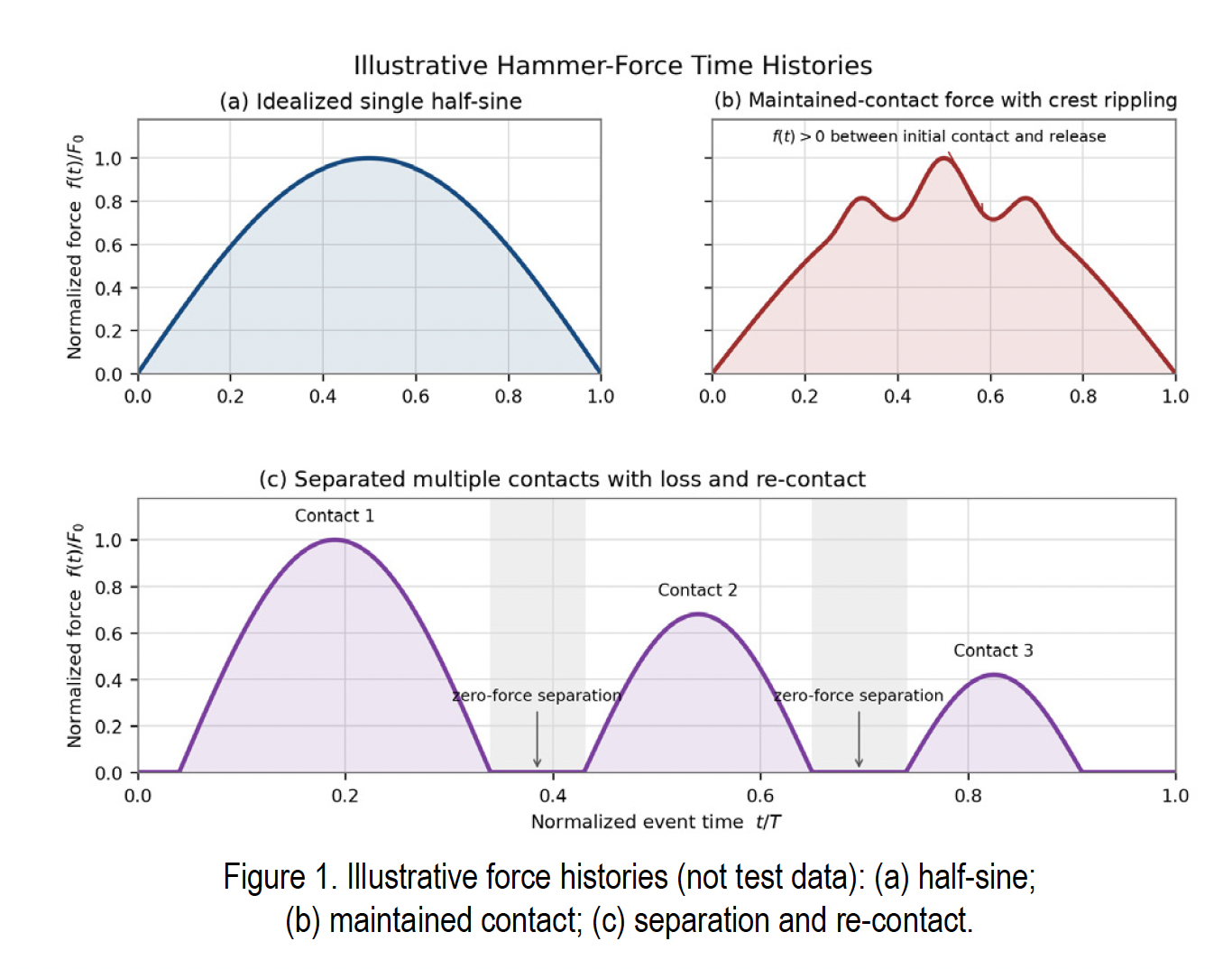
Instrumented hammer testing can remain useful even when its force history deviates from an ideal single half-sine pulse, provided the complete force and structural response are measured accurately. Crest ripple and separated contacts are known inputs rather than automatic reasons to reject a test. Suitability depends on measurement accuracy, bandwidth, signal-to-noise ratio, and whether the excitation covers the frequencies, amplitudes, and nonlinear behavior required by the test.
What the hammer measures
Hammer testing can support modal analysis [2–4] before a pyroshock test [6]. Figure 1 compares an ideal half-sine wave with sustained contact ripple and separated contacts. When the applied force drops to zero, the structure continues to vibrate, and any subsequent recontact affects that ongoing response.
If an exact model and test article receive the same forces and initial conditions, uniqueness requires them to produce identical responses over every limited measurement history. However, when the input excites different frequencies, amplitudes, or nonlinear states, the fitted model can show different errors. These effects should be considered when deriving accurate models [1].
The spectral content of a hammer impact
A half-sine is broadband, but not flat
Figure 2 shows that a finite half-sine pulse is broadband but has spectral zeros at f/fo = 3, 5, 7, …, where fo = 1/(2T) and T is the pulse width. The visual appearance of the force pulse alone therefore does not establish whether the test provides adequate excitation.
The measured force history determines the spectrum
Figure 3 normalizes each spectrum to its own direct-current (DC) value. Crest ripples can add spectral content and fill the notches of a half-sine spectrum. The timing between separated contacts can also produce critical interference. To assess suitability, examine the unnormalized measured spectrum together with the response signal-to-noise ratio.
Recommended practice
Evaluate a hammer test according to its intended purpose:
- Measure the complete applied force with appropriate bandwidth, calibration, dynamic range, and time synchronization.
- Verify that response measurements have adequate bandwidth and signal-to-noise ratio and are not clipped or saturated.
- Confirm that the excitation covers the frequencies, amplitudes, and nonlinear responses required for the test.
- Reject or rerun a test only when measurement, excitation, or coverage defects have been identified.
Conclusion
The appearance of a half-sine pulse neither establishes test validity nor guarantees suitability. Each hammer test should be judged according to its purpose and the accuracy and completeness of its force and response measurements across the required range.
For more information, contact Joel W. Sills at the Langley Research Center: [email protected].
References
- A. Majed, J. Sills, E. Henkel, V. Babuska, S. Yunis, D. Hamilton, J. Akers, and T. Kinney, Validity and Predictability of Measured Hammer Tap Inputs: Linear and Nonlinear Structural Systems, September 2026.
- D. J. Ewins, Modal Testing: Theory, Practice, and Applications, 2nd edition, 2000.
- ISO 7626-5:2019, Mechanical vibration and shock—Experimental determination of mechanical mobility—Part 5.
- K. G. McConnell and P. S. Varoto, Vibration Testing: Theory and Practice, 2nd edition, 2008.
- A. H. Nayfeh and D. T. Mook, Nonlinear Oscillations, 1979.
- NASA-STD-7003, Pyroshock Test Standard, 1999.
Source: www.nasa.gov