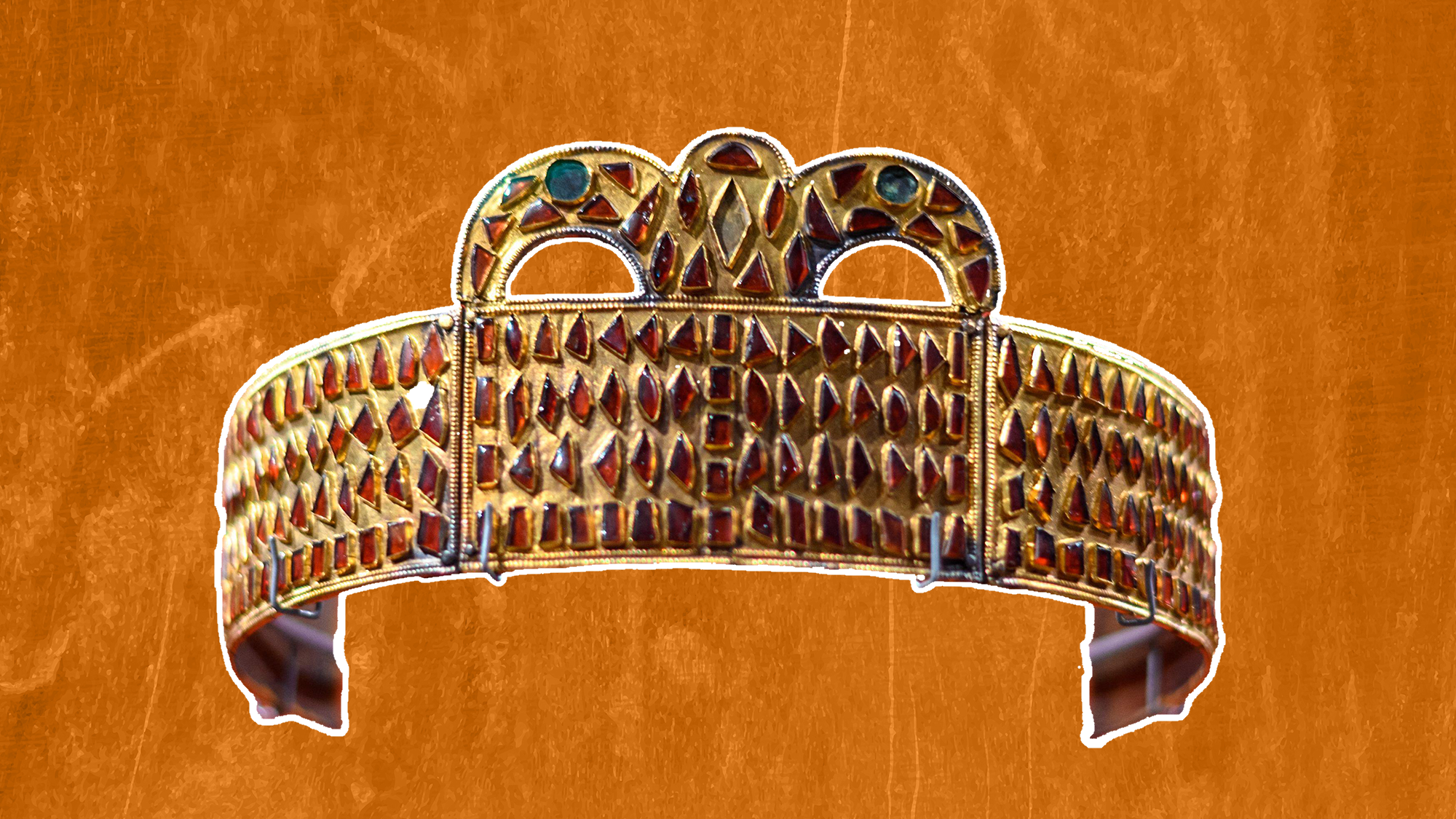
The Kerch Crown was discovered more than a century ago in the tomb of a high-status woman in Crimea.
(Image credit: Mirko Kuzmanovic/Alamy)
The Kerch Crown: A Gold Hunnic Treasure Found in Crimea
Quick facts
Name: Kerch Crown
What it is: A gold and garnet crown
Where it was found: Kerch, Crimea
When it was created: Late fourth to early fifth century
The Kerch Crown is a remarkable gold artifact associated with the Huns, a powerful nomadic people who moved westward across Eurasia during late antiquity. The crown was acquired in the early 20th century by a German art collector, along with dozens of other objects recovered during excavations at an ancient settlement in Crimea.
Today, the crown is displayed at Berlin’s Neues Museum. The object consists of three gold-covered bronze plates decorated with more than 250 garnets and other gemstones. Archaeologists believe it was discovered in the tomb of a high-ranking woman in the ancient city of Pantikapaion, located on the Kerch Peninsula in present-day Crimea.
The crown’s narrow gold band measures approximately 1.7 inches (4.4 centimeters) high. Its design reflects the artistic traditions of the Hunnic and late Roman worlds, which came into close contact as the Huns migrated west from the Don River region during the late fourth century.
From the latest videos Live Science
Pantikapaion and the discovery of the crown
Pantikapaion was founded as a Greek colony in the sixth century B.C. and later became an important city on the Black Sea. The Huns conquered the settlement in the late fourth century A.D. At the beginning of the 20th century, archaeologists excavated a large necropolis near the ancient city, uncovering as many as 2,000 burials. Only a small number of artifacts survived from these excavations, making the Kerch Crown an especially important discovery.
What the Kerch Crown symbolizes
The Kerch Crown features two stylized birds of prey, probably eagles, positioned on either side of a central floral design. Each bird has a round green gemstone for an eye. Birds of prey were associated with power, authority and elite status among the Huns and other groups living around the Black Sea during this period.
Similar bird motifs have been identified in early medieval jewelry, including Visigothic women’s ornaments found in Spain. These parallels suggest that the crown formed part of a broader artistic tradition shared across Europe and Eurasia.
Was the Kerch Crown worn by a queen?
German archaeologist Joachim Werner examined the crown in his 1956 study. He reported that the crown was found in a burial chamber near the skeleton of a woman who had suffered severe injuries. The burial also included a skull that had been artificially modified, a practice documented among some groups living in the region.
Although crowns are often interpreted as royal insignia, Werner argued that the Kerch Crown may have been worn during the woman’s lifetime. It could have been attached to a fabric cap or veil, functioning as a visible symbol of her rank and identity within Hunnic society.
Researchers have identified around two dozen similar gold crowns. Their existence suggests that the Kerch Crown was not necessarily a unique royal crown belonging to a queen. Instead, it may have been an elite headdress worn by a high-status Hunnic woman approximately 1,600 years ago.
Get the world’s most fascinating archaeological discoveries delivered straight to your inbox.
For more fascinating archaeological discoveries, explore our amazing artifacts archive.