


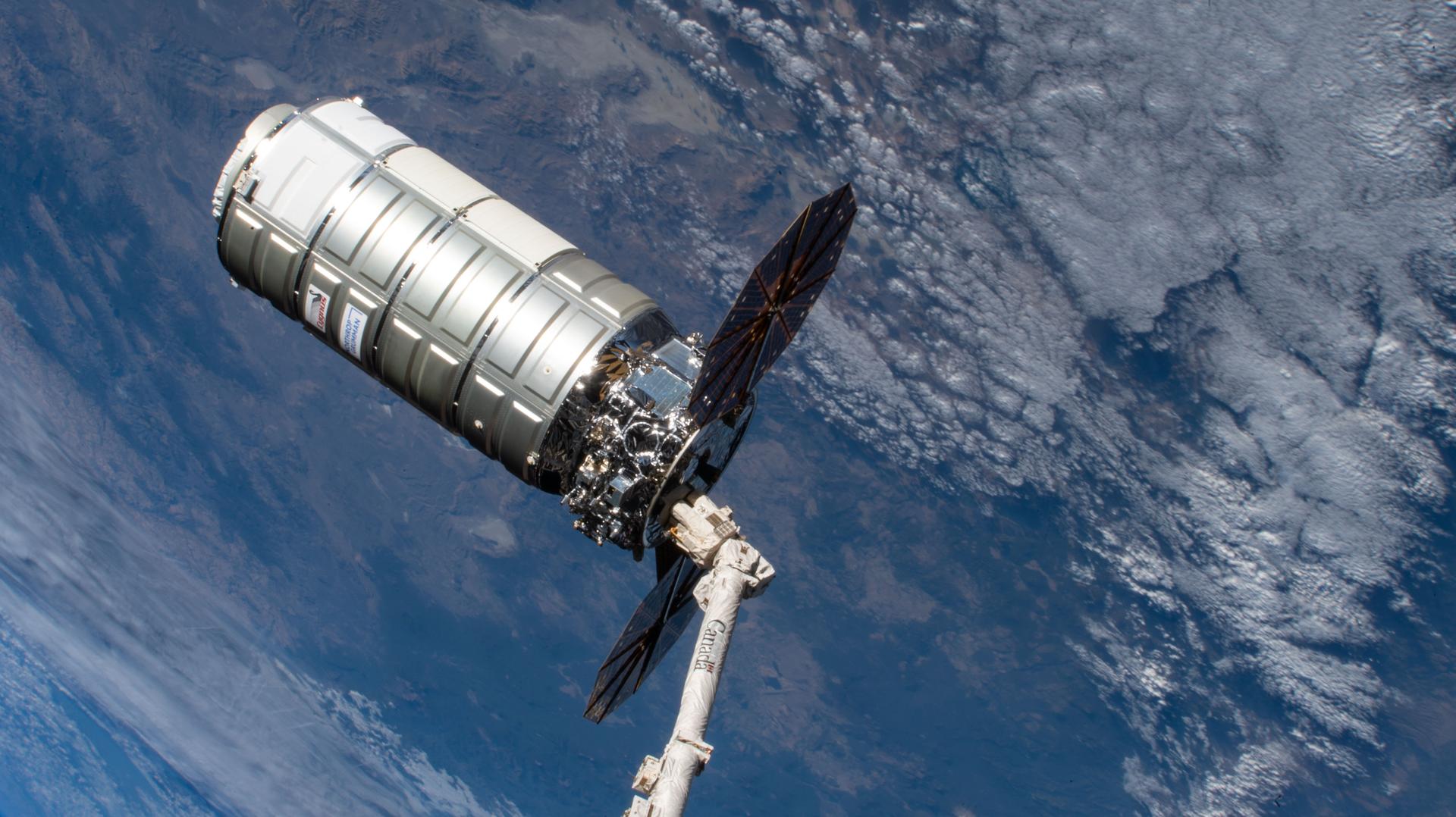
Media accreditation is open for NASA’s next commercial resupply mission to the International Space Station. Northrop Grumman’s Cygnus XL spacecraft is scheduled to launch on a SpaceX Falcon 9 rocket from Florida on Sunday, November 29, carrying crew supplies, equipment and scientific investigations for NASA.
Launch and station operations
Known as NASA’s Northrop Grumman Commercial Resupply Service 25, or NASA’s Northrop Grumman CRS-25, the mission is targeted to launch at 10:49 a.m. ET from Space Launch Complex 40 at Cape Canaveral Space Force Station in Florida.
After liftoff, astronauts aboard the station will use the Canadarm2 robotic arm to capture Cygnus and attach it to the Earth-facing port of the Unity module. The spacecraft will remain at the station until May 2027 while its cargo is unloaded. It will be Northrop Grumman’s 25th spacecraft built under contract with NASA to deliver supplies to the International Space Station.
Media accreditation
U.S. media organizations can apply for credentials to cover pre-launch and launch activities. The deadline for U.S. citizens is Thursday, November 12, at 11:59 p.m. ET. All certification requests must be submitted online.
Verified media will receive a confirmation email after approval. NASA’s Media Accreditation Policy is available online. Questions about accreditation or requests for special logistical support can be sent to [email protected]. Additional questions can be directed to the NASA Kennedy Space Center Newsroom at 321-867-2468.
Research aboard Cygnus
Along with food, supplies and equipment for the crew, Cygnus will deliver several new experiments. One investigation will carry hardware for manufacturing tiny DNA-inspired particles in space, work that could improve drug delivery for cancer and osteoarthritis. Another will study ways to guide cancer treatment by predicting whether a patient’s cancer is likely to spread to other parts of the body.
The spacecraft will also transport human muscle cells and drugs for testing treatments for age-related muscle loss in spaceflight and on Earth. A small radiation sensor designed to improve crew safety on future missions is also among the payloads.
Each resupply mission to the station supports research in biology and biotechnology, Earth and space sciences, physical sciences, and technology development and demonstration. Cargo delivered by U.S. companies helps maintain the nation’s ability to send scientific investigations to the space station and strengthens NASA’s capacity to conduct research in human laboratories in space.
The space station’s role
People have lived and worked continuously on the International Space Station for 26 years, advancing scientific knowledge and conducting research that would not be possible on Earth. The station serves as a testbed for NASA to understand and address the challenges of long-duration spaceflight while expanding commercial opportunities in low Earth orbit.
As commercial companies develop human space transportation services and destinations for a growing low-Earth-orbit economy, NASA is directing resources toward deep-space missions to the Moon through the Artemis and Lunar Base programs. The agency is also building the foundation for the first astronaut mission to Mars.
Media contacts
Josh Finch / Jimi Russell
Headquarters, Washington
202-358-1100
[email protected] / [email protected]
Stephen Cisselov
Kennedy Space Center, Florida
321-876-2468
[email protected]
Sandra Jones / Leah Cheshire
Johnson Space Center, Houston
281-483-5111
[email protected] / [email protected]
Source: www.nasa.gov