


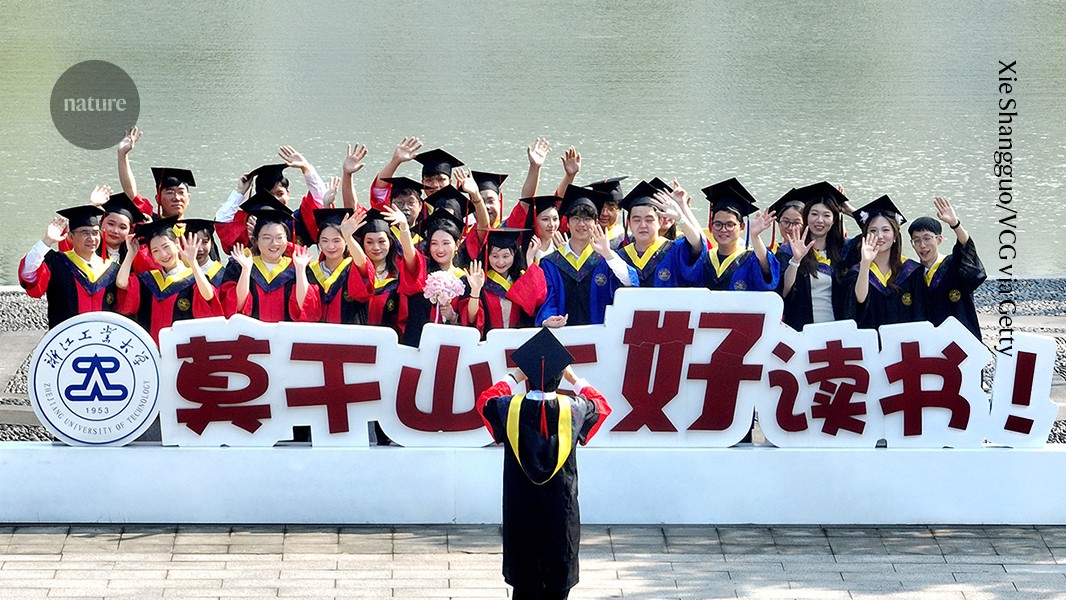
Students pursuing some professional master’s and doctoral degrees in clinical medicine in China may soon be able to graduate by demonstrating “practical achievements” instead of submitting a thesis. The proposed pathway follows a similar change for engineering degrees, under which master’s and doctoral students have been allowed since 2024 to graduate after developing new products, technologies, projects or equipment.
On 22 October, a government-appointed education advisory team published a draft policy document outlining graduation requirements for students enrolled in professional master’s and doctoral programmes in clinical medicine. Both programmes typically last three years and are taken by medical-school graduates and practising physicians.
In China, professional graduate programmes emphasize solving problems in a particular field of work rather than developing research skills. Under the proposed rules, students could graduate by completing practical work such as analysing unusual clinical cases or investigating problems faced by medical institutions.
The State Council Academic Degrees Committee, which promotes reform in graduate education, has indicated that similar graduation pathways are expected for postgraduate programmes in translation, agriculture, accounting and art.
Assessing real-world problems
Tayu Huang, a higher-education policy researcher at Hiroshima University in Higashihiroshima, said the reforms were a step in the right direction because students preparing for professional careers should be trained and assessed in ways that reflect those careers.
“The real challenge is to develop reliable, transparent, and profession-specific standards to measure actual outcomes,” Huang added.
For clinical-medicine students, the new pathway could make it possible to assess how their work benefits patients and society, said Feifei Zhou, a spine surgeon at Peking University Third Hospital in Beijing. “This will encourage children to find problems in real life and deal with them in a scientific way,” Zhou said.
One of Zhou’s students, Ti Dajiao, was selected for a pilot programme in 2023 and graduated with a “practical doctorate” in clinical medicine in June. Zhou said that Ti had developed artificial-intelligence software that enables doctors to classify rare spinal diseases and recommend appropriate treatment strategies.
Developing consistent standards
Liping Duan, chief physician of gastroenterology at Peking University Third Hospital and a member of the national advisory committee responsible for formulating policy on clinical medicine, said universities were being encouraged to create their own policies for training practical graduate students and setting graduation requirements.
One of the main challenges will be establishing consistent standards for evaluating practical outcomes, Duan said. “For example, what works in cardiology may not necessarily work in dermatology,” she added.
Ensuring the quality of students’ results will also be essential. “Some people may mistakenly think that it has become easier for students to graduate because they can now choose not to write a thesis,” Duan said.
Source: www.nature.com