


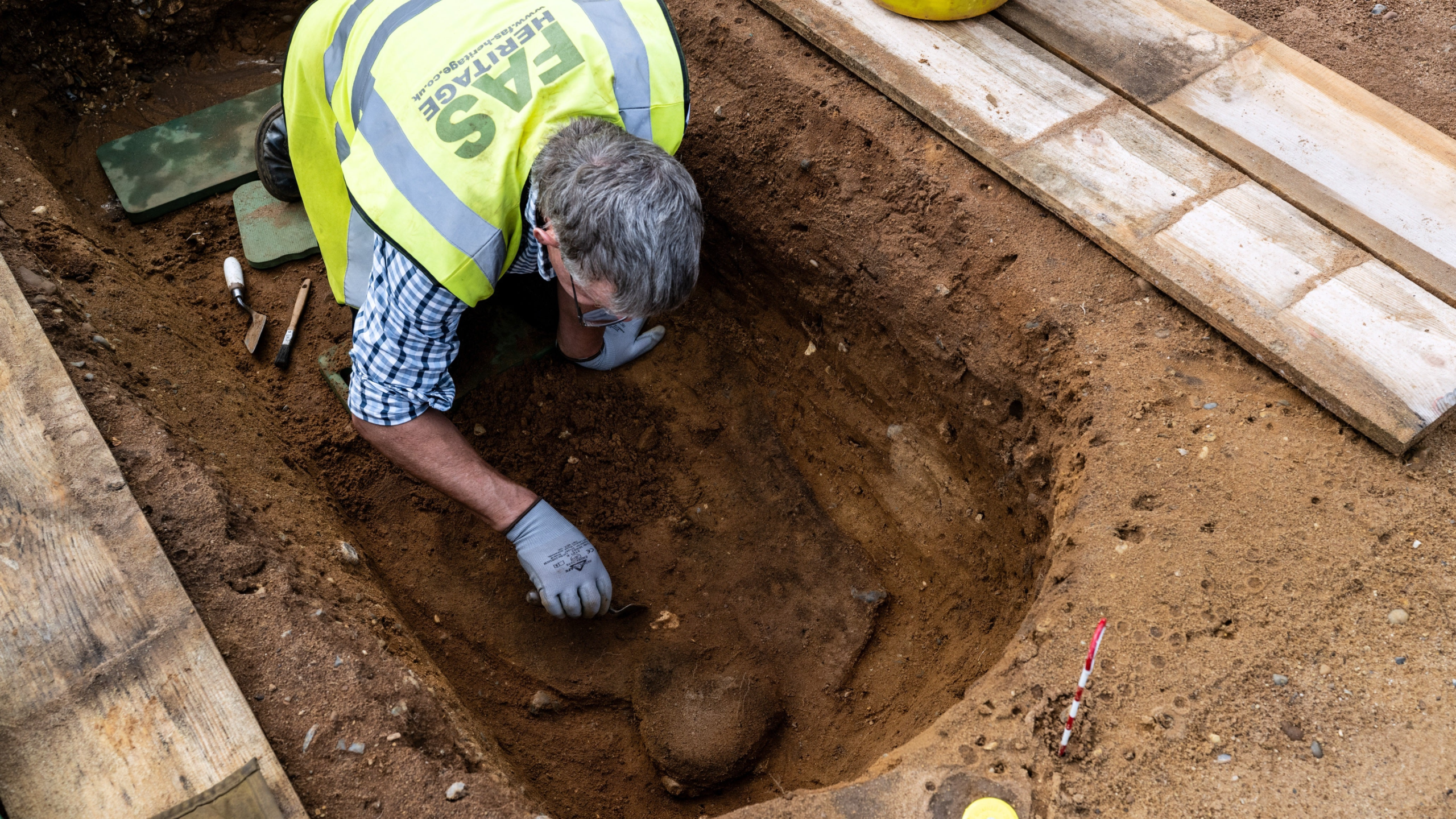
Archaeologists have discovered a rare “sand body” at Sutton Hoo, the Anglo-Saxon cemetery in England best known for its huge seventh-century ship burial. The remains have no surviving bones: acidic soil dissolved the body and replaced it with hardened sand that preserves the person’s shape. Found during excavations at the Garden Fields cemetery in 2025, the discovery is providing new evidence about the people buried at Sutton Hoo beyond its famous royal tomb.
A body preserved in sand
“Sand bodies” are burials in which acidic soil dissolves the body and bones, leaving hard sand that retains the human form. Angus Wainwright said the process is similar to the preservation seen in some bodies at Pompeii.
Such burials have been found previously at Sutton Hoo and at other Anglo-Saxon sites in Suffolk. The latest example was discovered at the end of excavations in 2025 at Garden Fields, one of the cemetery areas at the site.
The discovery features in the television series Time Team and in a four-part documentary produced by archaeological experts from the National Trust and FAS Heritage. The National Trust’s statement describes the excavation and the discovery.
Searching beyond Sutton Hoo’s royal tomb
The 2025 excavation was intended to establish the extent of the cemetery, determine when it was used and investigate whether the people buried there were related to the crew of Sutton Hoo’s famous ship burial. During the previous excavation in 2024, researchers found a bronze bucket used for cremation.
“Up until now, archaeologists have focused on royal tombs,” Wainwright said. Researchers have particularly sought to determine who was buried in the Great Ship Burial. That person may have been King Redwald, who ruled East Anglia and died around 627 AD. The burial also contained a complex and impressive helmet.
However, the 2025 work is shifting attention toward ordinary East Anglians. “The focus will shift to these people and their ancestors and descendants,” Wainwright said.
Evidence of another burial
The team uncovered the sand body during the final week of the month-long excavation. The deceased had been buried with grave goods including beads, tweezers, knives and brooches. Evidence beneath the sand body suggested that a second person may have been buried in the same grave.
“Finding another of these remains at Garden Field Cemetery was certainly the high point of this excavation,” Wainwright said. Experts believe the sand bodies and cremations at the cemetery may be older than the famous ship burial.
In the first episode of Sutton Hoo’s four-part Time Team series, experts reported on November 14 that people buried at Garden Field had acquired wealth and higher social status. At least one person was buried with gold nuggets.
A decorated cremation urn and a possible dock
The research team also investigated possible remains of a dock used to build and launch ships into the River Deben. They found fragments of a rare cremation urn, which surprised the archaeologists because it was decorated rather than plain.
“Well, this is Sutton Hoo. Anything can happen,” Justin Garner Lahire, managing director of FAS Heritage, said in a video.
Source: www.livescience.com