


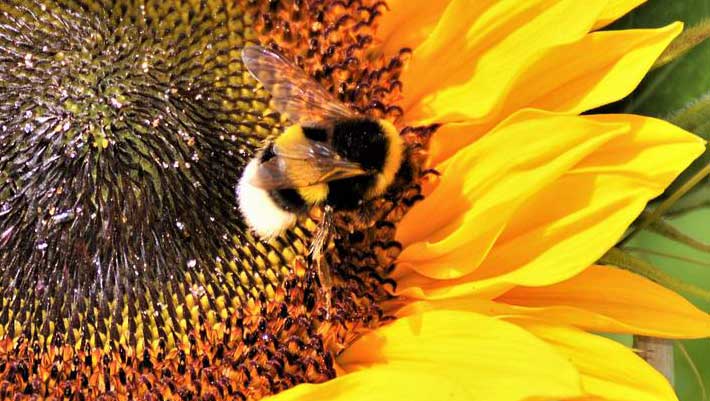
A new commentary by neuroscientists Lars Chitka of Queen Mary University of London and Stanley Heinze of Lund University argues that bumblebees can solve unfamiliar problems, learn behaviors from one another and communicate information about internal states such as optimism. Mapping the insects’ brains, the researchers say, could help identify the minimum neural machinery needed for complex intelligence.
Flexible problem-solving
“Animal intelligence is defined as the ability to change behavior to adapt to new situations, using cognition rather than instinct or trial and error,” Chitka and Heinze wrote.
“It has been studied across animals by analyzing phenomena such as planning, social learning, flexible decision making, abstraction ability and episodic memory.”
“While studies of bumblebee cognition do not address all of these areas, they reveal some core elements of complex cognition in animals with very compact nervous systems.”
In one experiment, researchers placed bumblebees in containers with ceilings too low for controlled flight, forcing the insects to walk. Artificial nectar-filled “flowers” were attached to the underside of the ceiling, beyond the bees’ reach.
The bees obtained the nectar by moving a ball into position and climbing on top of it. They could also guide the ball toward a target that was no longer visible.
Chitka and Heinze compare this behavior with the classic experiment in which a chimpanzee stacks boxes to reach a banana hanging from the ceiling.
“These results suggest goal-directed problem solving and show that insects can flexibly organize learned information to solve unprecedented challenges,” the researchers said.
Learning from other bees
Some of these abilities can spread through social learning. In a puzzle-box experiment, bees had to move latches in a specific order to obtain nectar.
Some inexperienced bees that watched skilled demonstrators eventually completed the task themselves. The source commentary reports that, without opportunities for social learning, the bees could not solve the problem.
“We only observed additional social acquisition in humans and chimpanzees of behaviors that are too complex to emerge through individual learning,” the researchers said.
The bees also appeared to respond to unexpected rewards in a way that suggested an optimistic state. After receiving an unexpected reward, they were more likely to judge an ambiguous stimulus as one associated with a reward. The researchers interpret this as similar to the “glass half-full” test used to assess optimism in mammals.
Other bees that watched their “optimistic” nestmates through transparent partitions showed similar tendencies. The effect was transmitted through visual information alone, rather than through food exchange or chemical cues.
Neural mechanisms of cognition
“The bumblebee brain exhibits several features that may explain complex problem-solving skills, generalization of learning, and emotional contagion,” the scientists said.
These features include associative memory that can generalize across different types of sensory input, working memory with enough capacity to maintain multiple memories in parallel, and neural circuits capable of changing their responses in different situations.
Associative memories are formed in the mushroom body, a region of the insect brain where neurons called Kenyon cells encode sensory information. Although the structure of the mushroom body is broadly conserved across insects, bumblebees have about 50 times more Kenyon cells than fruit flies. This could allow more separate memories to coexist without interfering with one another.
Bees also appear to possess a more sophisticated chemical signaling system, particularly involving neuropeptides. Such signaling may allow them to express a wider range of internal states.
Another region, the central complex, helps select actions. It is very similar to the corresponding region in Drosophila, but bumblebees have additional circuitry that could support memories of many navigational vectors at the same time. This may help explain how the insects find efficient routes between multiple food sources.
Mapping insect brains
Neuroscientists have already produced a complete wiring diagram, or connectome, of the fruit fly brain, which contains approximately 140,000 neurons.
Researchers are working to map parts of the brains of three bee species. So far, only some regions of the bumblebee brain have been mapped at synaptic resolution. The researchers said that the pace of technological progress suggests a complete honeybee connectome could be achieved within a decade.
The authors suggest that bees may not have required an entirely new neural algorithm to develop advanced cognitive abilities. Instead, evolution may have expanded the capabilities of ancient insect circuits, meaning that higher cognition could be far more widespread and have evolved many more times than previously thought.
“The availability of connectomes from different species with different phylogenetic proximities and whose cognitive abilities have been thoroughly studied will facilitate the identification of specific neural circuit properties underlying these abilities,” the researchers concluded.
“It appears that different neural solutions may have evolved to produce similar cognitive characteristics in different insects, just as between birds and mammals.”
“Both common and individual solutions shaping animal cognitive abilities may emerge as general principles, and some may apply to both vertebrates and invertebrates.”
The paper was published in this week’s issue of Science.
Lars Chitka and Stanley Heinze. 2026. “Bumblebee cognition.” Science 394 (6826): 835–837. doi:10.1126/science.aek1724.
Source: www.sci.news