


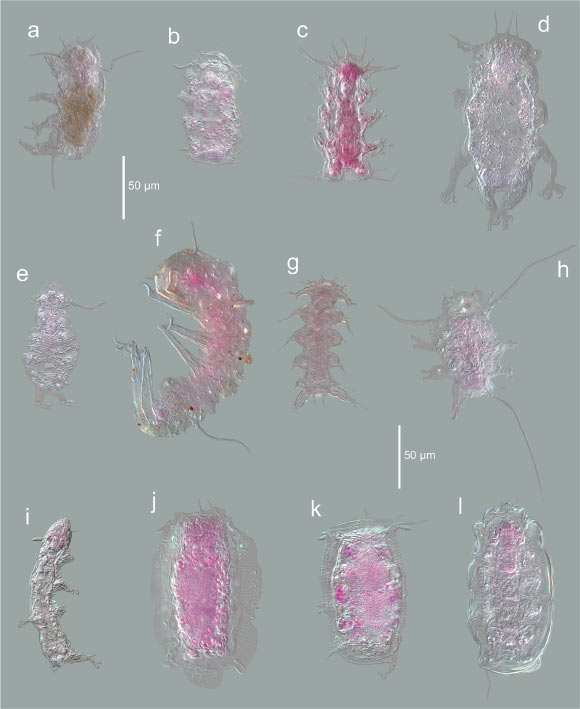
A team of marine biologists from the Netherlands, Germany, Denmark and Ukraine has discovered two new species of marine tardigrades on Senghor Seamount, an undersea volcano in the Cape Verde region off the coast of West Africa. The findings also reveal a much richer tardigrade community on the seamount’s plateau than on the surrounding deep-sea floor.
When most people hear the word tardigrade, they think of “water bears,” the tiny animals found in moss and lichen that are famous for surviving extreme conditions.
But tardigrades are a much broader group. Many species live in the ocean, inhabiting the spaces between grains of sand and other seafloor sediments in environments ranging from shallow coastal waters to the deep sea.
Marine tardigrades largely belong to the group Heterotardigrada and can differ substantially from their terrestrial relatives. Some have armor-like plates, elaborate sensory appendages and ornate claws.
Two new species from a seamount
The newly described species, Megastygarctides hecatae and Parastygarctus potercha, live on Senghor Seamount, a submerged volcano in the eastern tropical Atlantic.
The samples were collected during a 2009 research cruise aboard the German research vessel Meteor.
“Two new species were detected in sediment samples collected during a research vessel expedition aboard the Meteor at Senghor Seamount,” said lead author Dr. Roman Trokhymchuk, a researcher at the Naturalis Biodiversity Center in the Netherlands and the German Marine Biodiversity Research Center at Senckenberg am Meer.
“Our study therefore provides the first systematic investigation of the marine tardigrade fauna of this seamount.”
Trokhymchuk and his colleagues identified 20 tardigrade species in sediment from the top of the seamount, approximately 100 to 130 meters below the surface. By contrast, only two species were collected at a deep-sea site about 100 kilometers to the north, at a depth of approximately 3,300 meters.
Megastygarctides hecatae is less than 200 micrometers long. It is distinguished by a rare, spine-like structure near its reproductive opening, a feature previously known only in other tardigrade species.
The second new species, Parastygarctus potercha, is even smaller, measuring about 70 micrometers. Although adults, its members appear to retain some juvenile characteristics, including fewer claws than most of their relatives.
Seamounts as biodiversity hotspots
“We identified a total of 20 different taxa, which confirms our hypothesis that such submarine mountains are particularly species-rich habitats for tardigrades,” Dr. Trokhymchuk said.
“The striking difference in the number and diversity of tardigrades found on the plateau and on the deep-sea floor is further evidence that seamounts can be veritable oases of biodiversity, even for organisms that are barely visible to the naked eye,” added Dr. Alexander Kieneke, a marine scientist at the German Marine Biodiversity Research Center at Senckenberg am Meer.
“As many as 35 species of tardigrades have been recorded on the Faroe Plateau, another elevated region in the Atlantic Ocean. However, the deep sea remains largely unexplored.”
“Therefore, it is reasonable to think that biodiversity in other regions has historically been underestimated.”
The team’s paper was published online in ZooKeys.
R. R. Trokhymchuk et al. 2026. Tardigrades (Heterotardigrada) from the Senghor Seamount in the eastern tropical Atlantic Ocean: Two new species of the family Stygarctidae. ZooKeys 1295: 333–358. doi: 10.3897/zookeys.1295.205902.
Source: www.sci.news