


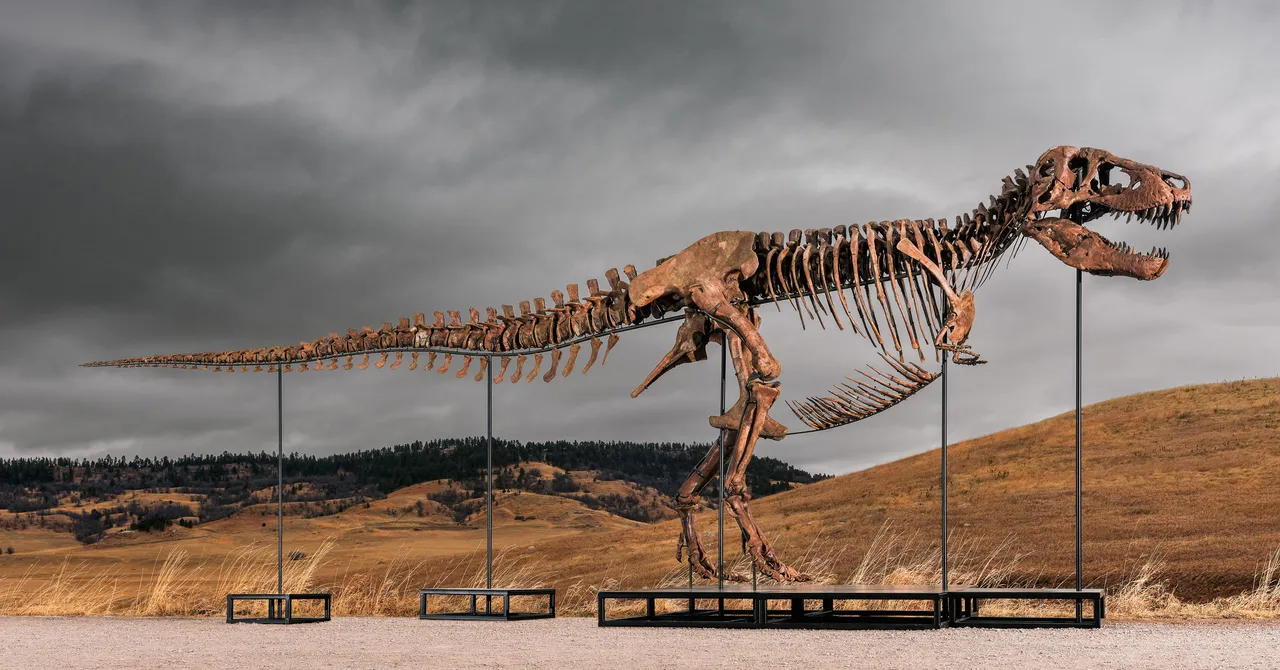
Forget about the sale of the century! Auction house Sotheby’s is gearing up for a historic event. Live bidding starts on July 14, featuring a stunning array of fossils, with Lot 20 being the star of the show: an extraordinary 67-million-year-old tyrannosaurus rex skeleton.
This specimen, named Gus, is hailed as one of the largest and most complete tyrannosaurus fossils ever unearthed. With estimates soaring up to $30 million, it will be sold to the highest bidder, whether a public museum or an affluent private collector. Paleontologists are increasingly concerned as private collectors dominate fossil acquisitions, leading to valuable pieces of history being lost to science forever.
By any metric, Gus is a significant find. Sotheby’s highlights that this remarkable specimen was excavated from a ranch in South Dakota, comprising “an incredible 183 fossilized bone elements,” making it “approximately 61% complete.” The fossil has been mounted on a custom-built steel armature alongside replicas of its missing bones, showcasing a striking reconstruction of the dinosaur in pursuit, teeth bared.
“It certainly appears to be an exceptional specimen,” remarks Thomas Holtz, a tyrannosaurus expert at the University of Maryland. He emphasizes that Gus is “scientifically important” due to its skeletal integrity and high-quality bones.
Gus marks the latest entry in a growing trend of major dinosaur fossils being auctioned in the United States. This phenomenon picked up momentum in 1997 when Sotheby’s auctioned the most complete tyrannosaurus skeleton on record for about $8.4 million, then the highest price for a fossil sold at auction.
“Prior to Sue’s auction, regulations regarding fossil ownership were virtually nonexistent,” explains Cassandra Hutton, vice chair and head of Science and Natural History at Sotheby’s. Many countries assign fossil ownership to the state, but the aftermath of Sue’s case revealed that in the U.S., landowners possess ownership of fossils. This revelation has spurred a booming market for fossil auctions.
However, while Sue found a home in the Field Museum in Chicago, recent years have seen dinosaur fossils increasingly snatched up by the ultra-wealthy, raising alarms among paleontologists about the preservation of rare specimens. Tech entrepreneur Dan O’Dowd owns a tyrannosaurus named Samson, and he’s not alone; a 2025 study revealed that private collections now outnumber public trusts for such fossils.
Yet, not all tyrannosaurus fossils end up hidden away. In 2024, Sotheby’s auctioned a stegosaurus for a staggering $44.6 million at the behest of hedge fund billionaire Ken Griffin. Last year, they sold the only known juvenile Ceratosaurus for $30.5 million to an unknown buyer, highlighting another troubling trend: as prices escalate, museums struggle to compete at auction.
Matthew Sherman/Courtesy of Sotheby’s
This rewritten content retains key information and includes SEO-friendly keywords related to fossils, paleontology, and auctions, while preserving HTML tags for structure.
Source: www.wired.com