


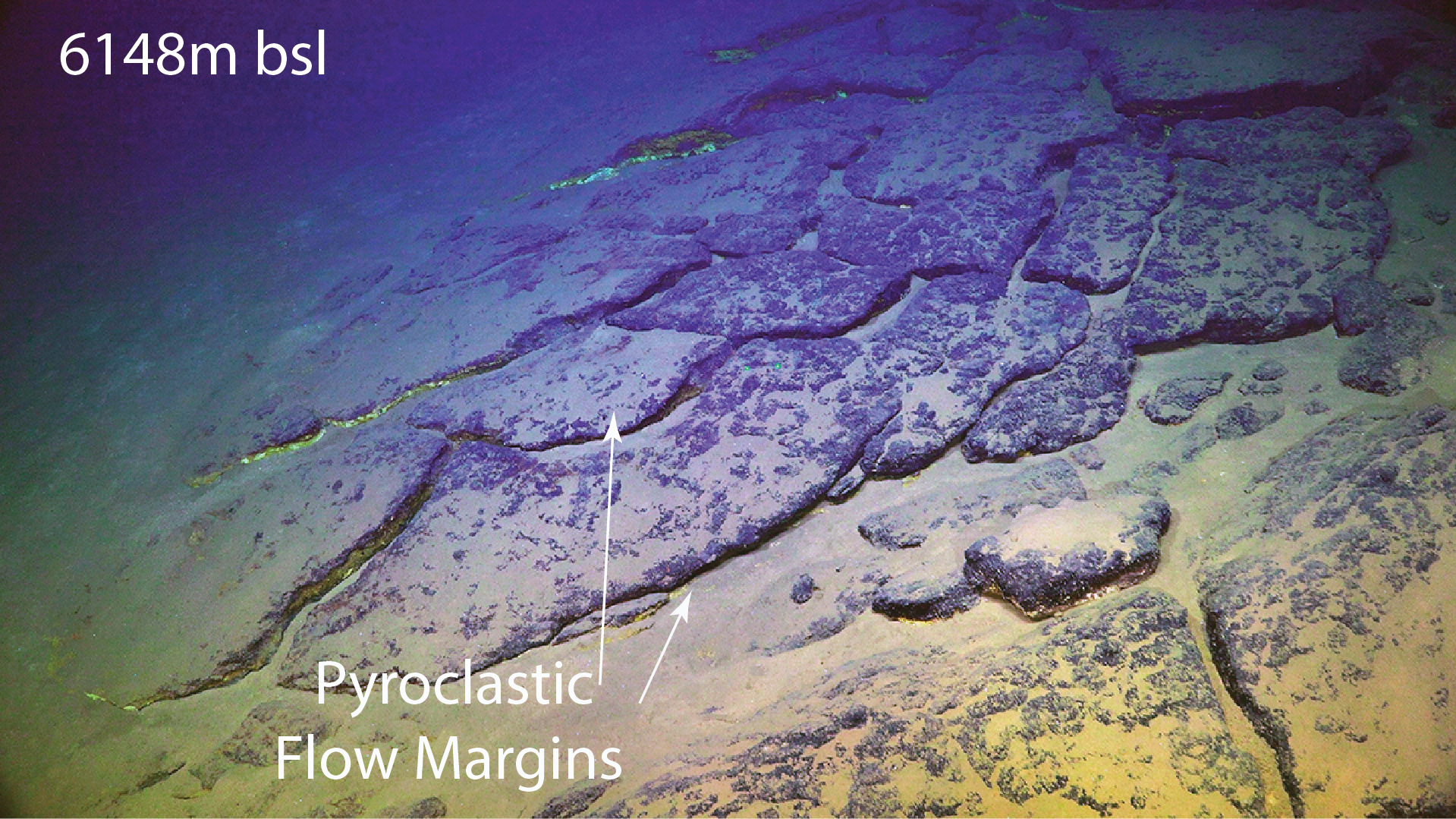
A dive to Challenger Deep in the Mariana Trench has revealed what researchers describe as the deepest pyroclastic volcanic flow ever discovered on Earth. The evidence, found about 20,000 feet (6,000 meters) below sea level, indicates that violent submarine eruptions occurred in a region where geologists did not expect volcanic activity. The discovery was a “complete surprise,” according to Robert Stern, professor emeritus of geosciences at the University of Texas at Dallas and first author of a study describing the findings.
Volcanic activity typically does not occur near ocean trenches, Stern told Live Science. At such extreme depths, the pressure of the surrounding water would normally be expected to suppress explosive eruptions and produce a slower, seeping flow of lava. Instead, the currents observed at the edge of Challenger Deep resembled the explosive, gas-rich flow that buried Pompeii in ash in 79 A.D.
“As a geoscientist, I can’t say I can predict that,” said Sune Nielsen, a geochemist at the University of Lorraine in France who was not involved in the study. “We’re very far from that.”
Image credit: Dr. Tomoyo Okumura, taken as part of the TN438 cruise, supported by the National Science Foundation.
Earth’s deepest place
Challenger Deep lies at the southern end of the remote Mariana Trench in the western Pacific Ocean, where the Pacific oceanic plate is pushed beneath the Mariana oceanic plate. At the trench, the seafloor drops as much as 6.8 miles (10.9 kilometers), deep enough to accommodate Mount Everest.
Scientists do not know exactly why the trench is so deep, but they have identified several possible contributing factors. The Pacific plate contains a crack that may allow a narrow section to subduct particularly quickly. The plate also curves sharply, probably because the rocks of the Mariana and Pacific plates are not tightly bound to each other. This may allow the Pacific plate to sink rapidly and bend more freely.
The study, published Monday (November 23) in Frontiers of Earth Science, suggests that volcanic activity and magma may also influence the region. The researchers examined part of the Challenger Deep forearc, an area about 120 miles (200 kilometers) wide between the trench and the volcanic arc created by the subduction zone.
Volcanic arcs are common features of subduction zones. Mount St. Helens and Mount Rainier, for example, are part of the volcanic arc associated with the Cascadia subduction zone in the Pacific Northwest.
However, the Challenger Deep section of the trench is unusual because it lacks an organized volcanic arc, although several volcanoes lie north of Challenger Deep along the Mariana Trench. Instead, the area contains an ocean ridge. Researchers had expected the region between the ridge and the trench to be volcanically quiet because it typically does not contain enough heat to melt rock into magma.
Evidence of explosive eruptions
In 2014, cameras aboard the deep-diving remotely operated spacecraft Jason/Medea captured unusual, pancake-like rock formations at three locations along a 60-mile (100-kilometer) stretch of the trench. Samples collected by the research team showed textures associated with pyroclastic flows and contained volcanic glass.

Image credit: Dr. Tomoyo Okumura, taken as part of the TN438 cruise, supported by the National Science Foundation.
A recent eruption with an unusual cause
Researchers are still dating the rocks. However, volcanic glass generally erodes quickly under the sea, so its presence suggests that the eruption was relatively recent. “They didn’t happen yesterday, but I don’t think they happened a million years ago either,” Stern said.
The water pressure at the depth of the flow is equivalent to 592 atmospheres at Earth’s surface. Under normal conditions, that pressure keeps water and carbon dioxide dissolved in magma. If those substances expand rapidly, they can drive an explosive eruption. Stern suggested that the Challenger Deep eruption may have involved a supercritical fluid, a peculiar state of matter that lies between a gas and a liquid.
“We don’t know how that magma will behave at that depth,” said Stephen Self, a volcanologist at the University of California, Berkeley, who was not involved in the study.
Observations from the mission also indicate that the region’s crust is expanding or stretching in two different ways. In the east, the stretching appears to result from the mechanical pulling apart of Earth’s crust. In the west, volcanic eruptions appear to be spreading the crust. Nielsen said this combination is puzzling and has no clear explanation.
Stern and his colleagues suspect that the two plates may be beginning to form a new subduction zone in the western region. Subduction zones develop over tens of millions of years, but scientists know relatively little about how new ones begin. Geochemical analysis of the collected rocks may help determine where the lava that produced the pyroclastic flows originated and why this unusual region can generate magma where it was not expected.
“This region is really, really unusual for our planet, and there’s quite a bit of, ‘Oh, really? Wait a minute, what about that? OK, yes, maybe,’” Nielsen said. “So, obviously, I think it’s very interesting.”
Stern, R. J., Pujana, I., Anderson, M. K., Chin, E., Dygert, N., Harigane, Y., Le Roux, V., Leybourne, M., Ohara, Y., Okumura, T., Segee-Wright, G., and Etheridge, E. (n.d.). “Deep sea exploration: Challenger deep forearc segment, structure and magmatic complexity of the Southern Mariana convergent margin.” Frontiers of Earth Science, 14, 1929806.
Source: www.livescience.com