


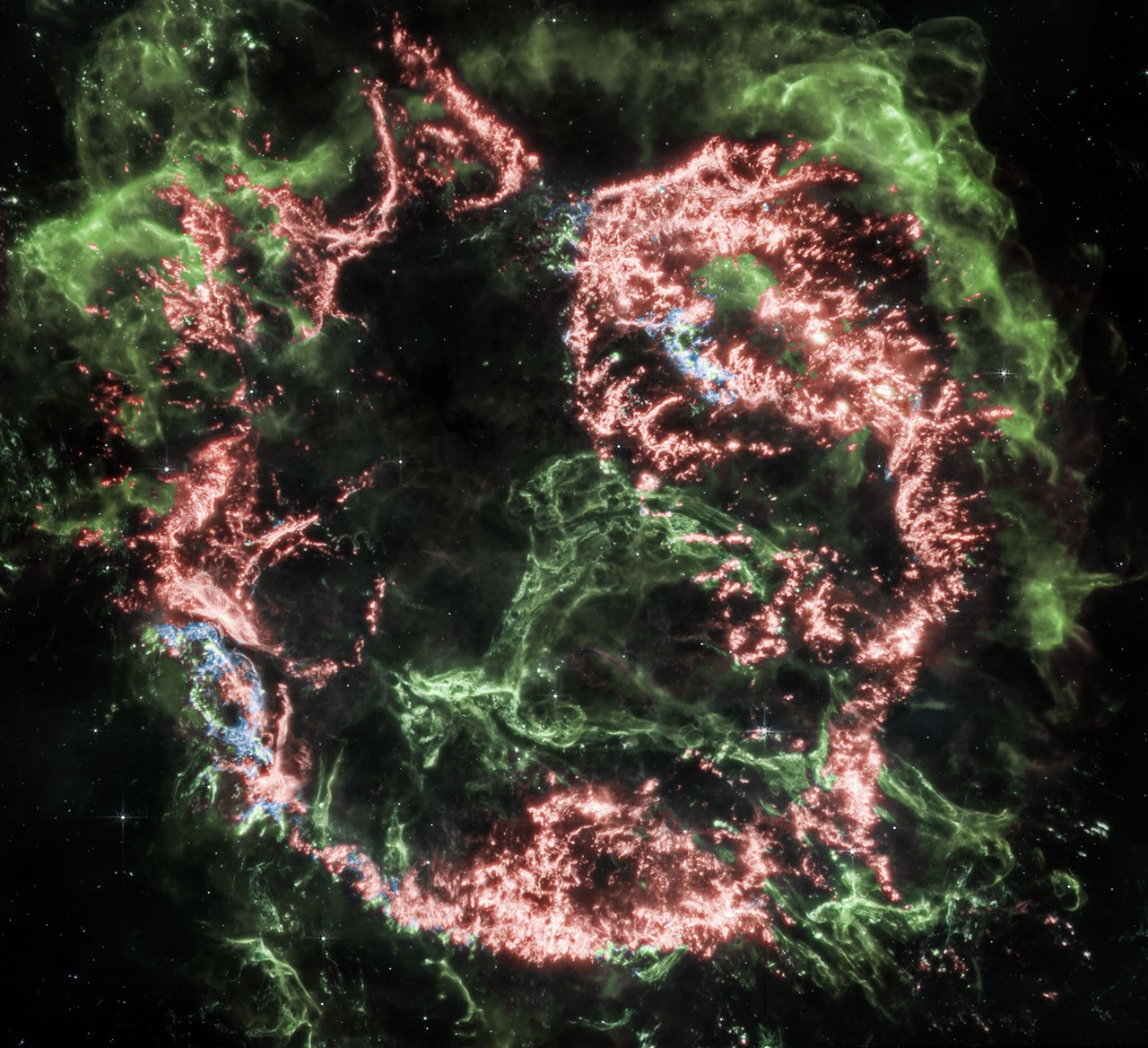
NASA’s James Webb Space Telescope has produced a detailed mid-infrared view of Cassiopeia A, or Cas A, revealing hot dust and chemical structures in the debris left by a stellar explosion. The observations suggest that layers inside the original massive star began mixing just hours before its core collapsed, offering clues to how the star’s structure changed immediately before the supernova.
Supernova remnants are clouds of gas and dust produced when massive stars explode. Over time, this material can help seed new generations of stars and planets. Webb’s high-resolution observations of Cas A are helping astronomers reconstruct the structure and evolution of the star that created the remnant. The results were announced Monday in The Astrophysical Journal Letters.
NASA’s James Webb Space Telescope has revealed the hot dust that makes up Cassiopeia A. The composition of the dust provides clues to the remnant’s original stellar structure.
Images: NASA, ESA, CSA, STScI, Tea Temim (Columbia University), Rick Arendt (UMBC), Dan Milisavljevic (Purdue University). Image processing: Joseph DePasquale (STScI)
Dust records the star’s final stages
Stars begin as large clouds made mostly of hydrogen gas and cosmic dust, known as molecular clouds. Gravity eventually causes these clouds to collapse, heating the material and forming protostars. As the gravitational pressure continues, hydrogen in a protostar’s core begins to fuse into helium. This marks the transition from a protostar to a fully formed star such as the Sun.
When the hydrogen in a star’s core is exhausted, the core contracts and heats up, allowing helium to fuse into heavier elements. In massive stars such as Cas A’s progenitor, this process continues through increasingly heavy elements, eventually stopping at iron. Lighter elements fuse in surrounding layers, creating a series of shells that preserve a record of the star’s evolution.
When the star explodes as a supernova, those elements are scattered into space. Some can condense into dust particles, which may clump together. By mapping the composition of individual, roughly solar-system-sized dust clumps in Cas A, Webb found evidence that the star’s internal shells had begun to merge before the explosion.
“As the material inside these shells stirs and circulates, the shells could coalesce just before the supernova explosion,” said Tea Temim, the paper’s lead author and a research scientist at Columbia University in New York. “So, for example, the oxygen- and carbon-burning shells in the star will coalesce, significantly changing the star’s structure. That will also change the abundance of chemicals found in the ejecta of the supernova remnant after the supernova explosion.”
Webb examines three regions of Cas A
To identify promising targets for Webb, researchers also used data from NASA’s retired Spitzer Space Telescope. Although Spitzer could not resolve the regions in detail, its observations identified three specific areas for Webb to investigate.
Two of the targets were inside Cas A’s reverse shock, where shock waves moving inward collide with debris thrown outward by the supernova. Webb found that one of these ejecta regions contained mainly silica dust, while the other consisted mostly of carbon dust.
The third target was the “green monster”, a structure first discovered by Webb. It is rich in complex magnesium silicates. Unlike the other two regions, the Green Monster did not come from supernova ejecta. Instead, it consists of material expelled by the star before it exploded.
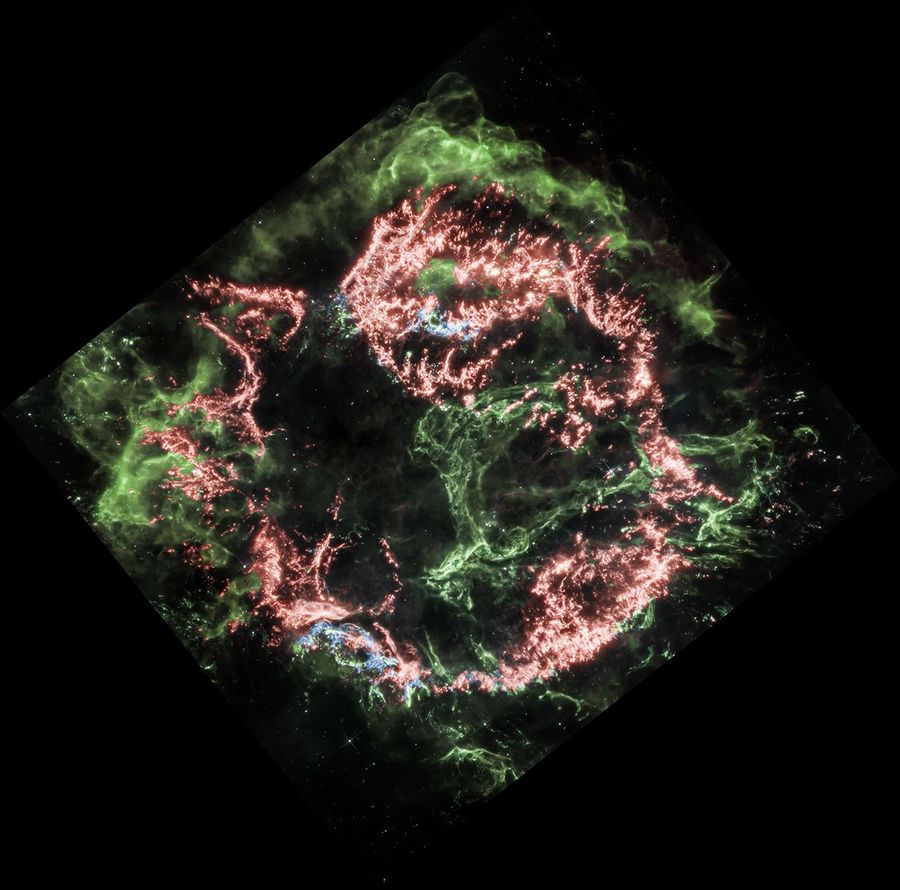
Webb’s observations reveal the hot dust that makes up Cassiopeia A. The dust’s composition provides clues to the structure of the star before it exploded.
Images: NASA, ESA, CSA, STScI, Tea Temim (Columbia University), Rick Arendt (UMBC), Dan Milisavljevic (Purdue University). Image processing: Joseph DePasquale (STScI)
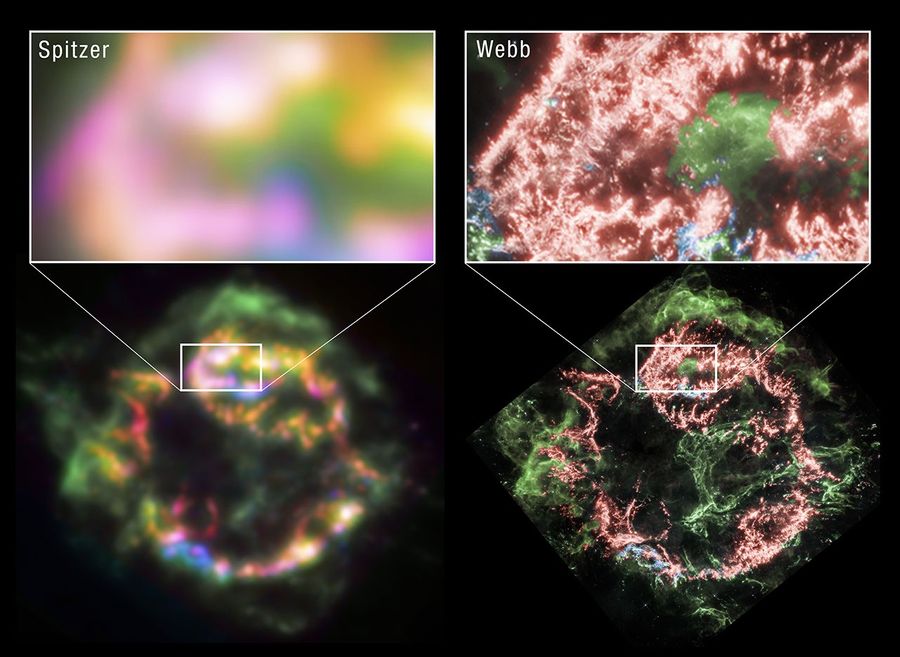
NASA’s decommissioned Spitzer Space Telescope helped identify a region of Cassiopeia A that was later examined by Webb. Webb’s higher resolution reveals more about the chemistry of the debris dust.
Images: NASA, ESA, CSA, STScI, Tea Temim (Columbia University), Rick Arendt (UMBC), Dan Milisavljevic (Purdue University). Image processing: Joseph DePasquale (STScI), Alyssa Pagan (STScI)
Evidence of mixing before the explosion
Researchers combined Webb’s dust map with X-ray observations from NASA’s Chandra X-ray Observatory and the Japan Aerospace Exploration Agency-led XRISM mission. These observations mapped the composition of dust throughout Cas A and provided further insight into the shell-coalescence process. Taken together, they indicate that the merger of the stellar layers was already underway shortly before the supernova explosion.
“Using Webb, we were able to significantly improve our ability to break down individual chunks, allowing us to perform more advanced dust chemistry,” said study co-author Dan Milisavljevic, an associate professor at Purdue University in West Lafayette, Indiana. “As a result, we can link the explosion to the composition of the progenitor star hundreds of years later. We think this explosion tells us a story about what was happening in the hours leading up to its core collapse. Understanding this process is essential for explaining which elements supernovae release into the galaxy and how those elements will enrich future generations of stars and planets.”
Webb’s dust map also found evidence of mergers in most of the supernova remnant. The findings provide other astronomers with new methods for using dust in supernova remnants to infer the structure of the stars that produced them.
About the James Webb Space Telescope
The James Webb Space Telescope is the largest and most powerful observatory ever sent into space, serving thousands of astronomers worldwide. Webb investigates the mysteries of the solar system, studies distant worlds around other stars, and explores the structure and origins of the universe and humanity’s place within it. It is an international program led by NASA in partnership with the European Space Agency and the Canadian Space Agency.
For more information about Webb, please visit:
Source: science.nasa.gov