


Close Menu
HitechubHitechub
    What's Hot
    Technology

    Drosophila melanogaster Remembers Its Larval Diet, Influencing Adult Lifespan

    Technology

    Ofcom Unable to Pursue Legal Action Against Suicide Forums: What You Need to Know

    Science

    Cancer-Promoting Proteins Could Also Help Fight Cancer

    Important Pages:
    • About Us
    • Privacy Policy
    • Terms & Conditions
    Facebook X (Twitter) Instagram Pinterest
    Facebook X (Twitter) Instagram
    HitechubHitechub
    Wednesday, November 25
    • Shop
      • Fashion
        • Mens
        • Womens
        • Accessories
          • Handbags
          • Keychain
          • Masks
          • Money clicps
          • Neck Pillow
          • Rings
          • Towels
          • Wallets
        • Jewelry
        • Watches
        • T-shirts
        • Hawaiian shirts
        • Vests
        • Swim trunks
        • Swimsuits
      • Fun
        • Magic cubes
        • Magnifiers
        • Misc
        • Photo books
        • Puzzles
        • Toys
      • Home
        • Cleaning/Care
        • Mailbox covers
        • Mugs
        • Pot Holders
        • Spoon
      • Office and Electronics
        • Chairs
        • Office Supplies
        • IPad cases
        • Laptop stickers
        • Mouse pads
        • Notebooks
        • Pencil bags
        • Pens
        • Phone cases
      • Personalized
      • Pets
      • Sports
        • Cycling
          • Balaclava Mask
          • Bike Bell
          • Bike Computer
          • Bike Fender
          • Bike Grips
          • Bike Kickstand
          • Bike Light
          • Bike Locks
          • Bike Mitts
          • Bike Pumps
          • Bike Repair Stand
          • Bike Seat
          • Bike Trainer
          • Bike Wheels
          • BIKES
            • Folding Bikes
            • Road Bikes
          • Carbon Fiber Bike Products
          • Cycling Mask
          • Kid’ Bike Helmets
          • Inner Tube
          • Motorcycle Bag
          • Nylon Pedals
          • Adult Helmets
          • Photochromic Sunglasses
          • Soft Coolers
          • Suction Cup Bike Rack
          • Tool accessories
          • Winter Cloth
          • Heart Rate Monitor
        • Outdoors/Camping
          • Outdoor Bags
        • Sweatband
    • Technology
      1. AI
      2. Gadgets
      3. View All

      This is the most popular CEO in the world

      Sectors in which “Chat-GPT” is most often used

      Artificial intelligence has begun to “swallow” professions

      The unusual robot conductor of a concert in Seoul

      Here’s how you can tell if your phone is being tapped

      PlayStation 5 becomes a completely silent console and gets more space

      This is the first phone that can be used to park a car

      Best Gaming Laptops 2023: Powerful Portables for PC Games

      Microsoft Fixes Microsoft 365 Bug Blocking Access to Office Apps

      Hackers Exploit Critical Drupal Remote Code Execution Vulnerability to Hijack Websites

      6 Best Latte Machines for Automatic Espresso Drinks in 2026

      Riemann Hypothesis Explained: What It Means and Why It Matters

    • Science
      1. Space
      2. Wheels
      3. View All

      Space Perspective: A Journey to the Edge of Space

      5 Fascinating Facts About Space

      Space Exploration: Unveiling the Wonders of the Universe

      Toyota wants to make a new generation battery with a range of up to 1,200 km

      Meet Toyota’s lunar “baby” that could make exploring the Moon easier

      What does a night drive look like with one of the most beautiful cars in the world: the Rolls-Royce Ghost

      Space Telescope Searching for Dark Matter Makes Unexpected Discovery

      Mira Causes Record-Breaking Eruption | Latest Science News

      This Winter’s El Niño Could Preview the 2030s: Why It Matters | Ioana Colfescu

      Alabama Coal Mine Scorpion Fossil Is North America’s Oldest

    HitechubHitechub
    Home » Space Telescope Searching for Dark Matter Makes Unexpected Discovery
    Science

    Space Telescope Searching for Dark Matter Makes Unexpected Discovery

    Share Facebook Twitter Pinterest WhatsApp
    Share
    Facebook Twitter LinkedIn Pinterest WhatsApp

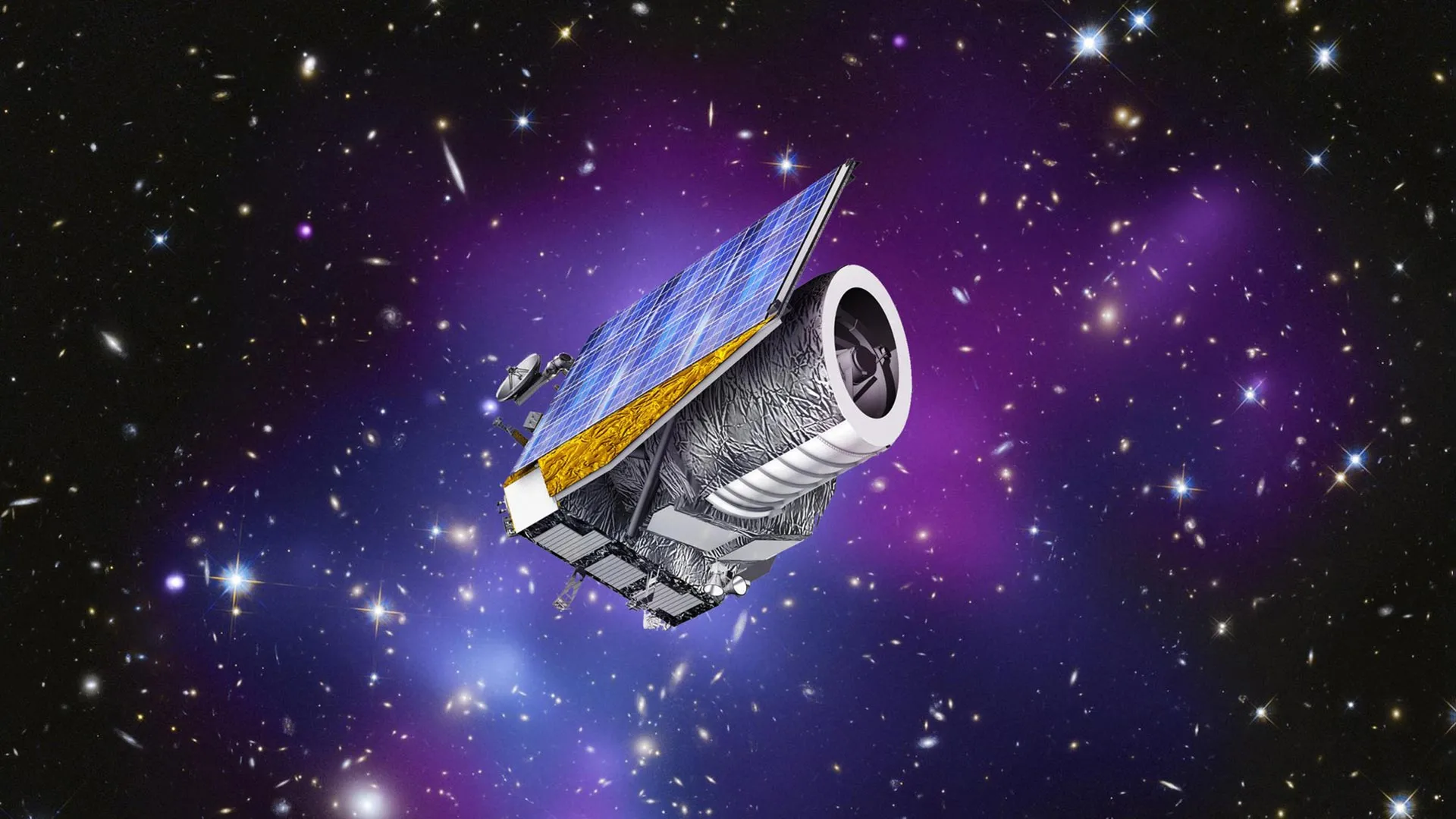
    The European Space Agency’s (ESA) Euclid Space Telescope has discovered a previously unknown comet in our solar system. Images captured between September 16 and 24, 2026, revealed the object, marking the first new comet discovered by the mission. The finding also demonstrates that Euclid may be able to identify distant comets early enough to support planning for future ESA interception missions.

    A faint streak reveals a new comet

    Mikko Pontinen, a PhD student at the University of Helsinki, made the discovery with the Euclid Consortium’s Solar System Object Science Working Group. Pontinen developed specialized software to detect and track small solar system objects in telescope images.

    “I was excited to see that my software marked a dirty ‘streak’ in some images as a result of a fast-moving object. By predicting its location, I was able to locate it in other images, and I was able to find it in a total of five image sets. Upon further inspection, I discovered that there was a fuzzy cloud around it, indicating an active object like a comet emitting dust or gas.”

    The object appeared in a region of the sky known as the “Euclidean Deep Field North.” Over several days, Euclid observed it in five separate fields, taking between two and four exposures in each field for a total of 16 exposures.

    Pontinen searched catalogs of known asteroids and comets but found no match. He then submitted the observations as a possible new comet to the International Astronomical Union’s Minor Planet Center (MPC), which enables astronomers to conduct follow-up observations with ground-based telescopes. On October 8, the MPC officially acknowledged the discovery and designated the comet C/2026 S1 (Euclid).

    An unusual orbit far from Earth

    The comet is about 1.3 billion kilometers, or roughly 800 million miles, from Earth. That distance is comparable to the distance between the Sun and a point somewhere between the orbits of Jupiter and Saturn.

    Unlike the planets, which orbit in a relatively flat plane, the comet has traveled well outside the solar system’s main orbital plane. It is currently positioned almost directly above the Sun and is following an extensive path through the solar system that will take thousands of years to complete.

    The MPC is the international focal point for observations of asteroids and comets. It collects data from observers around the world to verify discoveries, calculate orbital paths and assign official designations. As additional observations are collected, astronomers will be able to estimate C/2026 S1 (Euclid)’s orbital period more precisely.

    Why Euclid rarely finds new comets

    Euclid has detected comets before, but those objects had already been discovered. The telescope’s design and observing strategy make it difficult to identify previously unknown bodies in the solar system.

    Euclid deliberately avoids much of the region surrounding the solar system’s orbital plane, where many asteroids and comets are found. Dust concentrated in that area can create unwanted light and interfere with the telescope’s sensitive observations of the distant universe.

    The spacecraft also uses a “step and stare” observation strategy, typically imaging each section of the sky only once. As a result, researchers cannot easily redirect Euclid toward a newly detected comet for additional observations.

    Even so, identifying solar system objects is an important part of Euclid’s scientific work. Researchers must account for everything visible in the telescope’s images so that features such as comet trails and unwanted light can be removed without reducing the accuracy of galaxy measurements.

    “Very few comets are expected to be discovered by Euclid, so it was a happy coincidence that the combination of the comet’s orbit and contemporary scans by Euclid resulted in the object being captured in multiple images,” says Bruno Altieri, Euclid Archive scientist and a member of the discovery team.

    Experience for future comet missions

    Euclid’s unexpected discovery is also providing experience for scientists preparing ESA’s future comet interception missions. Although C/2026 S1 (Euclid) is not a suitable destination for an interceptor spacecraft, the successful detection and rapid notification process show how the missions could work together to identify potential targets.

    “Although this particular comet is not a good candidate for an interceptor comet, the discovery and alert process gives us a real test case for how our two mission teams will work together in the future. And of course we are pleased to have discovered a previously unknown comet for the solar system community to follow up on,” added Euclid project scientist Valeria Petrino.

    Ancient remnants of the solar system

    Comets are ancient bodies made of ice and dust that remained after the solar system formed about 4.6 billion years ago. Most are found in the distant Kuiper Belt and Oort Cloud, beyond the orbits of the outer planets. Interstellar comets, by contrast, originate in other solar systems.

    As a comet approaches the Sun, its temperature rises and its ice changes directly into gas. The escaping gas and dust form a glowing, diffuse cloud called a coma, along with an elongated tail.

    Comets in our solar system have changed relatively little since their formation, preserving evidence of the materials and environmental conditions present when the planets were developing. Studying them may also help scientists investigate the origins of Earth’s water and the chemical building blocks of life.

    Euclid’s study of dark matter and dark energy

    Euclid’s main mission is to investigate how dark matter and dark energy have shaped the visible universe. During its six-year survey, the space telescope will study the shapes and motions of billions of galaxies at distances of up to 10 billion light-years.

    The discovery was reported on behalf of the Solar System Object Science Working Group of the Euclid Consortium by M. Pontinen, AA Nusita, A. Franco, M. Granvik, B. Altieri, S. Crook, BY Irreta-Goyena and B. Carey.

    Source: www.sciencedaily.com

    Share. Facebook Twitter Pinterest LinkedIn WhatsApp
    Previous ArticleMicrosoft Fixes Microsoft 365 Bug Blocking Access to Office Apps

    Related Posts

    Science

    Mira Causes Record-Breaking Eruption | Latest Science News

    Science

    This Winter’s El Niño Could Preview the 2030s: Why It Matters | Ioana Colfescu

    Science

    Alabama Coal Mine Scorpion Fossil Is North America’s Oldest

    Science

    Medieval Chain Mail Found in 15th-Century “Floating Castle” Shipwreck Off Sweden’s Coast

    Science

    Humanoid Robots Use Living Human Neurons to Enhance Thinking, Lab Says

    Science

    Archaeologists Reveal Powerful Iron Age King May Have Been a Woman

    Science

    Rising Food Prices in India: How Inflation Is Straining Household Budgets

    Science

    Can an Atom-Sized Black Hole Destroy an Entire Star?

    Add A Comment
    Leave A Reply Cancel Reply

    Stay In Touch
    • Facebook
    • Twitter
    • Instagram
    • Pinterest
    Top Picks
    Science

    175 Years Ago, a Little-Known Photographer Captured the First Clear Image of a Total Solar Eclipse—and Revealed the Sun’s Mysteries

    From the first daguerreotype of a total solar eclipse to modern digital astrophotography, eclipse images…

    Spanish White Duck: Distinctive Coloration and Unique Plumage

    Liquid Glass on iPhone Duo Finally Makes Sense

    Extreme Unhappiness During Breastfeeding: A Diagnostic Dilemma in a Mother

    Best Binoculars of 2026: Ultimate Buying Guide for Birdwatching, Stargazing, and More

    Most Popular
    Science

    Massachusetts Shaken by Meteor Impact: Widespread Tremors Felt Across the State

    Technology

    Effective Data Cleanup Strategies: Avoid Relying on RAG for Fixing Bad Data

    Categories
    • AI (9)
    • Gadgets (6)
    • Science (3,578)
    • Space (3)
    • Technology (3,221)
    • Wheels (3)
    Our Picks
    Technology

    Industrial Intelligence: The Next Growth Opportunity in Manufacturing

    Science

    How Einstein’s Theory of Relativity Challenged the Fundamental Laws of Chemistry

    © 2026 Hitechub.
    • Home
    • About Us
    • Privacy Policy
    • Terms & Conditions

    Type above and press Enter to search. Press Esc to cancel.

    GDPR Cookie Banner

    We are using cookies to give you the best experience on our website.

    You can find out more about which cookies we are using or switch them off in .

    Ad Blocker Enabled!
    Ad Blocker Enabled!
    Our website is made possible by displaying online advertisements to our visitors. Please support us by disabling your Ad Blocker.