


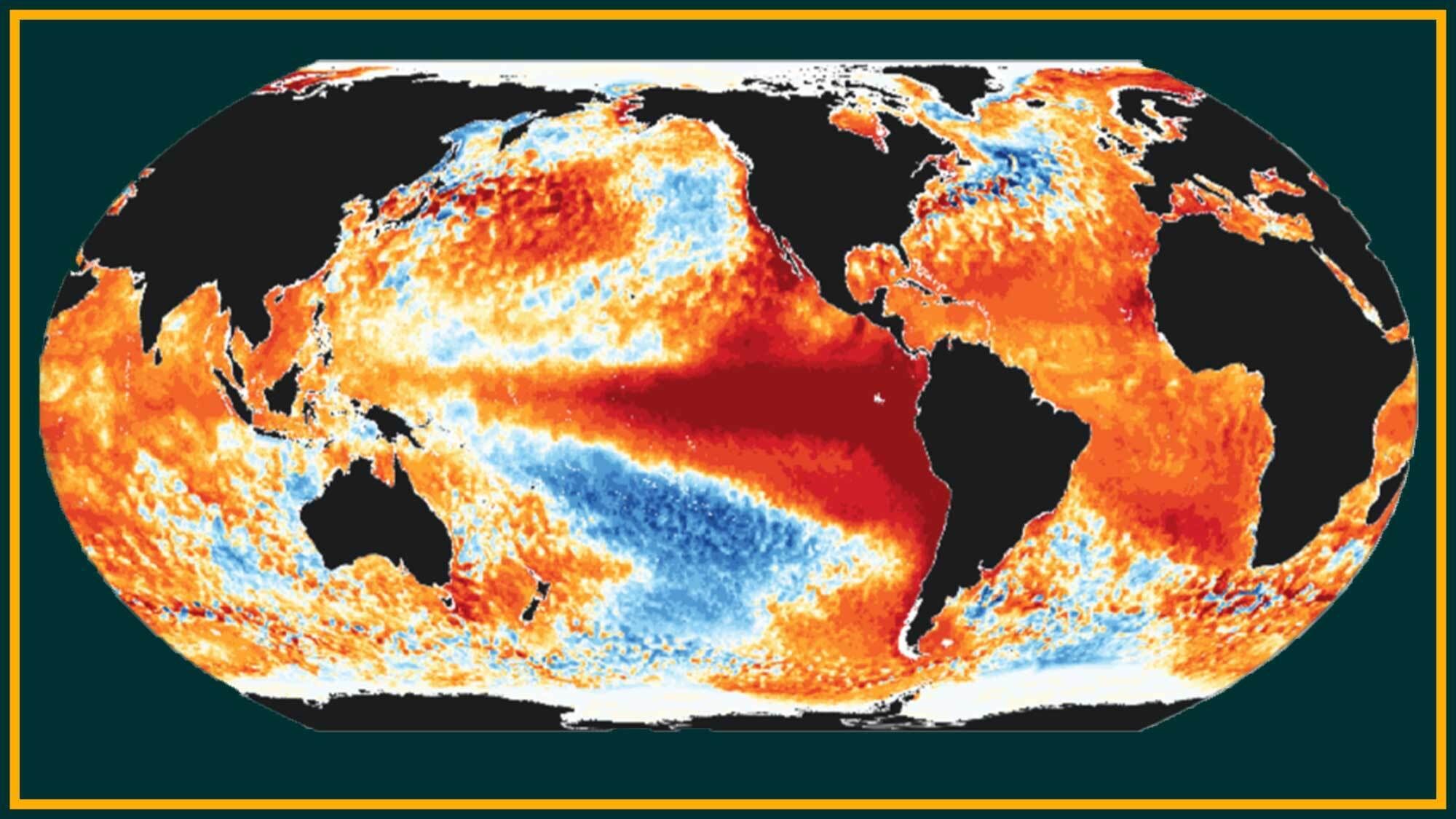
A potentially “supercharged” El Niño in the Pacific Ocean could make 2027 the hottest year on record, with global temperatures around 3 degrees Fahrenheit (1.7 degrees Celsius) above those of the late 1800s. The event may also provide a rare test of climate models, forecasts and emergency planning, although researchers emphasize that its strength and impacts remain uncertain.
El Niño is a natural warming pattern in the tropical Pacific and part of the El Niño-Southern Oscillation (ENSO). During an El Niño, the trade winds that normally blow from east to west along the equator weaken. Warm water then spreads eastward, allowing heat stored below the ocean surface to escape into the atmosphere.
Researchers predict that temperatures in the central equatorial Pacific Ocean could average about 6.7 degrees Fahrenheit (3.7 degrees Celsius) above normal from October through December this year. By comparison, during the second half of 2015, a period associated with a strong El Niño, the monthly average was about 4.5 degrees Fahrenheit (2.5 degrees Celsius) to 5.4 degrees Fahrenheit (3 degrees Celsius) above normal.
The long-term average temperature is not expected to reach 3 degrees Fahrenheit above the late-1800s level until the late 2030s at the current rate of warming. A particularly strong El Niño could bring that level of warming much sooner, potentially making 2027 the hottest year on record.
Potential consequences of an unusually strong El Niño
This could be an unusual event with serious consequences. The World Meteorological Organization has warned that a very strong El Niño could bring widespread abnormal weather, including bushfires, droughts and floods across Australia, Africa, Asia and South America.
Major grain-producing regions, including India and Southeast Asia, could experience lower crop yields. That could disrupt food supplies and push prices higher. One prediction suggested that additional warming caused by El Niño could contribute to more than 450,000 heat-related deaths by February, although such estimates are uncertain.
The event should be treated as a test: researchers, governments and industries can set out their expectations now, compare them with what happens and use the results to prepare for future extreme events.
What the event could reveal about climate models
Three findings from ongoing research shape how scientists should approach the coming winter.
Historical records may no longer be enough
First, long-term temperature records may not fully represent current conditions. Research suggests that the Pacific Ocean changed in the late 1970s. Before 1980, El Niño events that warmed the central Pacific by more than 5.4 degrees Fahrenheit (3 degrees Celsius) were thought to occur roughly once every 1,500 years, according to simple physical models. Since 1980, the estimated frequency has fallen to about once every 60 years.
The persistence of warm conditions has also changed, from about 1.1 years previously to approximately 1.5 years now. Forecasting systems built on an apparently complete historical record could therefore underestimate the next El Niño. Models that represent recent ocean conditions may be more useful.
El Niño may have a physical upper limit
Second, El Niño may have an upper limit, and scientists need to understand what sets it. The western Pacific is normally much warmer than the eastern Pacific. That temperature difference helps maintain the trade winds. El Niño grows as those winds weaken, allowing warm water to move eastward.
As the eastern Pacific warms, however, the temperature difference narrows. That can deprive El Niño of the conditions that help it intensify.
Over the past 76 years, each 1.8 degrees Fahrenheit (1 degree Celsius) of El Niño warming has been associated with a narrowing of the east-west temperature difference by roughly the same amount. At that rate, the difference would disappear when the central Pacific is about 7 degrees Fahrenheit (4 degrees Celsius) warmer than normal during the fall, when El Niño typically peaks, and about 3 degrees Fahrenheit (2 degrees Celsius) warmer in the spring.
No El Niño on record has reached that level during its peak season. In 1983 and 1998, the temperature difference disappeared in the spring, when both events were already weakening. The current event is continuing to grow and has come closer to this threshold than any previous event. September had the smallest remaining difference recorded for that month—about 0.6 degrees Celsius (1.08 degrees Fahrenheit).
The farther a point moves to the right, the stronger the El Niño. As temperatures rise, the difference between the warmer western Pacific and the cooler eastern Pacific becomes smaller. Each gray dot represents one month since 1950. As El Niño intensifies, the point moves toward zero, where the temperature difference disappears. That corresponds to temperatures about 6 to 7 degrees Fahrenheit (3.2 to 3.9 degrees Celsius) above normal in the fall and about 3 degrees Fahrenheit (2 degrees Celsius) above normal in the spring. There is no El Niño beyond this point. This year’s event, shown in red, is the closest yet, although it is still growing.
Image credit: NOAA ERSSTv5. Illustration: Ioana Colfescu, University of St. Andrews.
Forecasts will be published before the peak. If El Niño continues to intensify after the east-west temperature difference disappears, that would challenge current understanding of its physical limits.
Artificial intelligence is not a complete solution
Third, artificial intelligence (AI), which is increasingly being used to predict El Niño, is not a silver bullet. In a 2025 study, an AI weather model trained without the most powerful hurricanes failed to predict hurricanes. Similar limitations apply to El Niño forecasting.
Models trained only on records that contain few extreme events may not be able to predict how strong an unusually large El Niño could become. Models that incorporate the physics of the phenomenon, including the east-west temperature difference, may remain the best option for predicting extreme events. The strongest forecasts may combine physical models with AI.
Planning for uncertainty
Scientists and decision-makers need to be honest about the limitations of their models. Predictions from a simple physical model, an AI system or a complete climate model may all fall outside the range of events on which those systems were built and tested.
When models disagree, that disagreement can show where predictability is being lost. The range of possible outcomes is as important as the central forecast, and plans should account for it.
Crops, rivers, power grids, and human bodies respond to the heat they receive, whether that heat is due to annual fluctuations or long-term climate change.
Governments should assess the effects of El Niño both before and after it occurs. In June, the UK Government Office for Science brought together scientists, forecasters and industry experts to examine the risks to the UK from food, agriculture and energy. The resulting assessment warned that a very large El Niño “could have unexpected impacts” on the UK’s weather.
Similar assessments should become standard for governments. Before the peak, forecasters, health services, utilities and food agencies should publish their expectations. Afterward, they should compare those forecasts with what actually happened.
Measurements are also essential. Buoys, floats and satellites monitoring the Pacific are recording what may be the largest El Niño of modern times. Those observations will help train and test the next generation of forecasting models.
No single group can do this alone. The National Weather Service turns forecasts into warnings, while governments, industries and community services understand the costs of crop failures and gas shortages. Scientists can identify where predictions fail during an event of this magnitude.
These groups should agree before the peak on what to measure and how to evaluate their forecasts, then meet again after the event has passed.
Why uncertainty does not eliminate the risk
Two objections are reasonable. First, one year of El Niño does not mean that the climate of the 2030s has arrived. Heat, drought and flooding are concentrated in particular regions, while long-term warming has different patterns, so the preview may not apply equally everywhere.
Second, the numbers remain uncertain. Simple physical models, AI models and full climate models may produce different estimates of El Niño’s upper limit.
Those points are valid, but they do not eliminate the need to prepare. Crops, rivers, power grids and human bodies respond to the heat they receive, regardless of whether it comes from annual variability or long-term climate change. A 3-degree increase caused by El Niño can affect these systems in much the same way as a 3-degree increase caused by climate change, although the short-term event gives them less time to adapt.
El Niño events in 1982-1983 and 1997-1998 had major economic effects. One study estimated that the combined lost revenue between the two events cost the global economy $9.8 trillion.
The best response to uncertainty is to run as many simulations as possible with as many different tools as possible, treating the spread of results as a measure of what remains unknown. Real events provide an opportunity to determine which models are most accurate.
This winter, the Pacific may conduct an experiment that scientists could never have created deliberately. If El Niño stops growing where physical theory predicts, researchers will have a way to estimate an upper limit for the worst-case scenario. If it exceeds that limit, the worst case will be more severe than historical records suggest, and plans based on those records will need to be reconsidered.
By this time next year, researchers should know which models came closest to the outcome and how well they performed during an event that may resemble conditions otherwise expected in the 2030s.
Opinion on Live Science provides insight into important issues in science affecting people and the world around them, written by experts in the field and leading scientists.
Source: www.livescience.com