


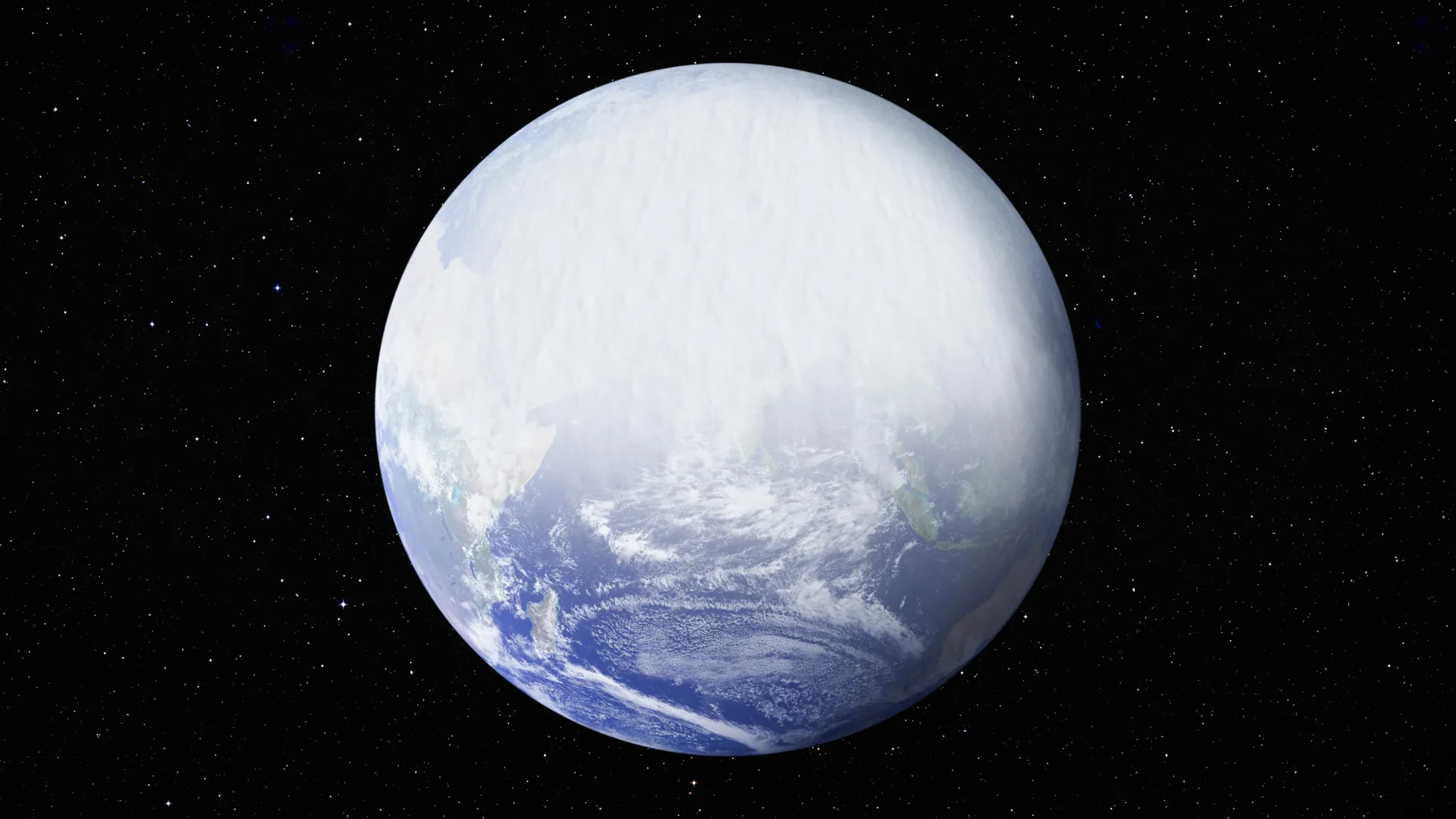
About 2,000 years ago, the remnants of a vast ice sheet covering parts of Canada began expanding again—possibly marking the start of Earth’s next glacial period. A new study suggests that this early-stage ice age was halted by rising summer temperatures in the 20th century. By the 1960s, the remaining ice was melting faster than winter snowfall could replace it, reversing a natural cooling cycle that had begun thousands of years earlier.
The findings suggest that global warming may have interrupted a new ice age that was already underway, altering climate cycles that have shaped the planet for millions of years.
“The ice age had just started, everything was normal, and the next ice age was about to start, and yet the ice age stopped,” said Nicholas Young, a geochemist at Columbia Climate School’s Lamont-Doherty Earth Observatory. “This is a very powerful example of how we shocked the system.”
Ancient Arctic ice reveals a surprising climate history
In a study published in Science, Young, Lamont geochemist Jorg Schäfer and their colleagues investigated the history of the Laurentide Ice Sheet. This enormous ice mass covered much of Canada and the northern United States from about 95,000 to 20,000 years ago.
At its maximum extent, the Laurentide Ice Sheet reached from north of the Arctic Circle south to Illinois. In some places, it was more than three miles thick. Most of the ice sheet disappeared as the climate warmed, but one section remains.
Known as the Barnes Ice Cap, the surviving ice mass is located on central Baffin Island in Nunavut, Canada, and covers an area roughly the size of Delaware.
“People always say it’s gone, but that’s not true,” Young says.
Scientists already knew that the Laurentide Ice Sheet had expanded and retreated repeatedly during the roughly 2.6 million years since large continental glaciers first developed in North America. What remained uncertain was whether the ice sheet had ever become smaller than it is today before beginning to grow again.
Answering that question could reveal whether the latest glacial cycle began much more recently than scientists had previously believed.
Strictly speaking, Earth is still in the Late Cenozoic Ice Age, which began about 34 million years ago. Within this long ice age, colder glacial periods alternate with warmer interglacial periods, including the interglacial period in which we currently live. In everyday usage, the term “ice age” usually refers to one of those colder glacial periods. The last such period ended about 11,700 years ago.
Ancient plants preserved beneath the ice provide clues
Reconstructing the history of an ice sheet is difficult, particularly when scientists are looking for evidence of its smallest extent and the earliest stages of renewed growth. Advancing glaciers often scrape across the ground, destroying geological traces that could show where and when the ice began to spread.
The Barnes Ice Cap offers a rare opportunity to investigate that history. Unlike many glaciers, parts of the ice cap are frozen directly to the bedrock beneath them rather than sliding across the landscape. As a result, plants that once grew there and were later covered by expanding ice can remain preserved in place for thousands of years.
Since the Barnes Ice Cap began retreating in 1960, previously buried plants have gradually emerged from beneath the melting ice. Researchers can collect these remains and use radiocarbon dating to determine when the plants lived.
Radiocarbon dating measures carbon-14, a radioactive form of carbon that living organisms absorb from the atmosphere. After an organism dies, its carbon-14 decays at a predictable rate. By measuring how much remains, scientists can estimate when the plant stopped growing and was buried beneath the ice.
These dates create a record of when advancing ice covered different parts of the landscape.
“If you do this enough times, you can actually create a timeline of the ice edge moving systematically over the plant. You’re actually tracking the expansion of that ice edge,” Young says.
The next glacial period may have begun 2,000 years ago
The researchers examined ancient vegetation exposed by the retreating Barnes Ice Cap, along with plant remains revealed beneath smaller ice caps that had recently melted in surrounding areas.
By combining the samples, the scientists reconstructed changes in the ice over thousands of years.
Their results indicate that the Laurentide Ice Sheet reached its minimum extent about 3,000 years ago. Then, about 2,000 years ago, temperatures became cold enough for the remaining ice to begin expanding again.
Young and his colleagues argue that this renewed growth should be recognized as the beginning of Earth’s next glacial period.
That interpretation differs from earlier studies based on climate models, which have generally suggested that the next ice age would begin in fewer than a few thousand years or perhaps tens of thousands of years.
Part of the disagreement involves how scientists define the beginning of an ice age. Instead of waiting for enormous ice sheets to spread across continents, Young’s team proposes using the first sustained expansion of existing ice sheets as the starting point.
By that definition, the next glacial period had already begun before modern scientists recognized it.
The discovery also sheds new light on a scientific debate from the 1970s, when some climate researchers suggested that another ice age might be approaching.
“It was actually happening,” Young says. “They couldn’t prove it completely, but now they have some evidence.”
The initial expansion would not have caused immediate or dramatic changes to Earth’s climate. Young said it would have taken thousands of years for the cooling to become noticeable and about 30,000 years for the Laurentide Ice Sheet to regain its enormous continental extent.
The process was still in its early stages when warming halted it.
Global warming reversed the ice sheet’s growth
By the 1960s, conditions had changed significantly. The Barnes Ice Cap was losing more ice during the summer than could be replaced by snowfall during the winter.
Instead of continuing to expand, the ancient ice began to shrink.
According to the researchers’ interpretation, this reversal effectively ended a developing ice age before a full glacial period could take shape.
The consequences could extend into the distant future. Models of the Barnes Ice Cap indicate that it could disappear completely within the next few centuries.
“That will be the last true remnant of Laurentide, and it will be gone forever,” Young says.
Loss of ancient ice could change future glacial cycles
The disappearance of the Barnes Ice Cap could also affect how future ice ages develop.
In the past, when Earth’s climate cooled sufficiently, the Laurentide Ice Sheet provided a starting point for new glaciers to form. Existing ice masses can create favorable conditions for additional accumulation, triggering feedback processes that allow glaciers to expand as temperatures remain low.
Scientists describe this as positive feedback: existing ice encourages the growth of more ice, allowing an ice sheet to expand progressively.
Without the last surviving remnants of the Laurentide Ice Sheet, future ice ages may develop differently.
Researchers cannot yet determine when a new glacial period would begin under atmospheric conditions affected by rising greenhouse gas concentrations. If large continental ice sheets eventually begin forming again, they may have to develop without the ancient ice that once helped initiate their growth.
The findings suggest that global warming is doing more than melting glaciers and shrinking existing ice sheets. It may have interrupted a glacial cycle that had already begun and removed landforms that helped sustain ice-age cycles across North America for millions of years.
“What used to be a very natural and predictable phenomenon is now gone,” Young said.
Source: www.sciencedaily.com