


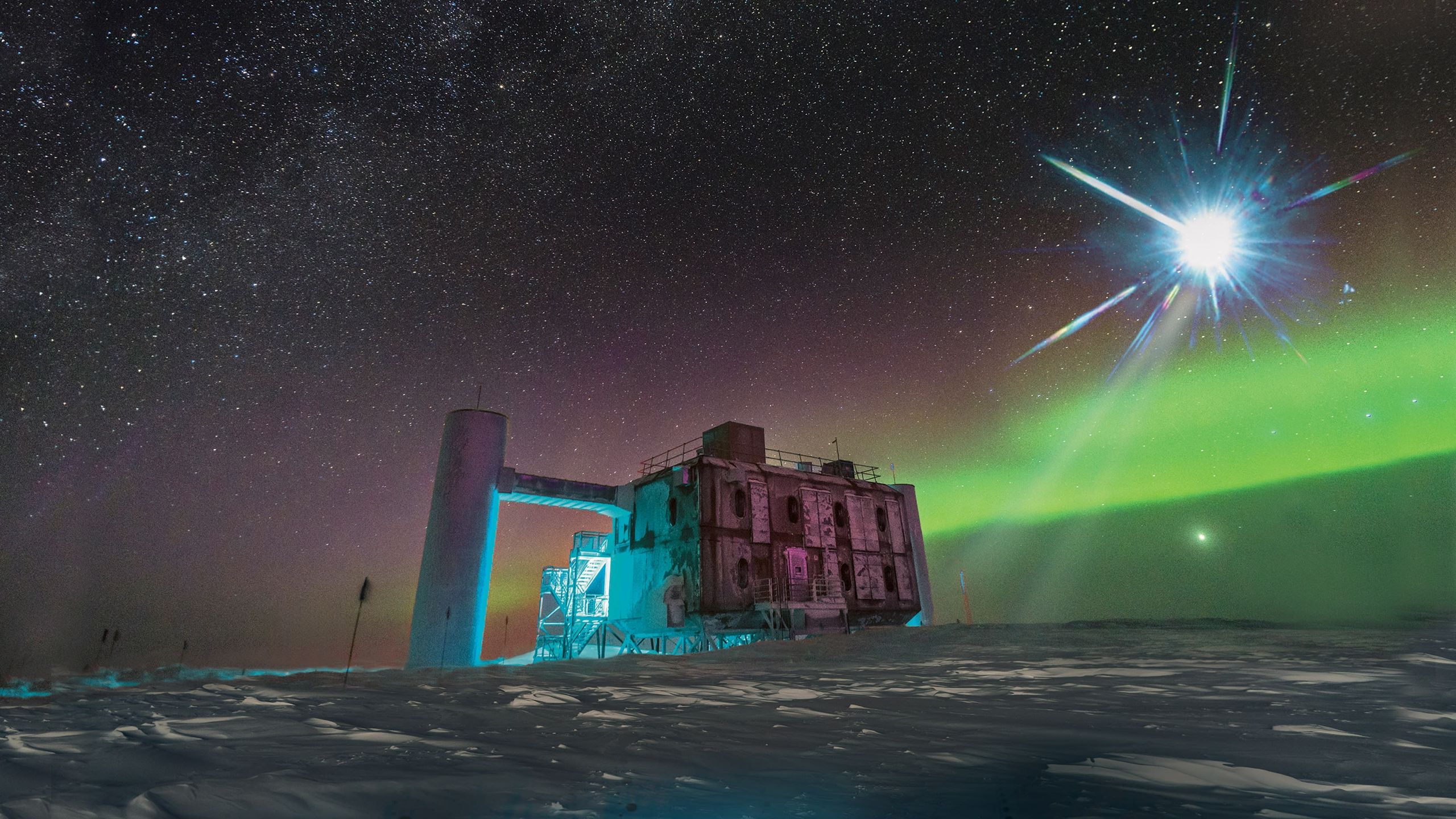
When Francis Halzen proposed placing a $271 million neutrino telescope beneath the South Pole, he expected to be laughed off the stage. Four decades later, the IceCube Neutrino Observatory—thousands of light sensors embedded in a cubic kilometer (0.2 cubic miles) of Antarctic ice—earned him the 2026 Nobel Prize in Physics. In an interview with Live Science, Halzen discussed the elusive particles IceCube detects, the engineering crises that nearly ended the project and the future of neutrino astronomy.
Halzen, a theoretical particle physicist at the University of Wisconsin–Madison, is not interested in obvious ways of studying the universe. His quarry is the neutrino: a nearly massless, chargeless particle produced by nuclear reactions and high-energy collisions. Neutrinos stream from the sun and the edges of black holes, passing through stars, planets and human bodies by the trillions every second. Yet a person has a 75% chance of living an entire lifetime without a single neutrino striking an atom in their body, according to CERN.
On the rare occasions when neutrinos interact with atoms, they produce charged particles that travel through water or ice faster than light travels through that material. The particles create a faint blue cone of light—the optical equivalent of a sonic boom. Since 2011, IceCube has used this light to study neutrinos from the universe’s most violent events, probing energies far beyond those available in Earth-based laboratories.
From mathematics to particle physics
Ben Turner: What first got you into physics?
Francis Halzen: I got into physics by accident. When I finished high school, I did not know what to do. I was interested in languages and science, so I am a bad example of an inspirational career.
I studied mathematics because the Belgian school system followed the old French model—it was created by Napoleon—and had not changed much since I was in high school. If you were a good student, mathematics was the thing to do. I studied it for two years, then studied physics in parallel before switching to physics.
My professor became my supervisor and gave me a paper by George Zweig, who co-proposed quarks with Murray Gell-Mann. It was a fundamental discovery. Zweig was actually an experimentalist, and he had made his calculations using little figures. Because I had studied mathematics, I recognized that he was using group theory and thought, “I can do this better.”
I wrote several papers on the subject and suddenly became a theoretical particle physicist. That is what I still am. My heart never left particle physics.
BT: How did quarks eventually lead you to neutrinos?
FH: I did not really study neutrinos until I became involved in starting this experiment. Half of my career had passed by the time I began AMANDA, IceCube’s prototype, and IceCube, and I had very little overlap with neutrino physics.
I became interested in neutrinos again while trying to solve a theoretical problem. The idea of detecting neutrinos using ice originated with the Armenian physicist Gurgen Askaryan in 1963.
You cannot see neutrinos. They have no charge and essentially no mass. The way to detect them is to wait for them to interact with an atomic nucleus. We are moving through a sea of neutrinos, but they normally do not interact with atoms, so we do not notice them. If one hits a nucleus, however, it creates a nuclear reaction that produces charged particles. It is like a spark, and you can detect a spark with antennas.
Askaryan proposed putting radio antennas in ice. We are doing something related, but instead of looking for radio emission, we detect the light produced by the charged particles. We use that blue light to reconstruct the neutrino and determine its properties, including its direction. That is why IceCube is a telescope.
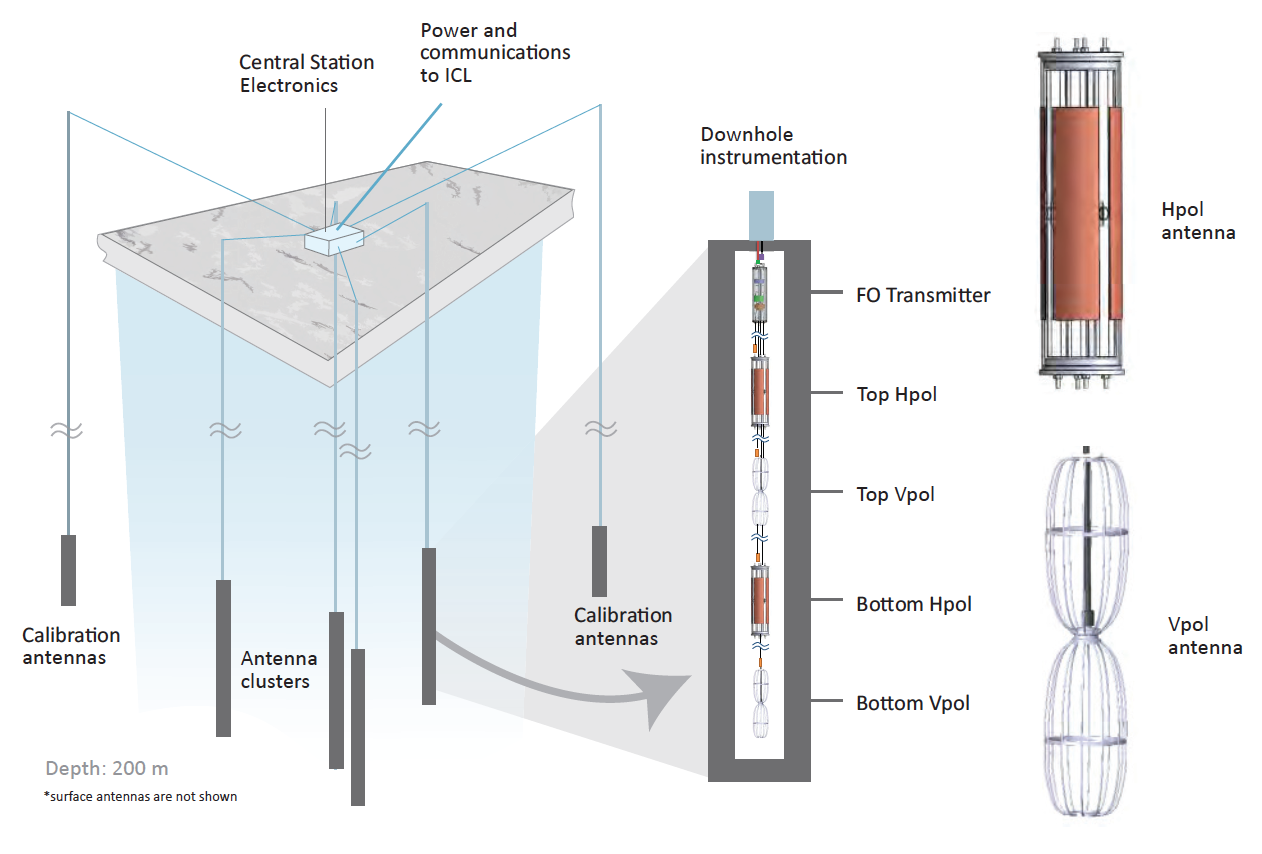
I was worried about the radio experiment because nobody had been able to calculate the power of the spark. They did not know whether the signal would be strong enough. At one point, someone told me that researchers in what was probably still the Soviet Union were pointing radio dishes into the ice at an Antarctic station. I thought, “This is crazy.”
But I had ice all over my brain. When I saw how difficult it was to conduct these experiments in deep ocean water in the late 1980s, it seemed natural to consider ice. To our credit, we realized it might actually be simpler.
Why Antarctic ice can act as a detector
BT: Why was calculating the power of the spark so important?
FH: It determines how much light is produced and how far the light travels through the detector. If there is not enough light, or if it is absorbed immediately, the experiment cannot work.
We were incredibly lucky that blue light can travel 100 meters (328 feet) or more through this ancient ice without being absorbed. That makes it relatively easy to instrument an ice block a kilometer on each side.
BT: When you first proposed melting 61 two-kilometer (1.2-mile) holes in the coldest place on Earth, you expected to be laughed off the stage. When that did not happen, you said you continued to worry. What concerned you?
FH: I worried that I was completely out of my league. I did not understand glaciology, and I was not an experimentalist, so I did not grasp the technological challenges. The experiments in water were not going well. The leading project was DUMAND, the Deep Underwater Muon and Neutrino Detector, off Hawaii. John Learned, who led it, was a good friend of mine, and I eventually contacted him.
There was also the glaciology. Nobody knew the optical properties of ice at depths of one kilometer (0.6 miles) or more beneath the South Pole. Ice cores had been collected, but they were small—about the size of a teacup—so they could not show how far light traveled through the ice. People thought the proposal was a cute idea that would never work.
If I had known more about glaciology, hot-water drilling and the technical challenges, I would never have started the experiment. That is the advantage of ignorance. It is why young people make great discoveries. When you are 82 years old, you do not make this kind of progress—you know too much.

BT: You have spoken about AMANDA and IceCube with ambivalence. You said you were “dragged into it by accident” and “tried to get out of it many times.”
FH: Theorists write two types of papers. The first are papers in which they believe they are contributing to scientific progress; usually they are not. The second type is written simply to show that you are smart. My paper on this was definitely in the second category. Then two people from Berkeley actually started the experiment.
BT: You won a Nobel Prize for it. If you wanted to look smart, you succeeded.
FH: Without a lot of luck, I would not be sitting here.
“They’re this almost non-existent piece of reality.”
Francis Halzen
Why neutrinos matter
BT: What made you stay interested in neutrinos despite all the uncertainty?
FH: Neutrinos are special. The Standard Model of matter, which describes all known particles and forces, includes quarks, leptons and neutrinos.
Neutrinos were thought to have no mass, like photons. They should travel at the speed of light, which means they can be used for astronomy. But unlike photons, they pass through planets and the Earth. They can reach us from the beginning of time, from the edge of the universe. They are an almost nonexistent piece of reality.
We have known about neutrinos since 1930, because without them a proton cannot change into a neutron. They were ghosts—that is where the term “ghost particle” comes from. They were part of physics, particle physics and nuclear physics, but they had never been directly observed.
Frederick Reines and Clyde Cowan finally detected the neutrino in 1956 by placing a detector near a nuclear reactor, where enormous numbers of neutrinos are produced. If particles rarely interact, one way to compensate is to go somewhere that produces a lot of them.
Neutrinos are now especially fascinating because they do have mass, something not allowed by the original structure of the Standard Model. That mass may carry information about new physics—the kind of physics being sought at the Large Hadron Collider in Geneva. Neutrinos have delivered some of the clearest messages about physics beyond the Standard Model.
Unfortunately, during the first 15 years of IceCube, they behaved like the Standard Model in everything we measured.
The drilling crisis
BT: In 1993 and 1994, microscopic air bubbles in Antarctic ice scattered the blue light like frosted glass, nearly killing the project. You saved it by drilling to depths where the pressure had crushed the bubbles, as far as 2.5 kilometers (1.6 miles) beneath the surface—one kilometer deeper than originally planned. How difficult was that?
FH: The drilling nearly killed the project twice.
Today, IceCube detects a neutrino roughly every minute, but those particles are produced in Earth’s atmosphere. Atmospheric neutrinos are our background—an interesting background, but still a background. To find neutrinos from astrophysical sources, we must distinguish them from lower-energy particles created in the atmosphere and by the sun.
Once we had solved the detection problems, the remaining challenge was creating a drill capable of building IceCube. The system had to melt ice more than 2.5 kilometers deep across an area roughly the size of a basketball. Hot-water drilling already existed for glaciers, but it produced shallow holes about the diameter of a wine bottle.
We approached companies that specialized in hoses and needed one 2.5 kilometers long. The first company told us, “You hang a hose the size of a teacup over two and a half kilometers of hot water—what do you think will happen?” It would collapse. Even the theorists understood that.
For weeks, I thought the project was finished. Then one of our engineers found a company in Padua, Italy, near Venice. They said, “We can build anything.” And they did.
Drilling remained difficult. During the first South Pole season, we drilled one hole. Brilliant engineers worked on a completely new piece of equipment, learned from the first year’s mistakes and made it work in the second year. They eventually deployed 86 detector strings without a single failure. That is remarkable. If you launch 86 satellites, you expect some of them to fail. We thought the same would happen, but none did.

IceCube’s first cosmic neutrinos
BT: IceCube went online in 2011. That year and the next, it detected “Bert” and “Ernie,” the first astrophysical neutrinos known to come from beyond the solar system. What did it feel like when they appeared?
FH: We were not sure we believed it. It was clearly a major discovery—if it was real. It took six months or more to find the courage to publish the paper.
I remember seeing the first events on my screen in October 2012. They looked as if they could not have come from the atmosphere because their energies were so high. We discovered the first two by chance in the first two years of data. Once we knew what to look for, we found 28 and felt able to publish.
Three weeks later, the discovery was declared the physics breakthrough of the year. I was not happy about that. I had to give a press conference while thinking, “If this is not true, how am I going to walk this back?”
It took me time to convince myself that the events were not simply something that looked like cosmic neutrinos. In this unusual area of science, you cannot always tell whether you are being fooled by another phenomenon you have not considered.
BT: What eventually convinced you?
FH: We now see neutrino sources. When 100 neutrinos arrive from an active galaxy and another telescope can point back to that galaxy with 0.04-degree resolution, there is no doubt.
For me, becoming convinced was a continuous process. My colleagues call me a total optimist, but it took time. Now, however, the statistics are impossible to deny. We are talking about 14 years of data, and it is incredible how quickly the field has progressed.
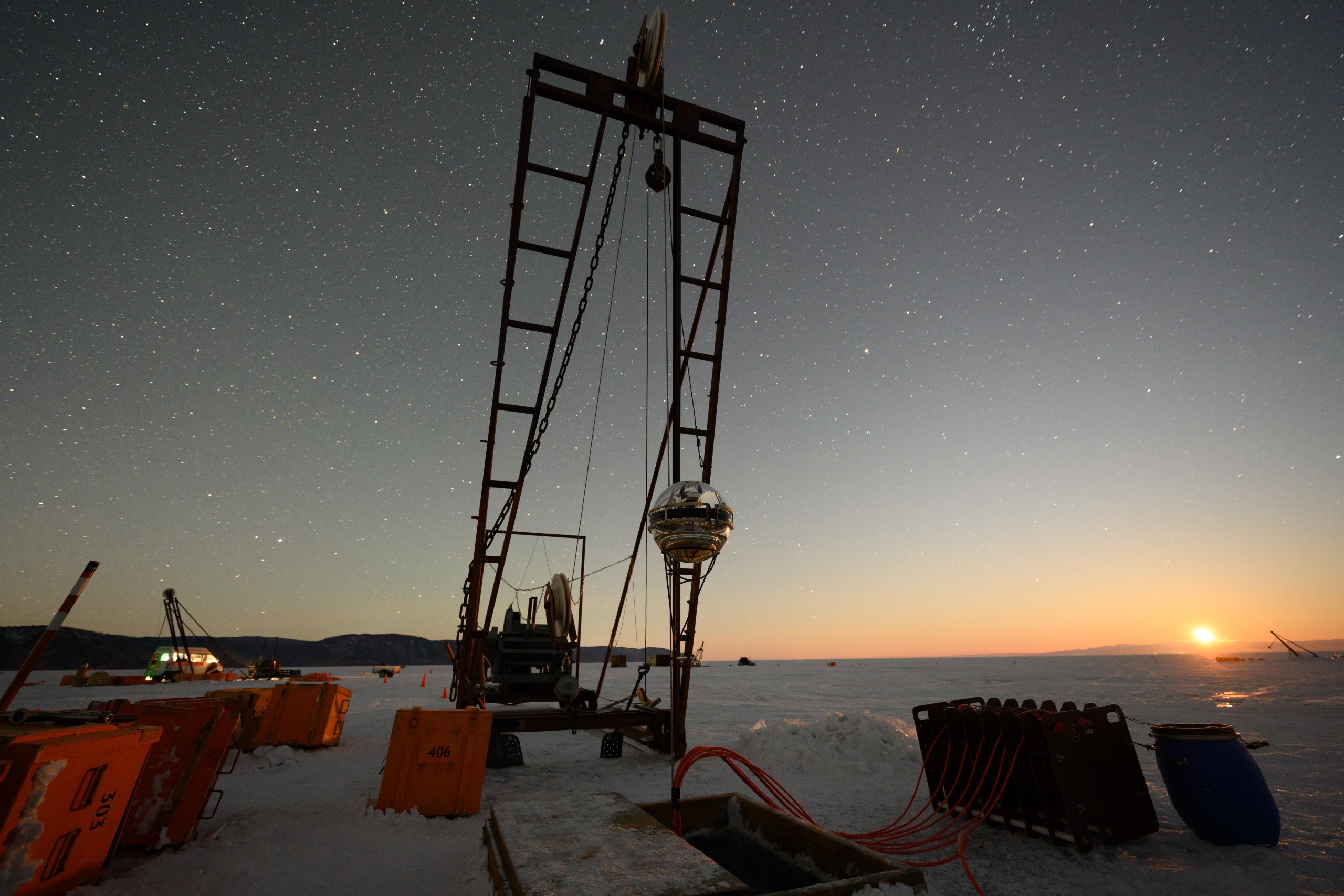
Officially, though, none of these observations has yet been independently confirmed by another experiment. Two other detectors—Baikal-GVD in Lake Baikal and KM3NeT in the Mediterranean Sea—are under construction. Both have produced some evidence, but a direct confirmation of the same observations has not yet occurred. The Nobel Prize Committee therefore showed more courage than I did.
A surprise Nobel Prize
BT: You were in a hotel room in Italy when the call came from Stockholm. What did you think after you hung up?
FH: After hanging up, I was sent a Zoom link and asked questions, which I answered. I did not realize I was giving a press conference. I still have not watched it.
That is how strange the moment was: I had forgotten it was Nobel season. The call came as a total surprise—or not a total surprise, because people have a game in which they predict the Nobel Prizes, and I had been considered a possible winner for several years.
People would send me condolence messages every year when I did not win. They meant it—they were my friends—but it made me feel as though I had disappointed my collaborators.
My first thought was, “The problem is solved now. Everybody can get credit for this experiment.” They deserved it. IceCube was becoming associated mostly with me, while the data, science and contributions of other people were being forgotten. The great thing about this Nobel Prize is that it recognizes a difficult problem solved by many brilliant people over almost four decades.
BT: Apart from winning the Nobel Prize, what has been the highlight of working on IceCube?
FH: The highlight was demonstrating that the technique worked. Seeing neutrinos pass through the Earth and then through the detector was incredibly exciting. There was no doubt that we were observing a stream of particles initiated by neutrinos passing through the Earth. What you see is what you get.
We assumed that building something this large would lead to interesting science. It was unlike anything built before. Our joke was, “We are all particle physicists, guys. God forbid we have to do astronomy.” But that is what we are doing.
It is very exciting to learn astronomy when you are 82 years old.
The next generation of neutrino astronomy
BT: IceCube–Gen2 is targeted to begin operating by 2033 and will be eight times larger than the original detector. What do you want from its future?
FH: Whenever I give a talk, I have a list of conclusions. My first is always that neutrino astronomy exists, and that is our contribution.
Real neutrino astronomy will require more and larger instruments. Astronomy does not rely on a single telescope. We need instruments that cover the entire sky and produce more neutrino detections with better angular resolution.
That will happen. Ambitious projects are under way in China, as well as the upgrade of our own project. The technology is much better now. We understand the ice perfectly, so we can design and optimize the detector. We should be able to achieve an order-of-magnitude improvement for the same cost as the original.
BT: You generally avoid making predictions, even a year in advance. What do you hope the future brings for neutrino astronomy?
FH: I hope for a galactic supernova within the Milky Way. In 1987, a supernova occurred in a nearby satellite galaxy, and physicists detected 20 neutrinos. Thousands of papers have been written about those 20 particles, and they are all interesting.
Neutrinos were expected to have no mass and to behave like photons. The best limit on the tiny, unexplained neutrino mass came from that supernova. The event allowed physicists to make fundamental measurements that could not be made using laboratory neutrino beams. It also confirmed the picture of a star collapsing into a neutron star. From the standpoint of stellar physics, it was a major event.
Instead of having three experiments, we now have multiple types of neutrino detectors. Some will detect thousands of neutrinos; IceCube will detect a million. We will not be able to reconstruct every particle, but we can create a detailed movie of what happened during a supernova as the star collapsed and exploded. The science from just a few seconds of data will be incredible.
We have been continuously looking for such an event with AMANDA and IceCube, but it has not happened since the mid-1990s. There are expected to be about two per century. We are due.
Editor’s note: This interview has been edited and condensed for clarity.
Source: www.livescience.com