


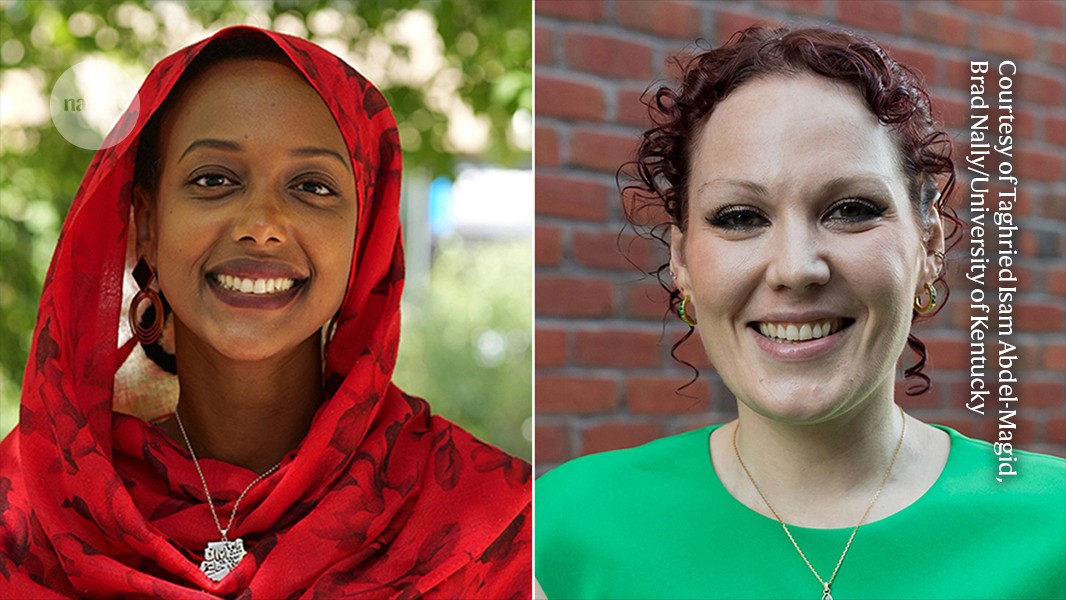
The 2026 Nature Prize for Inspiring Women in Science has recognized materials physicist Alexandra Patterson for developing flexible semiconductor materials and Sudanese scientist Taghried Abdelmagid for helping women and others affected by conflict continue their research careers. The awards, created in partnership with The Estée Lauder Companies, are intended to increase the visibility of women in science and support researchers early in their careers.
The awards come as the research community continues to call for greater recognition of women’s contributions. In 2026, no woman will receive a Nobel Prize in science or economics, continuing a pattern that has highlighted the unequal recognition of women’s work.
Flexible semiconductors
Patterson, the recipient of this year’s Scientific Achievement Award, is a materials physicist from the United Kingdom who works at the University of Kentucky in Lexington. Her research includes the development of semiconductors made from flexible, polymer-based materials.
These materials, known as plastic mixed conductors, could be used in applications ranging from cardiovascular sensors to low-energy computing. Unlike most conventional semiconductors, plastic mixed conductors are mechanically flexible and can be manufactured using low-cost printing techniques.
Researchers have struggled to make these conductors stable enough for long-term and reliable use. Last year, however, Patterson and her colleagues showed that their stability could be improved through new materials-engineering techniques (Nature Electronics 8, 116–126; 2025).
Supporting researchers in Sudan
The second winner, Taghried Abdelmagid, studies the sustainability of building materials at the University of Bath, UK. A native of Sudan, she received the award in the science-dissemination category for her work with Share the Knowledge-Sudan (StK), a volunteer-led initiative run by women.
StK provides training and mentorship to people in Sudan and in the Sudanese diaspora, most of whom are women, helping them to begin or continue research careers.
Sudan is experiencing what has been described as the world’s worst humanitarian crisis. Since armed conflict began in 2023, approximately 14 million people have fled either within the country or to neighboring countries including Egypt, Ethiopia, South Sudan and Uganda. The United Nations has estimated that hundreds of thousands of people lost their lives in August. Read more from the United Nations.
Many of Sudan’s universities have also been destroyed. Abdelmagid and her colleagues founded StK to help ensure that girls and women—whose education is often disproportionately affected by conflict—retain access to expertise, training, mentorship and scientific knowledge.
StK offers a range of online services, including talks by scientists that can attract up to 1,500 participants and access to a free digital library. The initiative also provides coaching and mentoring for people pursuing or planning research careers, help with writing research proposals and assistance with interview preparation.
Recognizing collaboration
Many research awards, including the Nobel Prize, focus on individual achievements. Such recognition is important because it ensures that discoveries and inventions receive appropriate credit. Scientific prizes should also recognize the collaborative efforts that make research possible, including work that crosses national and disciplinary boundaries.
Patterson’s research combines polymer chemistry, electronics and biotechnology, and her team collaborates with institutions across three continents. Many of this year’s Nature Prize finalists are also working to foster collaboration and make science accessible to people who might otherwise struggle to study it or build careers in research.
Patterson grew up in Oldham, a town in northern England that has some of the highest levels of poverty in the country. Now based in Kentucky, one of the most affluent states in the United States, she is involved in a project to establish a materials-science exhibit at the Lexington Children’s Museum.
Other honorees
Other women recognized in this year’s awards include Rose Huizenga, runner-up in the science-support category, and Coral Catch, a women-led marine-conservation organization based in Indonesia. Learn more about Coral Catch.
Nandintsetseg Dejido, runner-up in the Scientific Achievement category, studies animals that roam across Central Asia. She is based at the Senckenberg Center for Biodiversity and Climate Research in Frankfurt, Germany.
Victoria Peterson, a biomedical engineer at the Littoral Institute of Applied Mathematics in Santa Fe, Argentina, received a special jury award for her work on brain–computer interfaces for neurorehabilitation and her efforts to support the next generation of researchers in the field across Latin America.
The awards recognize the winners, finalists and the broader networks that support their work, while highlighting the many ways women are advancing science and making research more accessible.
Source: www.nature.com