


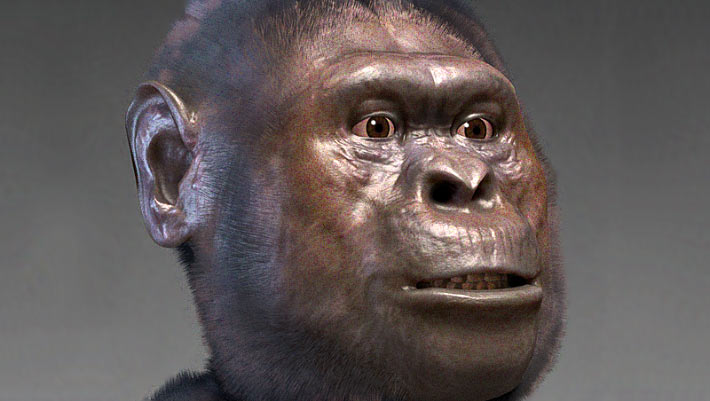
A bony ridge found on both sides of the lower jaw of an adolescent Australopithecus africanus who lived about 2 million years ago shows that mandibular tori—harmless growths commonly discussed in modern dental clinics—are not a recent feature of humans. The fossil, known as Sts 52b, suggests that strong chewing forces alone cannot explain the development of this unusual anatomical trait.
A rare feature in an ancient jaw
Mandibular tori are harmless bony growths that form on the inside of the lower jaw. They are described in modern populations, particularly in colder regions, where they occur in more than half of the circumpolar population but in only about 3% of people in Africa. Their causes remain uncertain, although researchers have suggested roles for genetics, powerful chewing forces, teeth grinding and periodontal disease.
The growths are present on both sides of the jaw of Sts 52b, a specimen of Australopithecus africanus excavated in 1949 at Sterkfontein, near Johannesburg, South Africa. The deposits at the site are estimated to be between 2.8 and 2.1 million years old.
“It is highly unexpected to find such a prominent and fully formed ridge in a young fossil specimen, which is not seen in other juvenile fossils of this species,” said Luka Morris Obst of La Trobe University.
“It makes our ancestors relatable. It humanizes our ancient relatives and shows that even subadult humans suffered from the very same harmless anatomical oddities and jaw changes that we discuss in dental clinics today.”
Chewing forces do not provide a complete explanation
The specimen was an adolescent whose second molars had only recently erupted, even though mandibular tori are typically reported in adults. The discovery therefore complicates explanations based on masticatory forces, or the stresses produced during chewing.
Researchers also found no signs of tooth decay, infection or unusually high tooth wear in Sts 52b. The study concluded that a strong bite force alone cannot account for the growth.
The researchers noted that even robust hominins such as Paranthropus robustus, which had powerful chewing muscles capable of producing extreme masticatory stress, do not consistently show this feature in the fossil record.

“The mandibular torus is so rare in the fossil record that even ‘robust’ hominids, which have huge masticatory muscles that produce extreme masticatory stress, lack this feature,” Morris Obst said.
“Therefore, high masticatory forces alone cannot explain the development of this benign bony prominence.”
A possible genetic explanation
The researchers suggest that the growth may reflect a rare genetic abnormality. They propose that it could have remained uncommon for roughly 2 million years before becoming widespread in human populations over the past 10,000 years or so.
“This discovery provides a more complex picture of how the human jaw developed,” Morris Obst said.
The study, “A deep time perspective on a rare anatomical variant: the presence of the mandibular torus in Australopithecus africanus from Sterkfontein, South Africa,” was published in Evolutionary Human Sciences.
Luka Morris Obst et al. 2026. A deep time perspective on a rare anatomical variant: the presence of the mandibular torus in Australopithecus africanus from Sterkfontein, South Africa. Evolutionary Human Sciences 8: e42. doi: 10.1017/ehs.2026.10070.
Read the study in Evolutionary Human Sciences.
Source: www.sci.news