


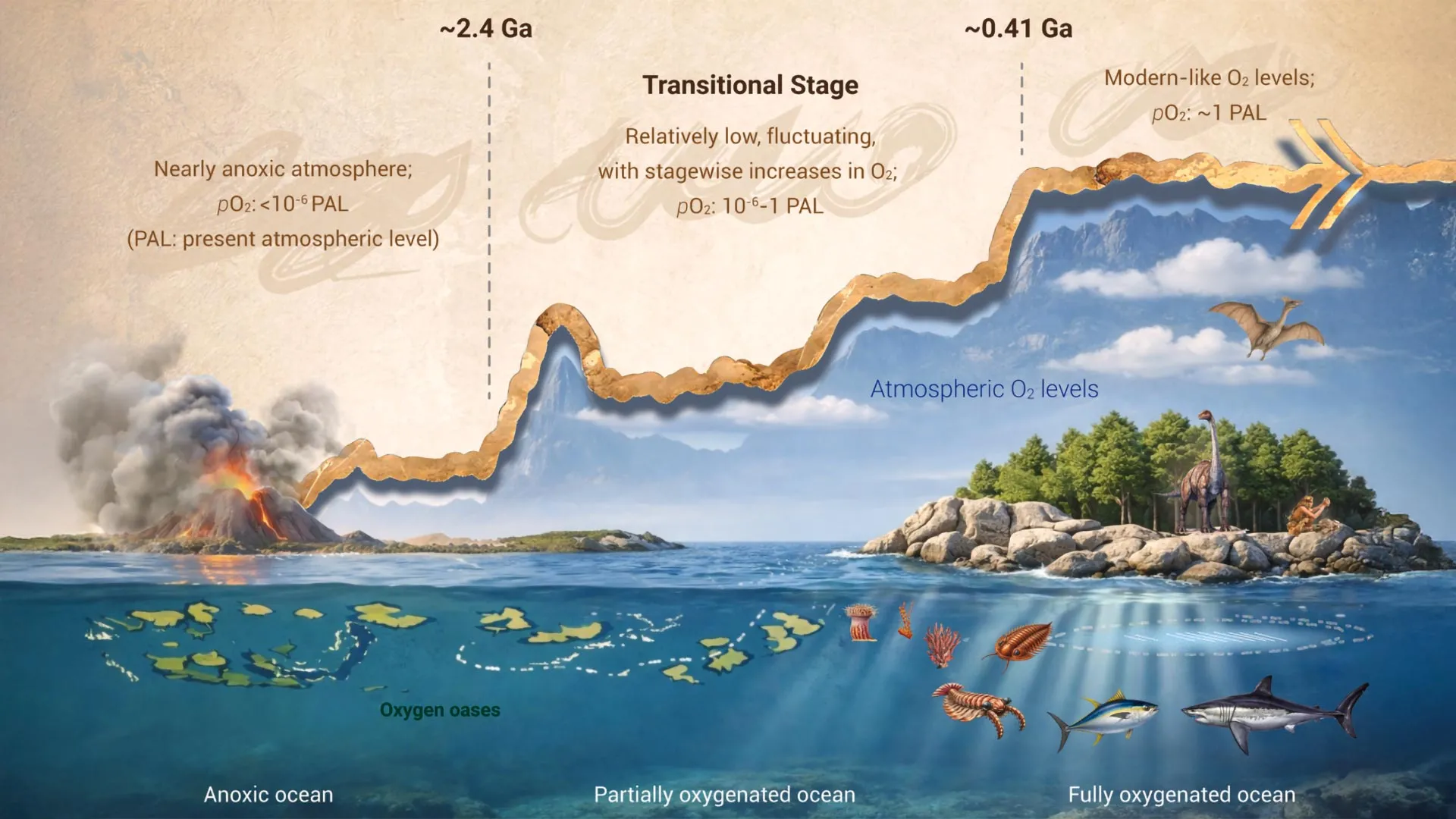
Earth’s atmosphere and oceans did not become oxygen-rich at the same time, according to a new analysis by two geochemists from Chengdu University of Technology. Their revised timeline identifies three major stages of atmospheric oxygenation and suggests that the deep ocean lagged behind by hundreds of millions of years, with roughly 600 million years separating the final transitions.
Ancient rocks reveal different oxygen timelines
Scientists have traditionally reconstructed Earth’s atmospheric oxygen history using chemical clues preserved in ancient ocean sediments. However, seawater oxygen levels are affected by more than atmospheric conditions, including nutrient availability, biological productivity, ocean circulation and the shape of ocean basins. Ocean chemistry therefore provides an imperfect record of the atmosphere.
The researchers instead examined sulfates, which can preserve distinctive signals of atmospheric oxygen. Reactions involving oxygen, ozone and carbon dioxide in the atmosphere create an unusual shortage of the oxygen isotope oxygen-17. When sulfide minerals weather, this chemical signature can be transferred to sulfates and eventually preserved in sedimentary rocks. These signatures offer a more direct indication of how atmospheric oxygen changed over time.
The evidence suggests that Earth’s first major increase in oxygen occurred during the Great Oxidation Event, between 2.4 and 2.1 billion years ago. Atmospheric oxygen rose from less than one-millionth of today’s concentration to between 0.1% and 10% of modern levels.
A second major increase occurred between about 1.3 billion and 1 billion years ago. A third followed between 440 million and 410 million years ago. Both increases occurred earlier than in the traditional timeline.
Under this interpretation, the Neoproterozoic and Paleozoic oxygenation events, traditionally dated to approximately 800 million to 500 million years ago and 420 million to 360 million years ago, primarily record delayed changes in ocean oxygen levels. The oceans responded roughly 200 million years after the corresponding atmospheric increase in the first case and about 30 million years later in the second.
Atmosphere and oceans did not change in lockstep
Despite these major increases, oxygen remained scarce for most of Earth’s history. Models based on isotope evidence suggest that atmospheric oxygen during the mid-Proterozoic Era reached only about 0.1% to 1% of present-day levels.
The fossil record of charcoal provides another clue. Charcoal formation requires atmospheric oxygen concentrations of about three-quarters of modern levels. The absence of charcoal in older rocks therefore suggests that oxygen concentrations were too low to support widespread combustion. Charcoal first appears in the geological record about 420 million years ago.
The researchers also emphasize that atmospheric and oceanic oxygen could behave differently over shorter timescales. Over very long periods, the two generally increased together, but over timescales of about a million years they could move in opposite directions.
When extra oxygen enters the ocean, it can react with accumulated organic carbon and sulfides. Those reactions consume oxygen and can reduce the amount remaining in the atmosphere.
As a result, some chemical signals previously interpreted as evidence of increasing oxygen may instead record periods when atmospheric oxygen declined. This possibility could alter scientists’ interpretations of major fluctuations in Earth’s ancient oxygen record.
Oxygen-rich oases existed billions of years ago
Oxygen did not spread uniformly through the oceans. The researchers identify two main sources of oxygen in seawater: oxygen produced locally by photosynthetic microorganisms and oxygen absorbed from the atmosphere.
The first process created isolated pockets of oxygen-rich water as early as 3 billion years ago, and possibly earlier. These small oxygenated environments existed during the Archean Era, when the atmosphere and most of the oceans contained little free oxygen.
As atmospheric oxygen gradually increased, oxygen entering seawater from the air became more important. Atmospheric input eventually overtook local biological production as the main process driving widespread ocean oxygenation.
Even so, the transition was slow. Under the proposed chronology, the deep ocean remained completely deoxygenated until about 410 million years ago, long after oxygen had begun accumulating in the atmosphere.
How rising oxygen influenced the evolution of life
The findings offer a different perspective on the relationship between oxygen and the evolution of complex organisms.
When Earth’s atmosphere contained virtually no oxygen, oxygen-dependent life faced major limitations. During the Proterozoic Era, increasing oxygen availability gradually opened new environments, although oxygen concentrations continued to fluctuate as early animals evolved.
Rather than acting as a single trigger for complex life, oxygen initially created opportunities for biological innovation. Only after the third atmospheric increase did higher oxygen levels become a powerful force supporting greater biological complexity.
This later change helped establish conditions favorable to larger animals, more active predators and organisms capable of living in deeper marine environments.
Remaining uncertainties
The researchers acknowledge that substantial uncertainties remain. Existing isotope records do not capture every change in detail, and determining the absolute atmospheric oxygen concentration since a billion years ago remains difficult. Additional increases or declines may have occurred without leaving sufficiently clear chemical evidence.
Nevertheless, the analysis suggests that the sequence that transformed Earth into an oxygen-rich planet may need to be revised. The evidence indicates that atmospheric oxygen increased long before the deep ocean responded, rather than the ocean oxygenating first and the atmosphere following.
This prolonged delay may have helped shape the environmental conditions in which complex life emerged and evolved.
Source: www.sciencedaily.com