


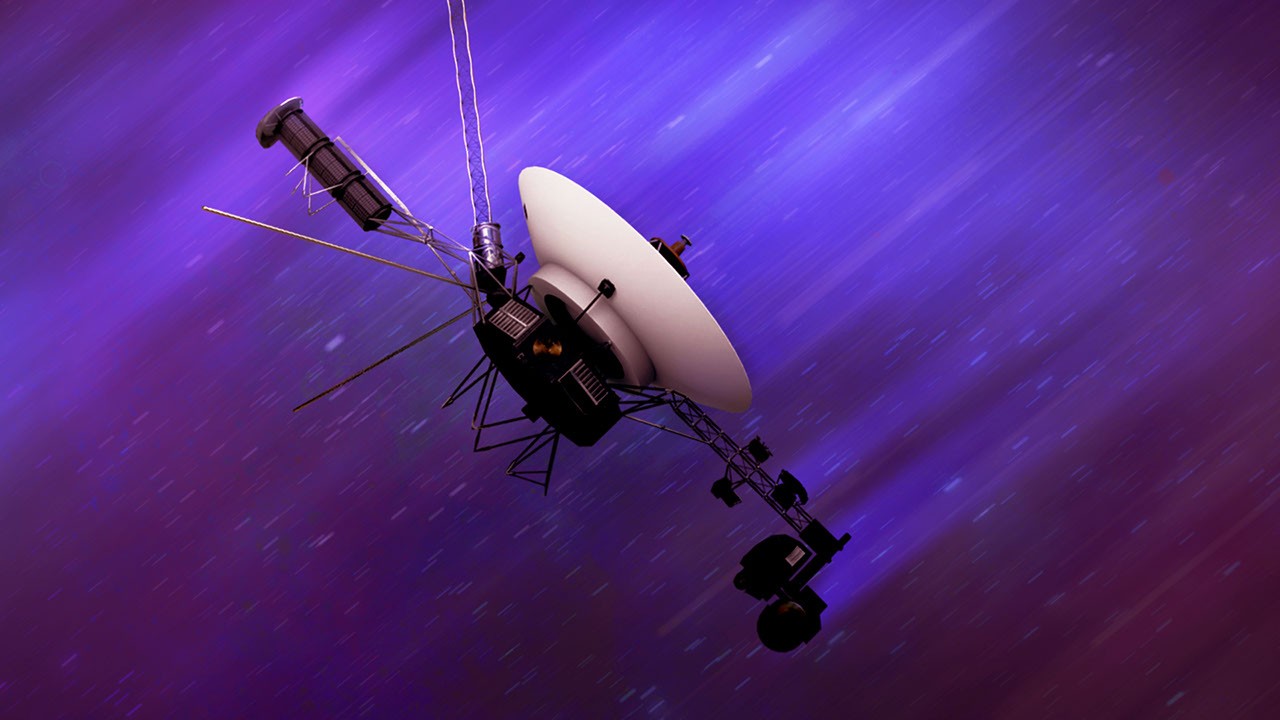
Launched in 1977, NASA’s Voyager 1 and Voyager 2 spacecraft used a rare alignment of Jupiter, Saturn, Uranus and Neptune to tour the outer solar system. After visiting the giant planets and several of their moons, the probes continued on separate trajectories, carrying the Golden Record and sending back landmark views of our planetary neighborhood. Voyager 1 is expected to cross the one-light-day mark on November 18, 2026, nearly 49 years after launch.
Voyager’s grand tour
NASA launched the twin spacecraft during a once-in-175-year alignment of the solar system’s four largest planets: Jupiter, Saturn, Uranus and Neptune. Through six gravity assists between them, the probes were able to observe the gas and ice giants, along with several of their moons, up close. The mission is often called the grand tour.
By the 1980s, the spacecraft had gone their separate ways at Saturn. Voyager 2 continued toward Uranus and Neptune, while Voyager 1 captured another portrait of our solar system—excluding Mercury and Mars—including the final images of the pale blue dot we call home.
“Hello from the children of Earth.”
Messages from Earth
A fun road trip requires music to match. Each spacecraft carries a Golden Record, a 12-inch gramophone record containing audio greetings in 55 languages, 27 music tracks, 116 images and other sounds from Earth.
Each record is protected by an outer cover etched with the Sun’s position relative to 14 pulsars, along with instructions for playing the record. The design uses several metals to protect the encoded information from cosmic radiation. The record is made with copper and gold plating, while aluminum is used for the cover. The cover was electroplated with an ultrapure sample of the isotope uranium-238, which has a half-life of 4.468 billion years.
Measuring Voyager’s distance
Light-minutes are a measure of distance, not time. In August 2012 and November 2018, Voyager 1 and Voyager 2 passed through the solar interface, the boundary where the Sun’s solar wind meets the interstellar medium.
NASA’s Deep Space Network communicates with both spacecraft and tracks their journeys. As of this writing, Canberra’s antenna has tracked Voyager 1 at a distance of 25.8 billion kilometers, or just over 16 billion miles.
On November 18, 2026, 49 years after its launch, Voyager 1 will pass the one-light-day mark, reaching a distance of 16.1 billion miles from the Sun. The term light-years is familiar from science-fiction films and television programs, as well as discussions of stars and other celestial bodies beyond our solar system. Light-based measurements can help illustrate the differences in scale between the inner solar system, the outer solar system and the space beyond. Each Voyager spacecraft can also be tracked through NASA’s mission resources.
Learn more about gravity assists
To better understand how a gravity assist works, try this gravity-assist activity. The activity explains the technique and demonstrates what it is like to measure “light-minutes.” A related activity guide offers a way to measure time with children.
Source: science.nasa.gov