


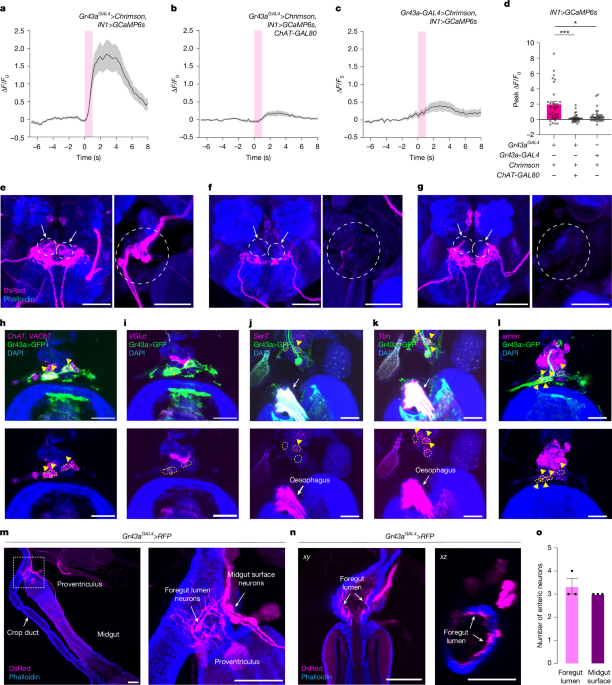
The supplied source is a bibliography of 63 studies examining how Drosophila melanogaster detects food, processes taste and texture, regulates feeding, and connects those signals to the brain and gut. The references span work on sugar and bitter receptors, mechanosensation, neural circuits, neurotransmitters, whole-brain connectomics and computational models, while also citing broader research on gut–brain communication in other animals.
What the research covers
Food sensing and feeding control
Several studies describe how flies combine external taste signals with internal information about hunger, nutrient status and reproduction. This work includes neural circuits that regulate ingestion, brain nutrient sensors, enteric neurons that influence food intake and mechanisms that connect gut distension or nutrient load to feeding behavior.
Taste, texture and nutrient detection
The bibliography covers the molecular basis of sweet, bitter, fructose, trehalose and water detection in Drosophila. It also includes research on food texture, mechanosensitive neurons and the role of the Piezo channel in sensing stomach stretch. More recent work examines the structural basis of sugar perception by fly gustatory receptors.
Brain-wide wiring and neural tools
The cited studies also document the tools used to map and manipulate the fly nervous system. These include genetically targeted neural control, fluorescent activity indicators, transsynaptic mapping, multiplex gene-expression imaging and the FlyWire whole-brain connectome. Research published in 2024 describes the neuronal wiring diagram, whole-brain cell typing, network statistics and a computational model of sensorimotor processing in the adult fly brain.
References
- Yapici, N., Cohn, R., Schusterreiter, C., Ruta, V. & Vosshall, L. B. “A taste circuit that regulates ingestion by integrating food and hunger signals.” Cell 165, 715–729 (2016). Article · PubMed · PubMed Central
- Prescott, S. L. & Liberles, S. D. “Internal senses of the vagus nerve.” Neuron 110, 579–599 (2022). Article · PubMed · PubMed Central
- Yu, C. D., Xu, Q. J. & Chang, R. B. “Vagal sensory neurons and gut–brain signaling.” Curr. Opin. Neurobiol. 62, 133–140 (2020). Article · PubMed · PubMed Central
- Miguel-Aliaga, I., Jasper, H. & Lemaitre, B. “Anatomy and physiology of the digestive tract of Drosophila melanogaster.” Genetics 210, 357–396 (2018). Article · PubMed · PubMed Central
- Min, S. et al. “Control of feeding by piezo-mediated gut mechanosensation in Drosophila.” eLife 10, e63049 (2021). Article · PubMed · PubMed Central
- Wang, P., Jia, Y., Liu, T., Jan, Y. N. & Zhang, W. “Visceral mechano-sensing neurons control Drosophila feeding by using piezo as a sensor.” Neuron 108, 640–650 (2020). Article · PubMed · PubMed Central
- Oh, Y. et al. “Periphery signals generated by piezo-mediated stomach stretch and neuromedin-mediated glucose load regulate the Drosophila brain nutrient sensor.” Neuron 109, 1979–1995 (2021). Article · PubMed · PubMed Central
- Hadjieconomou, D. et al. “Enteric neurons increase maternal food intake during reproduction.” Nature 587, 455–459 (2020). Article · PubMed · PubMed Central
- Kaelberer, M. M. et al. “A gut–brain neural circuit for nutrient sensory transduction.” Science 361, eaat5236 (2018). Article · PubMed · PubMed Central
- Borgmann, D. et al. “Gut–brain communication by distinct sensory neurons differently controls feeding and glucose metabolism.” Cell Metab 33, 1466–1482 (2021). Article · PubMed · PubMed Central
- Li, M. et al. “Gut–brain circuits for fat preference.” Nature 610, 722–730 (2022). Article · PubMed · PubMed Central
- Tan, H. E. et al. “The gut–brain axis mediates sugar preference.” Nature 580, 511–516 (2020). Article · PubMed · PubMed Central
- Stoffolano, J. G. & Haselton, A. T. “The adult dipteran crop: a unique and overlooked organ.” Annu. Rev. Entomol. 58, 205–225 (2013). Article · PubMed
- Cognigni, P., Bailey, A. P. & Miguel-Aliaga, I. “Enteric neurons and systemic signals couple nutritional and reproductive status with intestinal homeostasis.” Cell Metabol. 13, 92–104 (2011). Article · Google Scholar
- Hoopfer, E. D., Jung, Y., Inagaki, H. K., Rubin, G. M. & Anderson, D. J. “P1 interneurons promote a persistent internal state that enhances inter-male aggression in Drosophila.” eLife 4, e11346 (2015). Article · PubMed · PubMed Central
- Strother, J. A. et al. “The emergence of directional selectivity in the visual motion pathway of Drosophila.” Neuron 94, 168–182 (2017). Article · PubMed
- Klapoetke, N. C. et al. “Independent optical excitation of distinct neural populations.” Nat. Methods 11, 338–346 (2014). Article · PubMed · PubMed Central
- Chen, T. W. et al. “Ultrasensitive fluorescent proteins for imaging neuronal activity.” Nature 499, 295–300 (2013). Article · PubMed
- Miyamoto, T. & Amrein, H. “Diverse roles for the Drosophila fructose sensor Gr43a.” Fly 8, 19–25 (2014). Article · PubMed
- Uchizono, S. et al. “Deciphering the genes for taste receptors for fructose in Drosophila.” Mol. Cells 40, 731–736 (2017). Article · PubMed · PubMed Central
- Fujii, S. et al. “Drosophila sugar receptors in sweet taste perception, olfaction, and internal nutrient sensing.” Curr. Biol. 25, 621–627 (2015). Article · PubMed · PubMed Central
- Slone, J., Daniels, J. & Amrein, H. “Sugar receptors in Drosophila.” Curr. Biol. 17, 1809–1816 (2007). Article · PubMed · PubMed Central
- Jiao, Y., Moon, S. J., Wang, X., Ren, Q. & Montell, C. “Gr64f is required in combination with other gustatory receptors for sugar detection in Drosophila.” Curr. Biol. 18, 1797–1801 (2008). Article · PubMed · PubMed Central
- Wang, Z., Singhvi, A., Kong, P. & Scott, K. “Taste representations in the Drosophila brain.” Cell 117, 981–991 (2004). Article · PubMed
- Zhang, Y. V., Aikin, T. J., Li, Z. & Montell, C. “The basis of food texture sensation in Drosophila.” Neuron 91, 863–877 (2016). Article · PubMed · PubMed Central
- Wu, S. F., Ja, Y. L., Zhang, Y. J. & Yang, C. H. “Sweet neurons inhibit texture discrimination by signaling TMC-expressing mechanosensitive neurons in Drosophila.” eLife 8, e46165 (2019). Article · PubMed · PubMed Central
- Weiss, L. A., Dahanukar, A., Kwon, J. Y., Banerjee, D. & Carlson, J. R. “The molecular and cellular basis of bitter taste in Drosophila.” Neuron 69, 258–272 (2011). Article · PubMed · PubMed Central
- Cameron, P., Hiroi, M., Ngai, J. & Scott, K. “The molecular basis for water taste in Drosophila.” Nature 465, 91–95 (2010). Article · PubMed · PubMed Central
- Chyb, S., Dahanukar, A., Wickens, A. & Carlson, J. R. “Drosophila Gr5a encodes a taste receptor tuned to trehalose.” Proc. Natl Acad. Sci. USA 100, 14526–14530 (2003). Article · PubMed · PubMed Central
- Dahanukar, A., Lei, Y. T., Kwon, J. Y. & Carlson, J. R. “Two Gr genes underlie sugar reception in Drosophila.” Neuron 56, 503–516 (2007). Article · PubMed · PubMed Central
- Chen, Y. D. & Dahanukar, A. “Molecular and cellular organization of taste neurons in adult Drosophila pharynx.” Cell Rep 21, 2978–2991 (2017). Article · PubMed · PubMed Central
- Miyamoto, T., Slone, J., Song, X. & Amrein, H. “A fructose receptor functions as a nutrient sensor in the Drosophila brain.” Cell 151, 1113–1125 (2012). Article · PubMed · PubMed Central
- Kitamoto, T. “Conditional disruption of synaptic transmission induces male–male courtship behavior in Drosophila.” Proc. Natl Acad. Sci. USA 99, 13232–13237 (2002). Article · PubMed
- Kwon, J. Y., Dahanukar, A., Weiss, L. A. & Carlson, J. R. “Molecular and cellular organization of the taste system in the Drosophila larva.” J. Neurosci. 31, 15300–15309 (2011). Article · PubMed · PubMed Central
- Wang, Y. et al. “EASI-FISH for thick tissue defines lateral hypothalamus spatio-molecular organization.” Cell 184, 6361–6377 (2021). Article · PubMed
- Close, K., He, Y., Jeter, J., Ihrke, G. & Eddison, M. “Multiplex detection of gene expression in the intact Drosophila brain using expansion-assisted iterative fluorescence in situ hybridization.” J. Vis. Exp. 219, e67656 (2025). Google Scholar
- Kitamoto, T., Wang, W. & Salvaterra, P. M. “Structure and organization of the Drosophila cholinergic locus.” J. Biol. Chem. 273, 2706–2713 (1998). Article · PubMed
- Siekhaus, D. E. & Fuller, R. S. “A role for amontillado, the Drosophila homolog of the neuropeptide precursor processing protease PC2, in triggering hatching behavior.” J. Neurosci. 19, 6942–6954 (1999). Article · PubMed
- Daniels, R. W. et al. “Increased expression of the Drosophila vesicular glutamate transporter leads to excess glutamate release and a compensatory decrease in quantal content.” J. Neurosci. 24, 10466–10474 (2004). Article · PubMed
- Ma, D. et al. “Structural basis for sugar perception by Drosophila gustatory receptors.” Science 383, eadj2609 (2024). Article · PubMed
- Luan, H., Peabody, N. C., Vinson, C. R. & White, B. H. “Refined spatial manipulation of neuronal function by combinatorial restriction of transgene expression.” Neuron 52, 425–436 (2006). Article · PubMed
- Pfeiffer, B. D. et al. “Refinement of tools for targeted gene expression in Drosophila.” Genetics 186, 735–755 (2010). Article · PubMed
- Dorkenwald, S. et al. “FlyWire: online community for whole-brain connectomics.” Nat. Methods 19, 119–128 (2022). Article · PubMed
- Buhmann, J. et al. “Automatic detection of synaptic partners in a whole-brain Drosophila electron microscopy data set.” Nat. Methods 18, 771–774 (2021). Article · PubMed
- Dorkenwald, S. et al. “Neuronal wiring diagram of an adult brain.” Nature 634, 124–138 (2024). Article · PubMed
- Schlegel, P. et al. “Whole-brain annotation and multi-connectome cell typing of Drosophila.” Nature 634, 139–152 (2024). Article · PubMed
- Zheng, Z. et al. “A complete electron microscopy volume of the brain of adult Drosophila melanogaster.” Cell 174, 730–743 (2018). Article · PubMed
- Shiu, P. K., Sterne, G. R., Engert, S., Dickson, B. J. & Scott, K. “Taste quality and hunger interactions in a feeding sensorimotor circuit.” eLife 11, e79887 (2022). Article · PubMed
- Engert, S., Sterne, G. R., Bock, D. D. & Scott, K. “Drosophila gustatory projections are segregated by taste modality and connectivity.” eLife 11, e78110 (2022). Article · PubMed
- Lin, A. et al. “Network statistics of the whole-brain connectome of Drosophila.” Nature 634, 153–165 (2024). Article · PubMed
- Shiu, P. K. et al. “A Drosophila computational brain model reveals sensorimotor processing.” Nature 634, 210–219 (2024). Article · PubMed
- Manzo, A., Silies, M., Gohl, D. M. & Scott, K. “Motor neurons controlling fluid ingestion in Drosophila.” Proc. Natl Acad. Sci. USA 109, 6307–6312 (2012). Article · PubMed
- Friend, W. “Diet destination in Culiseta inornata (Williston): effect of feeding conditions on the response to ATP and sucrose.” Ann. Entomol. Soc. Am. 74, 151–154 (1981). Article
- Trembley, H. L. “The distribution of certain liquids in the esophageal diverticula and stomach of mosquitoes.” Am. J. Trop. Med. Hyg. 1, 693–710 (1952). Article · PubMed
- Sweeney, S. T., Broadie, K., Keane, J., Niemann, H. & O’Kane, C. J. “Targeted expression of tetanus toxin light chain in Drosophila specifically eliminates synaptic transmission and causes behavioral defects.” Neuron 14, 341–351 (1995). Article · PubMed
- Eckstein, N. et al. “Neurotransmitter classification from electron microscopy images at synaptic sites in Drosophila melanogaster.” Cell 187, 2574–2594 (2024). Article · PubMed
- Sterne, G. R., Otsuna, H., Dickson, B. J. & Scott, K. “Classification and genetic targeting of cell types in the primary taste and premotor center of the adult Drosophila brain.” eLife 10, e71679 (2021). Article · PubMed
- Talay, M. et al. “Transsynaptic mapping of second-order taste neurons in flies by trans-tango.” Neuron 96, 783–795 (2017). Article · PubMed
- Pauls, D., Blechschmidt, C., Frantzmann, F., El Jundi, B. & Selcho, M. “A comprehensive anatomical map of the peripheral octopaminergic/tyraminergic system of Drosophila melanogaster.” Sci. Rep. 8, 15314 (2018). Article · PubMed
- Chu, B., Chui, V., Mann, K. & Gordon, M. D. “Presynaptic gain control drives sweet and bitter taste integration in Drosophila.” Curr. Biol. 24, 1978–1984 (2014). Article · PubMed
- Tao, J. et al. “Highly selective brain-to-gut communication via genetically defined vagus neurons.” Neuron 109, 2106–2115 (2021). Article · PubMed
- Tuthill, J. C. & Wilson, R. I. “Parallel transformation of tactile signals in central circuits of Drosophila.” Cell 164, 1046–1059 (2016). Article · PubMed
- Bates, A. S. et al. “The natverse, a versatile toolbox for combining and analysing neuroanatomical data.” eLife 9, e53350 (2020). Article · PubMed
Source: www.nature.com