


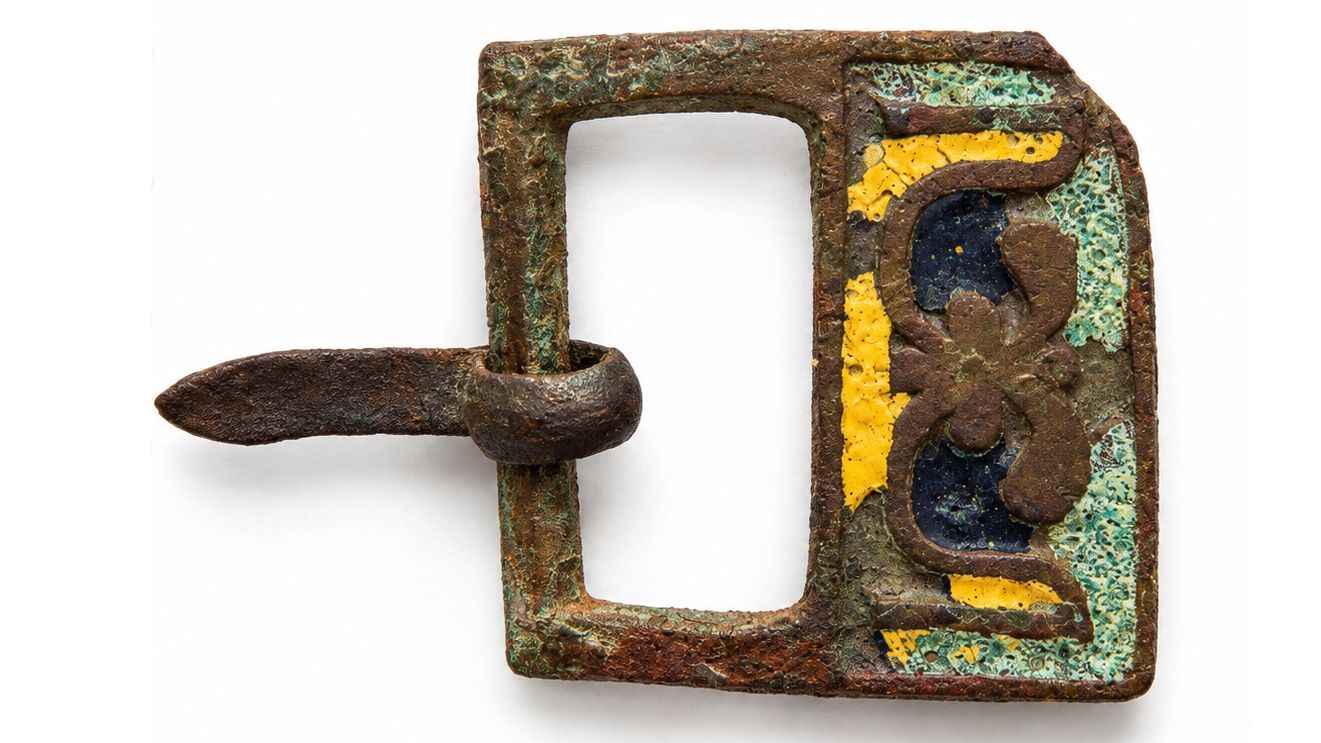
Archaeologists in Ukraine have identified a colorful enamel belt buckle that may have belonged to a nomadic mounted warrior about 1,800 years ago. Found in the Tsetsin Forest in southeastern Ukraine, the artifact may provide evidence of military and cultural contacts between the Roman Empire and communities living on its northern frontier.
A small, vividly decorated buckle
Local residents discovered the buckle in the forest and passed it on to researchers, including Anthony Moisei, a professor at Bukovinian State Medical University. In a statement, Moisei described the object as a roughly square metal buckle measuring about 2.1 centimeters on each side. Its surface is decorated with teal, blue and yellow enamel.
Moisei said the buckle’s decorative style and metal construction suggest that it was made during the second or third century A.D., when the region was part of the ancient Roman province of Dacia.
Roman expansion into Dacia
Under Emperor Trajan, Rome fought the Dacian Wars in 101–102 and 105–106 A.D. against the inhabitants of the Dacian kingdom and their ruler, Decebalus. Roman legions destroyed the kingdom and annexed it as a new province. Trajan commemorated the victory in Rome by completing his famous column, whose carvings depict events from the Dacian Wars.
In addition to the buckle, Moisei collected decorative belt fittings and three small, round metal objects that probably belonged to the same belt. He used the finds to create a reconstruction of how the belt may have looked before it was lost in the forest some 2,000 years ago.
Who wore the belt?
It remains unclear who lost the belt. One of Moisei’s theories is that it belonged to a mounted Sarmatian warrior from the Black Sea region. The Sarmatians were a group of tribes living outside the Roman Empire in areas that now include central Ukraine, southern Russia and the Balkans. Some fought against Roman invasions, while others served Rome as mercenaries.
The statement said the metal belt fragments could reflect Rome’s local craft traditions, or they may have been acquired as trade goods or war trophies. Moisei is still studying the artifacts to determine whether they are specifically Sarmatian. Regardless of their origin, the military-style belt offers further evidence of Roman contacts on the empire’s outskirts. Future research could help experts understand how Romans interacted with local Dacian communities during the wars.
Source: www.livescience.com