


Indonesia’s most severe fire and haze season in 30 years has devastated forests in Kalimantan, including habitat for endangered Bornean orangutans. Erin Vogel, a primatologist at Rutgers University in New Brunswick, New Jersey, says the smoke made the forest dangerously unhealthy, displaced orangutans and left some animals lethargic and sick, while researchers and fire crews worked for months to contain the flames.
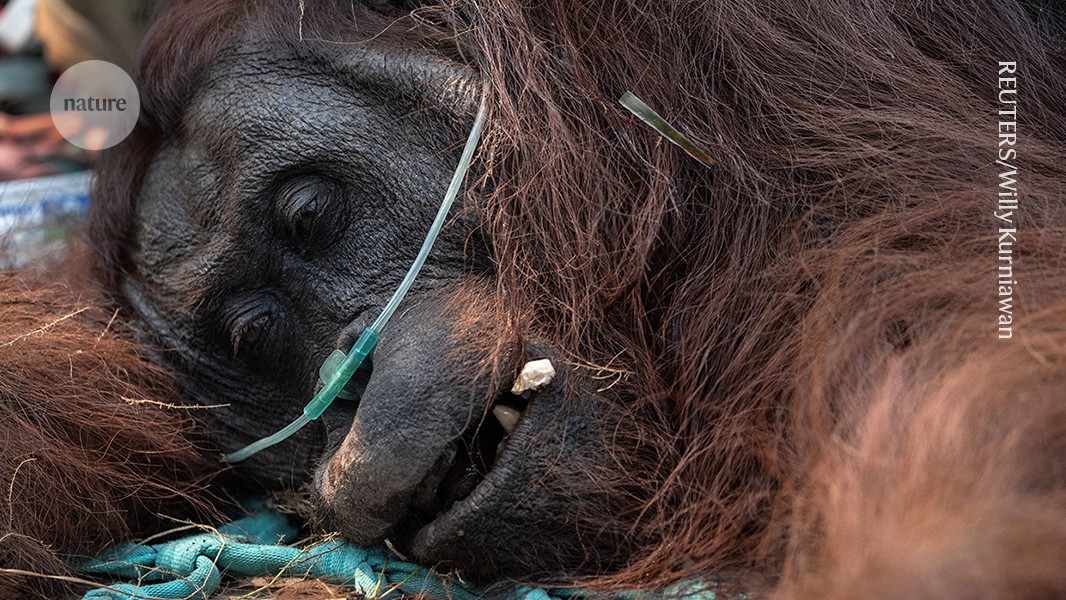
An emergency oxygen supply is provided to an orangutan suffering from smoke inhalation.Credit: REUTERS/Willy Kurniawan
For much of October, wildfires turned the sky reddish orange, giving parts of Indonesia a dystopian appearance.
“It felt like we were on Mars,” says Vogel.
At the time, Vogel was visiting the Tuanan Orangutan Research Base in Central Kalimantan, Indonesia. She and her colleagues study the endangered Bornean orangutan (Pongo pygmaeus). Vogel has spent more than 20 years working in the region, but during this visit she devoted much of her time to fighting fires.
About 300,000 fires broke out in the region between July and October. In October, levels of toxic particulate matter in the air were about 400 times higher than the levels considered safe by the World Health Organization.
Indonesia is experiencing its most severe fire and haze season in 30 years. The conditions are partly linked to a Super El Niño, which brought winds that dried out vegetation and provided more fuel for the flames. More than 2.8 million hectares have burned across Indonesia so far, with Kalimantan the hardest-hit island.
The fires have consumed 60% of Kalimantan’s Bornean orangutan habitat, including healthy forests such as those around the Tuanan Research Base and Gunung Palung National Park. At the time of the interview, fires were still smoldering in the Tuanan peat-swamp forest.
What was the Tuanan research base like at the height of the fires?
“It was depressing and scary. In the 23 years I have worked in Indonesia, I have never seen so much forest loss. The orange-brown haze in the sky was so thick it could burn your lungs if you weren’t wearing a respirator.”
When the team arrived at Tuanan, the forest was startlingly quiet. “I couldn’t hear any birds. I couldn’t hear any insects. There was nothing to be heard except the sound of trees burning and falling.”
Forest staff, orangutan researchers, phenology staff and the fire brigade all helped to extinguish the fires. Vogel says she was inspired by the volunteers who worked day and night for more than two months.
“It takes real strength to make it happen and not give up, but our team is very positive and hopeful.”
How did the fires affect orangutans?
The researchers saw some orangutans that appeared lethargic and sick. One male they had been studying for more than 15 years was found lying on the ground and breathing heavily.
When Vogel saw him again several days later, however, he appeared to have improved. He was near the research station, eating plants on the ground, climbing trees and eating fruit. “It reassures us that he is doing better,” she says.
The researchers are also seeing orangutans displaced from one area to another. That could create competition for limited resources and alter the animals’ behavior. “It will be interesting to see what happens,” Vogel says.
Source: www.nature.com