


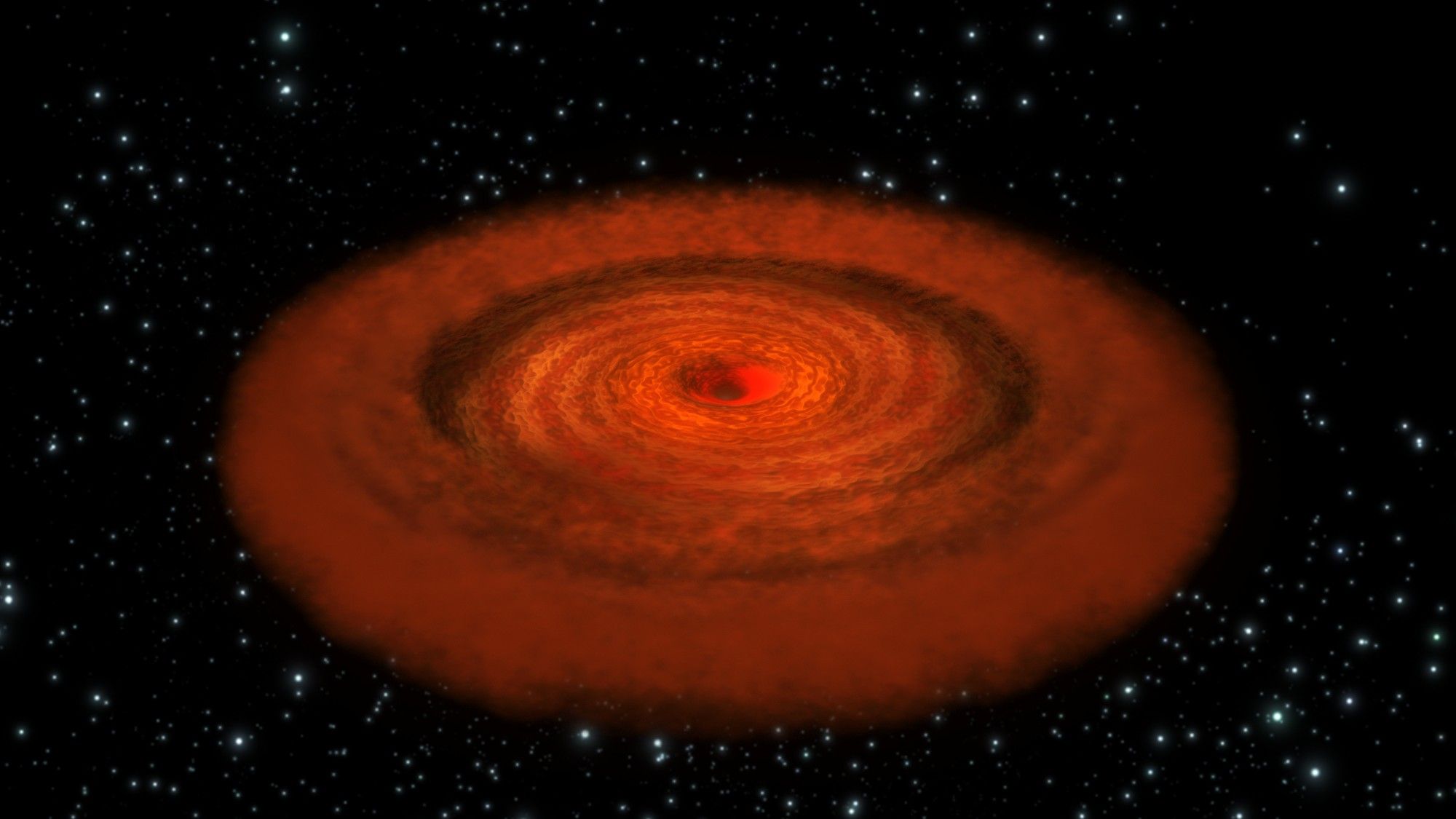
Astronomers using the James Webb Space Telescope (JWST) have identified a compact, unusually red object whose light was emitted when the universe was just 450 million years old. Known as CW-LRD-z10, it could be the most distant example yet of a “little red dot” (LRD)—a mysterious class of early-universe objects that may surround rapidly growing black holes. If confirmed, the object could offer clues to how the first supermassive black holes formed.
“Such an object would be one of the most distantly accreting black holes known,” Roberto Maiorino, a professor of experimental astrophysics at the University of Cambridge who was not involved in the study, told Live Science via email. CW-LRD-z10 could provide further evidence that little red dots represent an early stage in the growth of supermassive black holes, he added.
The study was published Nov. 24 in Astrophysics Journal Letters.
A spectroscopically confirmed candidate
Little red dots are compact, very red objects observed in the early universe. Their light is shifted toward longer, redder wavelengths as it travels across the expanding universe, a phenomenon known as redshift.
JWST’s near-infrared camera has detected objects at redshifts of about 9, corresponding to a lookback time of roughly 13.1 billion years. In 2025, the team behind the new study used JWST’s Mid-Infrared Instrument (MIRI) to search for even more distant sources.
CW-LRD-z10 was the only candidate identified in that search, according to lead author Takumi Tanaka, a doctoral student at the University of Tokyo.
The researchers measured the object’s redshift at 10.36, indicating that its light was emitted when the universe was only about 450 million years old. They identified a sudden drop in the object’s light and interpreted it as a “Lyman-alpha break,” a feature that can help determine how far away an object is.
Maiorino said the redshift measurement appears reliable. “The break looks relatively convincing, so we can say that the redshift determination is fairly robust,” he said.
The object’s color provides the strongest evidence that it could be a little red dot. CW-LRD-z10 is much redder in the mid-infrared than in the near-infrared. Its spectrum also contains a V-shaped dip typical of little red dots, possible iron emission and a tentatively detected emission line whose proportions resemble those seen in other little red dots and active black holes.
None of these features is conclusive on its own, Tanaka said, but together they support the little red dot interpretation.
However, the spectrum does not show the broad hydrogen emission line that would provide stronger evidence for an LRD. The wavelengths where that line would appear were outside the range covered by the new observations.
“At this stage, this should only be considered as an LRD candidate,” Maiorino said. Tanaka agreed that CW-LRD-z10 should continue to be described as a highly promising candidate rather than a confirmed little red dot.
What else could CW-LRD-z10 be?
One alternative is that the object’s spectrum contains a Balmer break, a sharp drop in light produced by older stars. Under that interpretation, the object would be a much closer galaxy at a redshift of about 3, or roughly 11.4 billion light-years away.
Tanaka said the available data do not support that explanation. The colors would be difficult to produce in a galaxy of that type, and the emission lines expected at that distance were not detected.
“The characteristics of the observed break are too strong to be explained by a normal Balmer break from a typical stellar population,” he said.
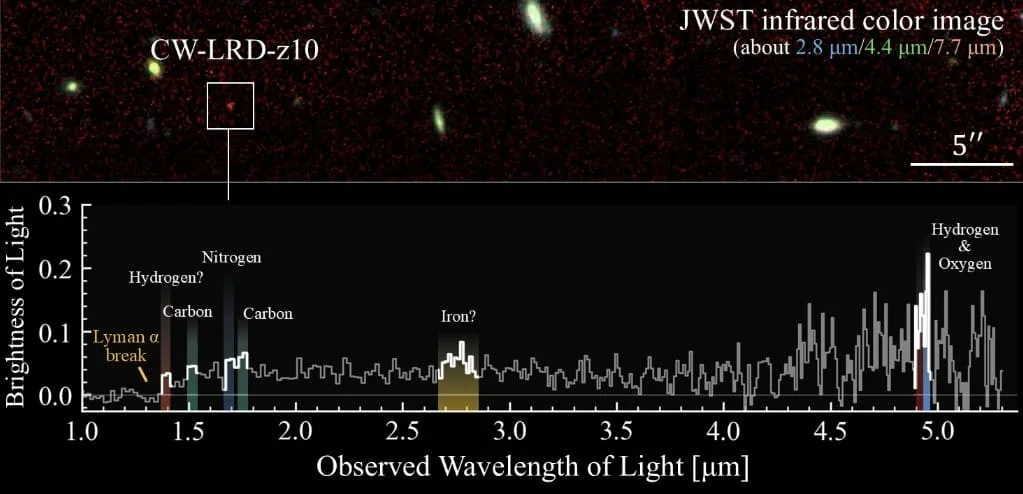
A normal star-forming galaxy at a redshift of 10.36 could, in principle, also produce an extremely red color. However, it would require unusually strong characteristic spectral lines. Those lines fall outside the current spectrum, so future observations will be needed to test this possibility.
CW-LRD-z10’s light also appears to contain iron emission. Such emission is thought to come from gas close to actively feeding black holes, including quasars, rather than from ordinary star-forming galaxies.
“If confirmed, this would support the existence of actively accreting black holes and suggest that gas containing heavy elements was already present in the black hole’s potential environment,” Tanaka said.
Possible seeds of supermassive black holes
The nature of little red dots remains under debate. One leading theory is that they contain rapidly growing black holes surrounded by dense gas. Other proposed explanations include growing black holes, a supermassive star, a black hole star or a dense star cluster.
Tanaka stressed that CW-LRD-z10 cannot yet provide firm conclusions about how supermassive black holes first formed. The true nature of little red dots, and their role in black hole evolution, remains uncertain.
If CW-LRD-z10 does host an accreting black hole, its properties could help distinguish among different black-hole seeding scenarios, Maiorino said.
JWST’s mid-infrared instrument is scheduled to observe the object’s spectrum in 2027. Those observations are designed to detect hydrogen and oxygen emission lines as well as the underlying continuum. The data should help researchers determine whether the object’s red appearance reflects its true color or is instead caused by strong emission lines.
“I’m really looking forward to seeing the data,” Tanaka said.
Source: www.livescience.com