


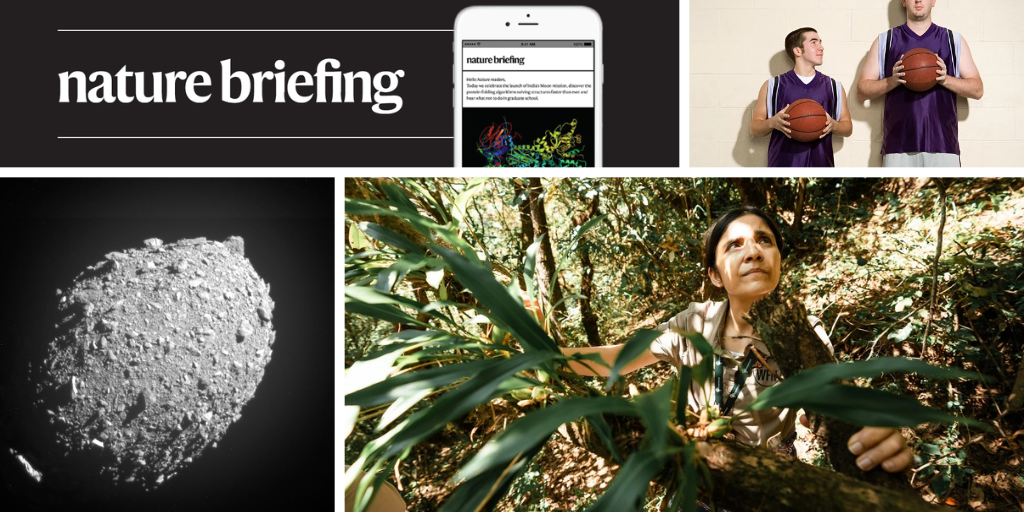
An analysis of protein-coding DNA from more than 1.4 million people has identified hundreds of genes associated with human height, including rare variants linked to changes of up to 17 centimeters. The briefing also examines the global rise in dengue cases, the concentration of major economics prizes among eight US universities, new images from the European Space Agency’s Hera asteroid mission, competing claims about an artificial-intelligence-generated proof of the Riemann Hypothesis, and conservation efforts to protect Nepal’s orchids.
Credit: XinXinXing/Getty
Researchers identified 207 genes associated with an average height difference of 2 centimeters. They also found 17 rare variants with more pronounced effects that interfere with the function of the proteins produced by those genes. One variant reduces height by 17 centimeters, while another increases it by 11 centimeters. The findings could help researchers develop treatments for height changes caused by some medical conditions.
Nature | 4 minute read
Reference: Nature paper
Major economics prizes, including the Nobel Prize, are increasingly being awarded to researchers affiliated with American universities. Just eight institutions dominate these leading economics awards: the University of Chicago, the Massachusetts Institute of Technology (MIT), Stanford University, Princeton University, Yale University, the University of California, Berkeley, and Columbia University.
By contrast, awards in the natural sciences, engineering and social sciences other than economics have become less concentrated among particular institutions over the past 70 years.
Nature | 6 minute read
Reference: National Bureau of Economic Research report (not peer reviewed)
Hera examines the results of NASA’s asteroid impact
Four years after NASA’s DART (Double Asteroid Redirection Test) mission successfully struck an asteroid and changed the motion of space rocks, a follow-up mission has confirmed the result with cameras. The European Space Agency has released the first images from the Hera mission, providing a detailed view of the new crater.
New York Times | 7 minute read
“Hera is like Inspector Columbo, who returns to the scene of the crash to investigate what the consequences of the crash will be,” said Patrick Michel, chief scientist of the Hera mission.

This clip shows images from the final five and a half minutes before the DART spacecraft intentionally crashed into the asteroid Dimorphos. The replay is shown at 10 times the actual speed, except for the final six images, which are displayed at the same speed at which they were returned by the spacecraft. (NASA/Johns Hopkins APL)
Where I work

Bashal has observed species such as Coelogyne orchids, which are commonly found in tropical lowland forests and mountainous areas. Credit: CJ Karki/Nature
Wildlife conservationist Resh Bashal works with people in Nepal to protect the country’s more than 500 orchid species. Valued as ornamental plants and for their use in traditional medicine, hundreds of these flowering plants are illegally harvested and sold each year.
A complete ban on the orchid trade is unlikely to be effective, Bashal said, so more innovative strategies are needed. One approach is the Anti-Poaching Task Force, which documents illegal activities, carries out patrols and shares information about the importance of conservation.
Nature | Leisurely scroll
Features and impressions
A biomedical innovation model in which governments use industry scientists as the primary funders could accelerate the development of treatments for common diseases that companies consider too risky to pursue, argue physician Victor Zau, health-policy adviser Emily Shambaugh and health-care entrepreneur Will Elaissi.
The funding could be administered at the national level, or several countries could form a consortium. Such a model “moves beyond the market-determined trajectory of research translation and ensures the public’s role in shaping the future of health,” the authors write.
Nature | 9 minute read
Communal eating, or sitting down and sharing a meal with other people, has numerous health and social benefits. It may help prevent cognitive decline and build trusting relationships, while the presence of others can make meals more enjoyable. In an increasingly digital world, there may appear to be fewer opportunities to eat with other people. However, research suggests that people are more open and receptive to invitations than we think, and that taking the initiative can make arranging a dinner date easier.
Black-and-white photography
The monochrome world takes centre stage in this year’s black-and-white photography awards. The overall winner was photographer Dai Shengwei. His image Vishwa Ijtema depicts a man taking a leap of faith between the fronts of two vehicles. Competition judges described it as “a scene full of energy, tension and detail”.
Let us know which image you think is the winner, along with your feedback about this newsletter, at [email protected].
Thank you for reading,
Jacob Smith, Associate Editor, Nature Briefing
Contributed by Flora Graham
- Nature Briefing: Careers — insights, advice and award-winning journalism to help you optimize your work life.
- Nature Briefing: Microbiology — the most abundant life forms on Earth, microorganisms, and the role they play in health, the environment and our food system.
- Nature Briefing: The Anthropocene — climate change, biodiversity, sustainability and geoengineering.
- Nature Briefing: AI and Robotics — 100% written by humans, of course.
- Nature Briefing: Cancer — a weekly newsletter written with cancer researchers in mind.
- Nature Briefing: Translational research — covering biotechnology, drug discovery and pharmaceuticals.
Source: www.nature.com