


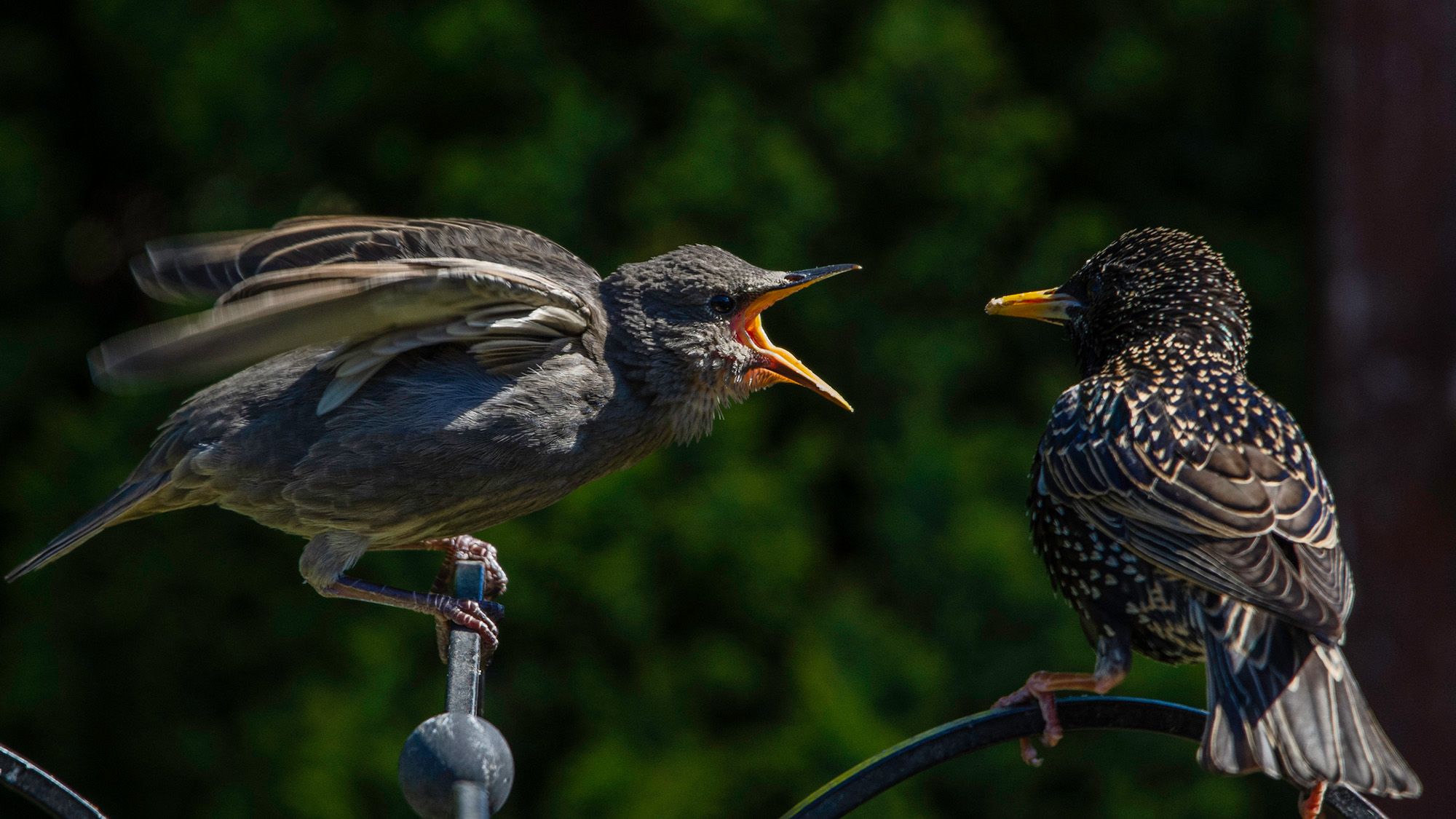
European starlings spread across the United States after roughly 100 birds were released in New York City’s Central Park in the late 19th century. Their population reached about 200 million by 1970 and now stands at approximately 93 million, offering evolutionary biologist Julia M. Gicello an opportunity to investigate how a rapid expansion from a small founding group may have shaped the species’ genetic and physical diversity.
The story appears in an excerpt from Birds on the road: The unnatural history of starlings (Columbia University Press, 2026), by evolutionary biologist Julia M. Gicello. Gicello describes how a box containing a dead starling helped her begin thinking about the remarkable adaptability of one of the world’s most invasive bird species.
From Central Park to the entire country
In the late 19th century, amateur ornithologist Eugene Schiefferin released about 100 European starlings (Sturnus vulgaris) in New York City’s Central Park. Schiefferin was president of the American Acclimation Society, an organization dedicated to introducing European plants and animals to North America.
The experiment had disastrous consequences. Within a few decades, the birds had established themselves in their new habitat and begun spreading across the country. By 1970, their population had reached 200 million birds—less than a century after their introduction.
U.S. wildlife management agencies now cull starling populations each year at airports and farms because the birds can damage crops, interfere with livestock operations and collide with aircraft. They are trapped, gassed or poisoned, and some are killed by dislocating their cervical vertebrae.
In the United States, it is technically not illegal to kill a starling without permission, as is also the case with most other birds. In 2014, Gicello emailed the U.S. Department of Agriculture’s Animal Control division to request starling specimens for a research project.
She later spoke by phone with a wildlife expert who sounded cautious, although professional, as if he did not understand why anyone would want to study the birds. To him, a starling was “literally trash.” Nevertheless, the agency sent her a specimen in a box labeled “Honey Baked Ham.”
Approximately 2 million starlings are killed by the Department of Agriculture each year in the United States. Gicello now had five of them.
Why variation matters to evolution
Small differences between individuals of the same species are known as intraspecific diversity. These differences can result from different developmental or evolutionary mechanisms. For example, age-related changes produce anatomical differences between older and younger individuals, while hormones activate many differences between the sexes.
Other differences are not explained by age or sex, and they can reveal important information about evolution. In fact, this is where evolution begins: at the level of variation within a species, or microevolution.
Variation is shaped by the continual interaction of mutations, natural selection, founder effects, migration and genetic drift. These forces operate at different speeds and intensities, sometimes working together and sometimes in opposition.
Determining the relative influence of each force on the genetic and physical variation observed within a species is one of evolutionary biology’s oldest and most fundamental questions. Some evolutionary processes create differences between individuals, while others make those differences less pronounced.
Mutations are one source of new variation. Although they often receive negative attention, mutations can create new versions of genes that may be beneficial in particular environments. Several new mutations arise every time an offspring is born. Most are neutral, while some are favorable and others are unfavorable. In this sense, mutations make each individual slightly different from both parents.
Founder effects occur when a new population is established by a small number of individuals from a larger original population. They often reduce the genetic diversity of the new population. As diversity declines, a particular version of a gene, or allele, can become common very quickly.
However, an allele can become common through genetic drift even when it offers no advantage. It may simply be the only version represented in a small population. This statistical sampling process is strongest when populations are small.
The influence of founder effects on genetic variation is relatively well understood. Their effects on physical traits, however, are more difficult to explain. A single physical, or phenotypic, trait such as wing length is controlled by many genes at once.
In the 1860s, Austrian monk Gregor Mendel conducted pioneering experiments with pea plants and discovered that a single gene could control a trait such as flower color or pea texture. Scientists now know that this simple one-gene model does not describe how most complex physical traits are genetically programmed.
This complexity heightened Gicello’s interest in how starling phenotypes might have changed over time as a result of founder effects. Patterns of change—or the absence of change—can provide evolutionary clues and indicate that something happened in the past. Identifying exactly what happened is one of the central challenges of studying a historical science such as evolutionary biology.
What five dead starlings could reveal
Historical records show that the U.S. starling population began with about 100 birds and expanded rapidly to its current population of 93 million. Gicello’s central question was whether starlings had unusually limited genetic and phenotypic diversity because of this dramatic population history, which was created by human intervention.
At a casual glance, the birds in a flock appear extremely similar—“like shiny little soldiers,” sometimes pecking at grass and sometimes moving forward in unison. But visual impressions are not enough to answer a scientific question. Gicello and her colleagues needed to measure the birds’ differences and similarities.
That approach—using the entire living species to look back into its history—was why Gicello was excited about her five specimens. She could dissect them, collect tissue for DNA extraction and preserve them as research specimens for the future. The project, she wrote, was “an evolution inside a garbage bag.”
This article has been republished from Bird on the Street: The Unnatural History of Starlings, by Julia M. Zichello. Copyright © 2026 Columbia University Press. Used by arrangement with the publisher. Unauthorized reproduction is prohibited.
About the book
Bird on the Street: The Unnatural History of Starlings, published by Columbia University Press, combines natural history with scientific memoir. The book follows starlings from streets and skies into museums and laboratories, exploring the mechanisms of evolution and the relationship between humans and wildlife. Julia M. Zichello describes the small discoveries, frequent setbacks, uncertainty and wonder involved in the daily practice of science.
Source: www.livescience.com