



A critical Linux kernel vulnerability in the Network File System (NFS) server, tracked as CVE-2026-99362 and named NFS2ROOT, could allow an unauthenticated remote attacker to gain root privileges on exposed systems. The flaw affects the kernel’s nfsd component and can be exploited remotely when NFS is running and TCP port 2049 is reachable.
Linux NFS vulnerability enables remote root access
NFS2ROOT was discovered by Jérémy Jean of France’s National Agency for Information Systems Security (ANSSI), with a correction submitted in August. The vulnerability was named by cybersecurity firm OpenSec, which shared a complete remote-root exploit and a patch with NFSD maintainers in late September.
The flaw has existed since Linux kernel 3.16, released in March 2014. It is caused by a heap buffer overflow in the Linux NFS server, known as nfsd.
NFS2ROOT affects systems running Linux kernels older than 6.12.117, 6.18.61, 7.3.2, or 7.4-rc1 when NFSv4.1 or NFSv4.2 is loaded and running and TCP port 2049 is accessible over the internet.
A successful attack could enable a remote, unprivileged attacker to corrupt kernel memory and obtain root access to an exposed Linux server. The attack is described as low complexity and does not require user interaction.
How the NFS2ROOT attack works
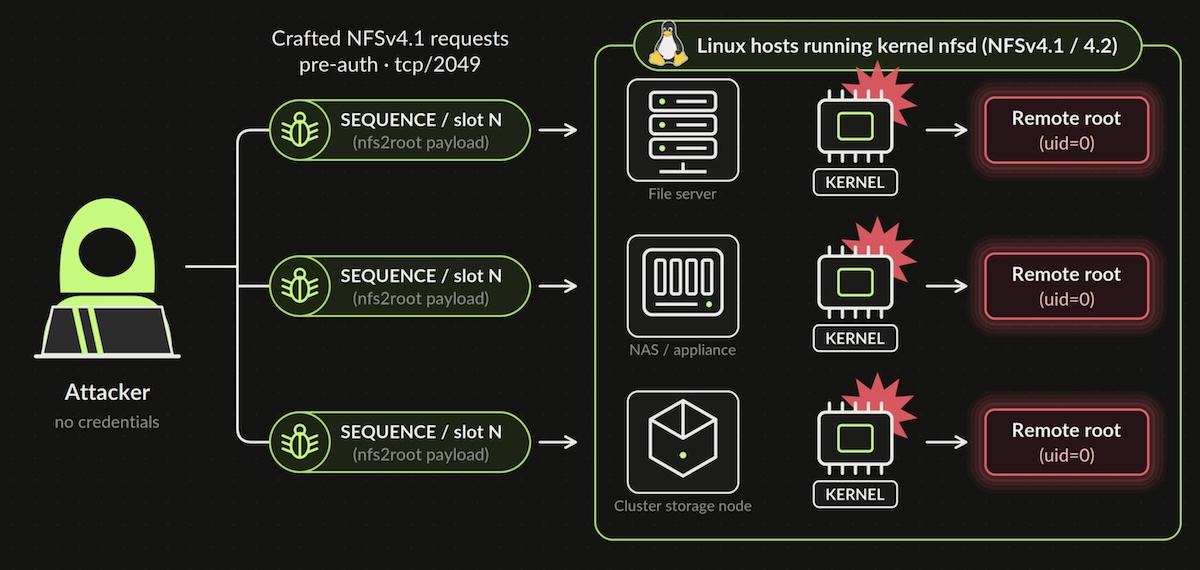
An attacker can exploit the vulnerability by sending a specially crafted request that writes data beyond the NFS server’s allocated memory buffer. This can be used to place callbacks that read kernel memory, bypass Kernel Address Space Layout Randomization (KASLR), and execute commands in freed memory.
When the attacker closes the NFS connection, the kernel executes an embedded command with root privileges, potentially giving the attacker complete control of the unpatched server.
Linux administrators urged to patch exposed systems
There are no reports that CVE-2026-99362 has been exploited in the wild. However, security teams should immediately install the latest kernel security updates from their Linux distribution vendors and reboot affected systems to ensure that the patched kernel is running.
If an update cannot be installed immediately, administrators should restrict access to the NFS server on TCP port 2049 to trusted clients or networks. Systems that do not require NFS shares can also have the nfs-server service stopped and disabled in /etc/nfs.conf.
“Port 2049 is left open on file servers, NAS appliances, build farms, and Kubernetes storage nodes. Since 2014, the Linux kernel listening on port 2049 has allowed anyone with access to port 2049 to write to kernel memory before logging in,” OpenSec said. “Hardening the kernel will not resolve the overflow. Please patch all hosts.”
Potential signs of exploitation
OpenSec said the NFS2ROOT attack does not produce network signatures. Security teams have nevertheless identified several potential indicators, including kernel warnings from nfsd4_check_resp_size, shells spawned by kernel workers on file servers, brief bursts of NFSv4.1 sessions from a single source, and kernel oopses involving nfsd4_*, svc_*, or call_usermodehelper* frames.
NFS2ROOT is the latest in a series of Linux privilege-escalation vulnerabilities exposed and patched since the beginning of this year. Other flaws in that series include RefluXFS, CIFSwitch, Dirty Frag, Fragnesia, PinTheft, Copy Fail, Pack2TheRoot, and DirtyDecrypt/DirtyCBC.
Source: www.bleepingcomputer.com