


The U.S. Food and Drug Administration has approved a generic version of the HIV drug lenacapavir for use as pre-exposure prophylaxis, bringing twice-yearly injections that are more than 95% effective at preventing infection closer to people in low- and middle-income countries. At the same time, advances in vaccine research—particularly an approach called germline targeting—are raising hopes that an effective HIV vaccine could finally be developed. Both breakthroughs come as cuts to US-funded HIV research, treatment and clinical trials threaten progress against the epidemic.
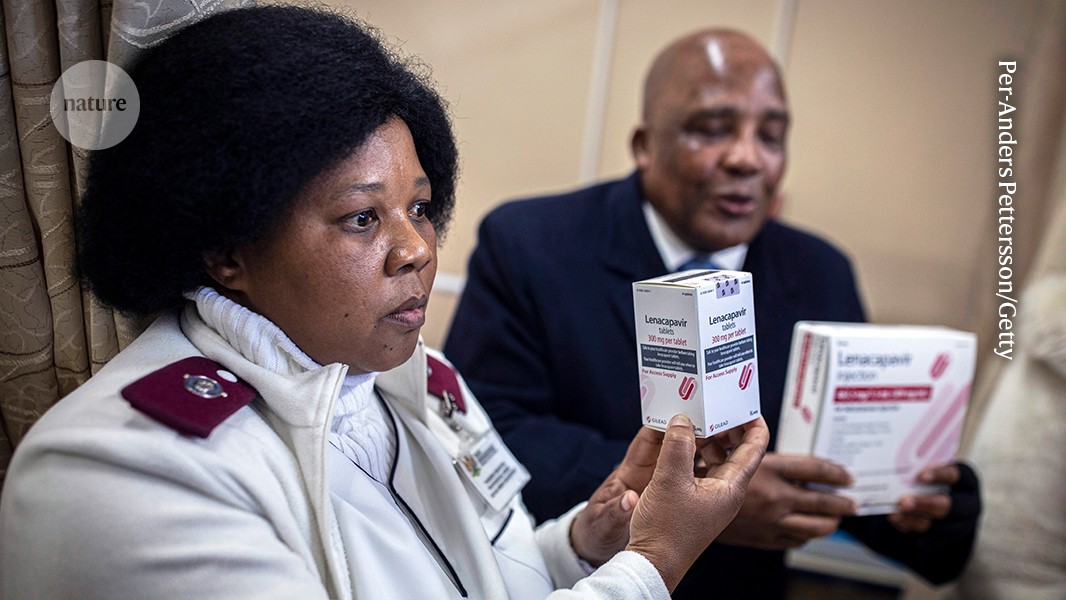
South African health officials attend the launch ceremony for lenacapavir in June. Lenacapavir provides strong protection against HIV when given twice a year. Credit: Per-Anders Pettersson/Getty
Lenacapavir was originally developed by Gilead Sciences in Foster City, California. In 2024, Gilead signed licensing agreements with six drug companies allowing them to manufacture and sell generic versions of the drug in 120 low- and middle-income countries, subject to regulatory approval. The latest FDA decision brings access in those countries one step closer. The planned cost to users is $40 a year, raising hopes that lenacapavir could help curb the global HIV epidemic.
These developments contrast sharply with the state of public funding for HIV research and treatment. The research discussed in Nature‘s news feature was funded by the Preclinical HIV Vaccine Research Program run by the National Institutes of Health (NIH). US authorities ended the programme last year, forcing researchers to scale back their work and seek alternative funding. Any replacement funding is likely to be less stable and predictable than support from the NIH. The cuts should be reversed, or new sources of government funding should be found.
A costly failure
Developing an HIV vaccine has been a long and difficult process, marked by decades of high-profile and costly failures. There is now renewed optimism, however. The latest strategy, known as germline targeting, is designed to stimulate the production of rare, highly potent antibodies that can protect against multiple HIV strains.
The approach has produced promising results in animal models2–4 and in early human tests5. Researchers are more optimistic than they have been in recent years that an effective HIV vaccine could be on the horizon.
In the meantime, antiretroviral drugs such as lenacapavir could have a major effect on HIV prevention. In Africa, new infections could fall by about one-third if the drug were given to just 5% of adults most likely to acquire HIV, and by half if it were given to one-fifth of those adults, according to the Gates Foundation Disease Modeling Institute in Seattle, Washington.
Lenacapavir is unlikely to control the epidemic on its own. It can be difficult to identify the people who most need the drug, and effective prevention requires treatment for most of a person’s life—or at least during periods of sexual activity. Even an annual cost of $40 is unaffordable for people on the lowest incomes.
Unstable access
Until recently, the United States was the leading funder of antiretroviral drugs for people living with HIV in low- and middle-income countries. That support ended when the US government stopped funding in January 2025. Although funding has since recovered to a limited extent, the consequences have been severe. A study published earlier this year found that approximately 1,700 facilities that had previously provided HIV treatment had closed as a result (go.nature.com/4a7ftp4).
This instability underscores the importance of vaccines. “The funding cuts that have taken place over the past few years have further exposed how fragile a system that relies on drug access is,” said Penny Moore, a virologist at South Africa’s National Institute of Infectious Diseases in Johannesburg. Roger Saunders, an HIV vaccine researcher at the Amsterdam University Medical Center, said that this vulnerability is why vaccine research remains a priority: “Vaccines make us independent of access to drugs.”
US cuts not only curtailed the preclinical vaccine programme but also forced the postponement and reduction of HIV vaccine trials in South Africa. They are affecting supporting research as well, including surveillance efforts that track the evolution of HIV in African countries, said Vincent Muturi-Kioi, a Nairobi-based director of HIV vaccine development at the International AIDS Vaccine Initiative in New York City.
The repurposing of lenacapavir as a preventive treatment, together with advances in vaccine development, demonstrates the importance of sustained investment in health research. HIV vaccine research and clinical development must continue to receive support, while lenacapavir is made available as widely as possible.
Translating promising germline-targeted results into an effective HIV vaccine could take more than a decade, and current strategies are likely to face additional obstacles. The world is closer than ever to having both an effective HIV vaccine and drugs that can prevent infection. Now is the time for funders to invest more, not less.
Source: www.nature.com