


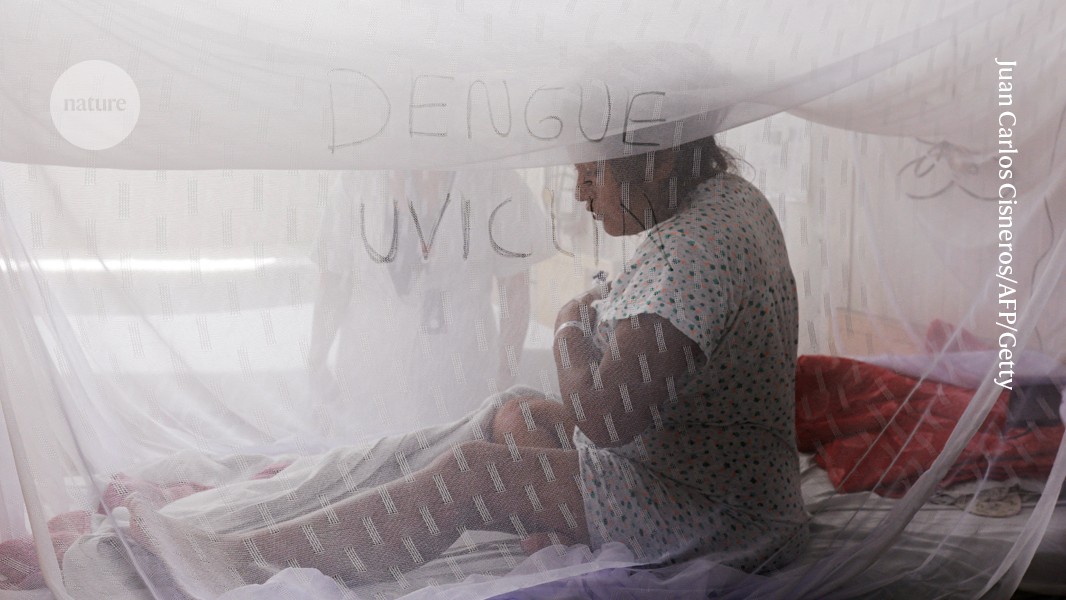
A pregnant woman infected with dengue fever speaks to a nurse in Peru, which has seen a surge in infections this year. Credit: Juan Carlos Cisneros/AFP/Getty
Dengue fever is spreading much faster than previously estimated, according to a new analysis presented at the American Society of Tropical Medicine and Hygiene (ASTMH) annual meeting on November 22. Reported global cases rose from 430,000 in 1990 to 14.7 million in 2024, a 34-fold increase. Researchers also reported strong evidence that releasing mosquitoes carrying Wolbachia bacteria can reduce dengue transmission, although scientists warned that controlling the disease will be complex and expensive.
“We are at an extraordinary and pivotal time” in the history of mosquito-borne disease research, said ASTMH President Albert Coe. The trial results presented at the conference showed that “we can now get rigorous evidence about what works, what doesn’t, and what needs to be done to scale up these effective interventions,” he said. Such work could help protect the 4 billion people worldwide who are exposed to dengue and other mosquito-borne diseases.
Dengue’s spread
Dengue fever can cause fever, headache and severe bone pain. It is transmitted primarily by Aedes aegypti, a mosquito that breeds in warm urban environments. Global warming and increasing urbanization have expanded the mosquitoes’ range, while existing vaccines provide incomplete protection.
Dengue cases are often recorded in separate databases that are difficult to compare, said Ayong Lim, an infectious-disease modeller at the London School of Hygiene and Tropical Medicine who has researched dengue incidence. Some results are also published as preprints1, which are released on Research Square before peer review.
Because no single database contains all reported dengue cases over time, Lim and her team compiled the most complete available record and used statistical modelling to fill gaps in the data.
The sharp increase in reported cases is not surprising, said Eng Ong Oi, a dengue virologist at Duke-NUS Medical School in Singapore who was not involved in the study. Urban populations are continuing to grow around the world, he said, meaning that “more and more people are living at risk of dengue fever every year.”
Good mosquito, bad mosquito
One promising strategy for controlling dengue involves breeding mosquitoes infected with Wolbachia, a bacterium that reduces insects’ ability to transmit viruses. When these mosquitoes are released into the wild, they pass the bacteria to their offspring, ultimately reducing the population of mosquitoes that can efficiently spread dengue.
At the ASTMH meeting, researchers presented results from the first randomized controlled trial in the Americas to examine the effect of Wolbachia on dengue transmission. From January 2021 to May 2022, the team released approximately 32 million Wolbachia-infected mosquitoes in designated areas of Brazil. The researchers monitored about 6,000 children living inside and outside those areas.
The children provided blood samples each year from 2020 to 2024. Children living in Wolbachia-treated communities were 68% less likely to contract dengue than those living in communities without the bacteria.
These positive results are an important milestone in demonstrating the potential of Wolbachia, said Elizabeth Nelson, an epidemiologist at the Yale School of Public Health in New Haven, Connecticut, and a researcher on the trial. The approach could significantly reduce dengue cases, she said.
Source: www.nature.com