


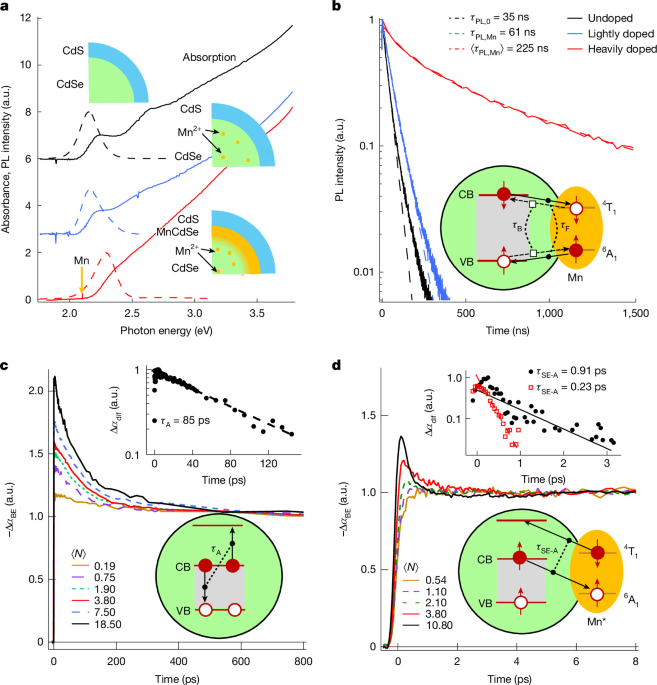
Researchers synthesized manganese-doped CdSe/CdS quantum dots, fabricated them into Auston-switch photoconductive devices, and characterized their optical and electrical behavior. The procedure involved preparing wurtzite CdSe cores, introducing approximately two to five Mn2+ dopants per quantum dot, coating the cores with CdS shells, and assembling the resulting films into 50 Ω microstrip transmission lines. Transient-absorption (TA) and time-resolved photocurrent (TPC) measurements were then performed using femtosecond laser pulses under controlled conditions.
Materials
Cadmium oxide (CdO, 99.99%, Aldrich), octadecylphosphonic acid (ODPA, 99%, PCI), trioctylphosphine oxide (TOPO, 99%, Aldrich), trioctylphosphine (TOP, 97%, Aldrich), diphenylphosphine (DPP, 98%, Aldrich), selenium (Se, 200 mesh, 99.999%, Alfa Aesar), 1-octadecene (ODE, 90%, Aldrich), oleic acid (OA, 90%, Aldrich), oleylamine (OAm, 70%, Aldrich), manganese(II) acetate tetrahydrate (Mn(ac)2·4H2O, 99.999%, Strem), and tributylphosphine (TBP, 95%, Aldrich) were used as received.
Synthesis of Mn-doped core/shell CdSe/CdS quantum dots
CdSe core synthesis
CdSe core particles with a wurtzite crystal structure were synthesized according to a previously reported method.17 CdO (100 mg), ODPA (490 mg), and TOPO (5 g) were placed in a three-necked flask and degassed under vacuum at 150 °C for 1 hour. Under a nitrogen stream, the mixture was heated to 320 °C and held at that temperature until a clear solution formed. TOP (1 ml) was then rapidly injected into the flask.
After the temperature reached 380 °C, 1 ml of a 1.4 M TOP-Se solution was rapidly injected. At this stage, DPP was added to the TOP-Se solution at a concentration of 1 mol% to control the growth rate.17 After 3 minutes, the heating mantle was removed and the reaction mixture was cooled to room temperature.
The resulting nanocrystals were collected by adding ethanol and centrifuging at 8,000 rpm. This washing procedure was repeated three times. The purified nanocrystals were then redispersed in toluene.
Mn doping
A diffusion-doping procedure was used to incorporate Mn into the synthesized CdSe nanocrystals.16 The protocol followed the procedure described in Ref. 17. To remove residual Cd species, presynthesized CdSe nanocrystals dispersed in toluene were precipitated with ethanol. A 75 mg portion of the precipitate was dissolved in a mixture of 27 ml of degassed ODE and 2.7 ml of OA. The mixture was heated to 60 °C under vacuum for 1 hour.
After cooling to room temperature, the nanocrystals were precipitated again with ethanol and collected by centrifugation at 8,000 rpm. The resulting precipitate was added to a mixture of Se (510 mg), degassed ODE (3 ml), and TBP (3 ml).
Separately, Mn(ac)2·4H2O (90 mg), ODE (45 ml), OA (1.8 ml), and OAm (3.9 ml) were placed in a flask and degassed under vacuum at 100 °C for 1 hour. Under nitrogen, the mixture was heated to 300 °C, after which the preprepared ODE solution containing the CdSe nanocrystals and TBP-Se was rapidly injected.
The reaction temperature was maintained at 300 °C, and the doping level was controlled by the reaction time, which was typically 5–30 minutes. The mixture was then cooled to room temperature. Magnetic circular dichroism measurements indicated approximately two to five internal Mn2+ dopants per quantum dot, depending on the doping time.17
Growth of the CdS shell
Because of their high concentration of surface trap states, the as-prepared Mn-doped CdSe cores did not exhibit detectable photoluminescence. To suppress surface defects, the cores were coated with a CdS shell using the procedure reported in Ref. 17.
To prepare the Cd-oleate precursor solution, CdO (123 mg), OA (2.45 ml), and ODE (10.8 ml) were placed in a flask and degassed under vacuum at 100 °C for 1 hour. The temperature was then increased to 250 °C under nitrogen and maintained for 1 hour, until a clear solution formed. The precursor solution was cooled to 100 °C and held at that temperature until it was injected during CdS-shell growth.
The TOP-S precursor solution was prepared by stirring TOP (18 ml) and sulfur powder (44.3 mg) overnight in a glovebox.
For shell growth, Mn-doped CdSe quantum dots (75 mg) were dissolved in a mixture of ODE (28 ml), OAm (2.4 ml), and OA (1.2 ml). The mixture was degassed under vacuum at 100 °C for 1 hour. Under nitrogen, the flask was heated to 220 °C. Aliquots of the Cd-oleate and TOP-S precursor solutions, each 0.4 ml, were injected alternately and dropwise for two cycles, with a 2.5-minute interval between injections.
Manufacture of Auston-switch devices
A 100 nm gold layer was deposited on the backside of a 1 mm glass substrate to serve as a ground plane. Approximately 200 nm-thick films of either undoped reference quantum dots or Mn-doped CdSe/CdS quantum dots were deposited on the top surface through repeated spin-coating cycles that included ligand exchange and rinsing.
For deposition, the quantum dots were dispersed in octane at 20 mg ml−1 and spin-coated at 1,600 rpm for 30 seconds. To facilitate charge transport between quantum dots, solid-state ligand exchange was used to replace the original long-chain ligands with short, bifunctional 1,2-ethanedithiol (EDT) molecules.
For ligand exchange, 60 μl of a 1 M EDT solution in methanol (MeOH) was dropped onto the quantum-dot layer and allowed to soak for 60 seconds. The layer was then spin-coated for 30 seconds at 1,200 rpm. Excess ligand was removed by spin-coating with pure MeOH.
The three steps—quantum-dot deposition, ligand exchange, and rinsing—were repeated five times to produce a quantum-dot layer approximately 200 nm thick. The resulting film was annealed at 150 °C for 30 minutes.
Finally, two 200 nm-thick gold contacts separated by a 70 μm gap were deposited on top of the quantum-dot film through a shadow mask. Together with the gold ground plane on the back of the substrate, the contacts formed a microstrip transmission line with a nominal impedance of 50 Ω.
Additional TA measurements were performed on a 200 nm-thick Mn-doped CdSe/CdS quantum-dot film prepared using the same ligand-exchange procedure as the TPC device. These measurements were used to verify that the quantum-confined electronic structure of the quantum dots was preserved during ligand exchange and film fabrication. Membrane samples were analyzed under identical excitation conditions: 3.6 eV excitation, 150 fs pulse duration, and N = 0.3. The results are shown in Extended Data Figure 8.
Equilibrium electrical properties were characterized through dark-conductivity measurements on a 120 nm-thick Mn-doped CdSe/CdS quantum-dot film deposited on glass. The film was contacted by thermally deposited interdigitated gold electrodes containing 25 pairs of 2 mm-long fingers separated by 10 μm gaps. The corresponding current-voltage characteristics are shown in Extended Data Figure 2.
Electrostatic simulations of the Auston-switch geometry were performed with the electrostatic interface in COMSOL Multiphysics. The simulations were used to calculate the electric-field distribution, effective gap capacitance, and effective RC constant; the results are shown in Extended Data Figure 1.
Transient-absorption measurements
TA measurements were performed with a standard pump-probe setup. In this configuration, short pump pulses induced changes in absorption that were measured in the time and spectral domains using probe pulses with variable delays.
The TA system was built around a regeneratively amplified ytterbium-doped potassium tungstate gadolinium (Yb:KGW) femtosecond laser (PHAROS, photoconversion), which generated approximately 190 fs pulses at 1.2 eV. The laser output was divided into two beams. One beam seeded a harmonic generator (HIRO HHG, photoconversion) to produce second-harmonic (2.4 eV) or third-harmonic (3.6 eV) pump pulses. Nonlinear optical pulse compression reduced the pump-pulse duration to approximately 150 fs.
Pulses from the second beam were delayed relative to the pump with an optical delay line capable of delays of up to 5 ns. They were focused onto a 3 mm-thick sapphire plate to generate broadband probe pulses as a femtosecond white-light continuum.
The pump beam was focused onto a spot approximately 120 μm in diameter. The smaller probe beam, with a diameter of less than 90 μm, was focused near the center of the pump spot. Probe pulses transmitted through the sample were detected with an Avantes AvaSpec-Fast ULS1350F-USB2 spectrometer. The measured TA spectra were corrected for chirp—spectral dependence in the arrival time within the white-light probe pulse—using the procedure described in Ref. 2.
In Auger-recombination studies of undoped and Mn-doped quantum dots, pump-induced band-edge absorption bleaching, Δα, was used to track the decay of the exciton population at the band edge.14
Time-resolved photocurrent measurements
To minimize sample degradation during TPC measurements, the fabricated Auston-switch device was mounted in a nitrogen-filled, airtight chamber equipped with an optical window and electrical feedthrough. No measurable changes in the TPC response were observed during full device characterization, including measurements dependent on pump fluence, transport distance, and applied bias.
The chamber was mounted on a translation stage that allowed the laser-beam position within the electrode gap to be changed. One top gold electrode was biased with a DC power supply (Keithley 2430), while the other was connected by coaxial cable to a 20 GHz-bandwidth sampling oscilloscope. To reduce timing jitter, the oscilloscope was triggered by an electrical pulse from a fast Si photodetector illuminated by a portion of the laser beam split from the excitation path.
The quantum dots in the photoconductive gap were excited at 2.4 eV or 3.6 eV using 150 fs pulses from the second or third harmonic, respectively, of an amplified Yb:KGW femtosecond PHAROS laser. A cylindrical achromatic lens focused the laser beam into a narrow stripe along the edge of the top gold electrode.
The excitation beam had an approximately Gaussian spatial profile, with a stripe width of approximately 70–80 μm full width at half maximum (FWHM), as measured with a beam profiler. The excitation position within the photoconductive gap was varied by moving the sample in a plane perpendicular to the laser beam. The position was initially calibrated with a beam profiler and monitored in real time on the sample using a CMOS camera.
As discussed in Supplement 3, the nonlinear dependence of SE-Auger upconversion on excitation density produces a narrower lateral spatial profile for the mobile hot-electron population than for the laser beam itself, as shown in Extended Data Figure 9. Through the film thickness, the initial hot-electron population was weighted toward the irradiated surface. However, because the optical absorption length was comparable to the quantum-dot film thickness, excited Mn ions were generated throughout the layer.
Consequently, SE-Auger regeneration remained active throughout the film thickness, even though the hot-electron population spread vertically while passing through the photoconductive gap.
Source: www.nature.com