


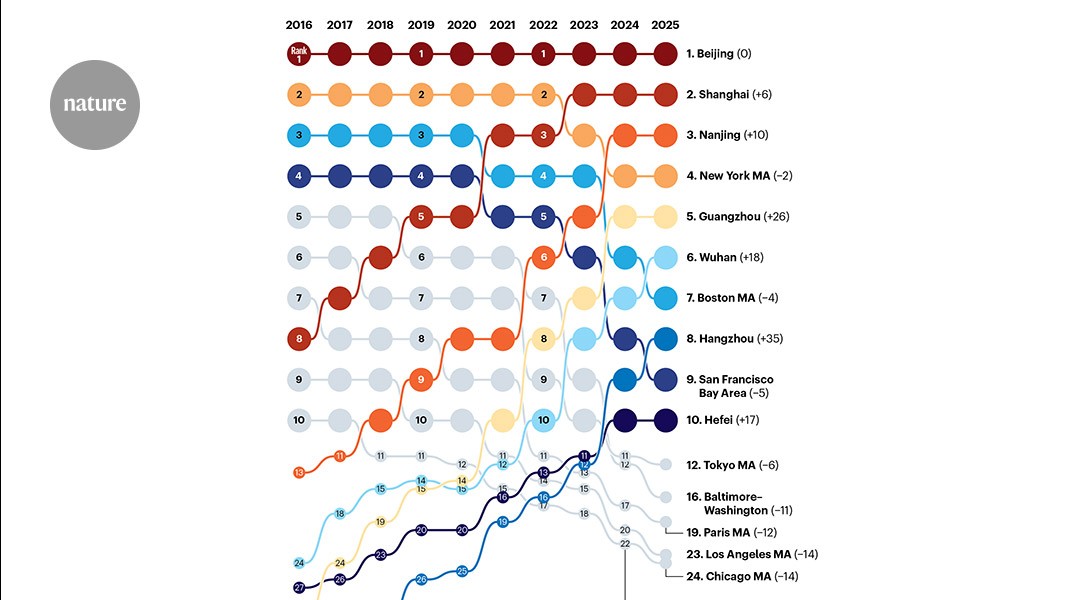
Beijing remained the top-ranked city in the natural sciences in the Nature Index from 2016 to 2025, while China strengthened its presence across the rankings. Five additional Chinese cities entered the natural-sciences top 10 during the period, whereas two US cities that had previously been in the top 10 fell out of the top 20. The subject-specific rankings also show strong growth for Chinese cities in chemistry and continued geographic diversity in biological sciences.
Natural sciences
The graphic shows how cities’ rankings in the natural sciences changed between 2016 and 2025, based on their share of the Nature Index. Beijing held first place throughout the period. Five more Chinese cities joined the top 10, while two US cities that were previously among the top 10 dropped below the top 20.
Source: Nature Index
Biological sciences
The leading cities for biological sciences in 2025 are shown with their adjusted shares in the subject for 2016 and 2025. Biological sciences was the most geographically diverse of the natural-sciences fields listed: the top 10 included four cities in the United States, four in China and two in Europe.
Chemistry
Chinese cities occupied all 10 positions in the 2025 chemistry rankings. The interactive graphic compares their adjusted shares in 2016 and 2025. Among the top 50 cities covered, Beijing and Shanghai recorded the greatest growth over the period, with each increasing its chemistry-adjusted share by almost 900 points.
Earth and environmental sciences
Beijing accounted for 25% of China’s share in earth and environmental sciences in 2025. This was the highest percentage among the five leading cities across the natural- and health-sciences subject areas. Of the top 10 cities in Earth and Environmental Sciences in 2025, Qingdao recorded the largest change in adjusted share between 2016 and 2025, at 545.5%. Beijing recorded the largest increase in adjusted share points, at 703.
Source: www.nature.com