


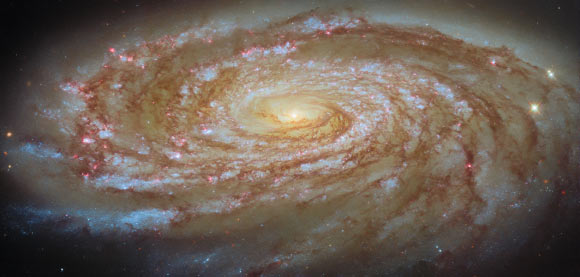
A stunning new Hubble image reveals Messier 88, a captivating spiral galaxy, actively pulled by a supermassive black hole as it navigates toward the densely populated center of the Virgo Cluster.
This image, captured with the Wide Field Camera 3 (WFC3) aboard the NASA/ESA Hubble Space Telescope, showcases the beauty of Messier 88. Image credit: NASA / ESA / Hubble / D. Thilker / MAUVE-HST Team.
Messier 88 is situated roughly 63 million light-years away in the constellation Coma.
Also known as M88, NGC 4501, or LEDA 41517, this remarkable galaxy was discovered by French astronomer Charles Messier on March 18, 1781.
Messier 88 features an active galactic nucleus, indicating that its central region outshines the rest of the galaxy.
At its center lies a supermassive black hole, estimated to be about 100 million times heavier than the sun.
“The galaxy’s aged, reddish stars create a warm, luminous core,” Hubble astronomers stated.
“Symmetrical spiral arms, tightly coiled, radiate from the core, each adorned with radiant pink and blue star clusters along with entwined dust clouds.”
“From our viewpoint, we see Messier 88 as elongated, with its spiral arms gracefully fanning out.”
As a member of the Virgo Cluster, which includes over a thousand galaxies bound by gravity, Messier 88 is on a cosmic journey.
The researchers noted, “As this colossal galaxy cluster moves through space, the galaxies continually orbit around the cluster’s center.”
“Messier 88 is on a long, somewhat risky path into the cluster’s depths, approximately 2 million light-years from its current spot.”
“In 200 to 300 million years, Messier 88 will approach Messier 87, a massive elliptical galaxy that anchors the Virgo Cluster.”
“As it nears this immense gravitational force, Messier 88 will experience severe ram pressure stripping.”
Ram pressure stripping occurs when intergalactic gas is swept away, effectively removing the gas that normally exists between galaxies within a cluster.
Scientists have observed this phenomenon in Messier 88.
“The galaxy’s swirling gas disk appears truncated and compressed, accumulating gas and dust as if a snowplow were moving through it,” the researchers observed.
“In fact, Messier 88 exhibits noticeably less cold gas, the essential ingredient for star formation, than expected for a galaxy of its size, especially in its outer regions.”
“This indicates that Messier 88 will undergo significant changes due to its journey, impacting its star formation potential and evolutionary trajectory.”
Source: www.sci.news