


Feedback is New Scientist. We actively welcome readers who stay updated on the latest trends in science and technology. To share suggestions or feedback, please reach out to us at [email protected].
A Ship Is Coming In
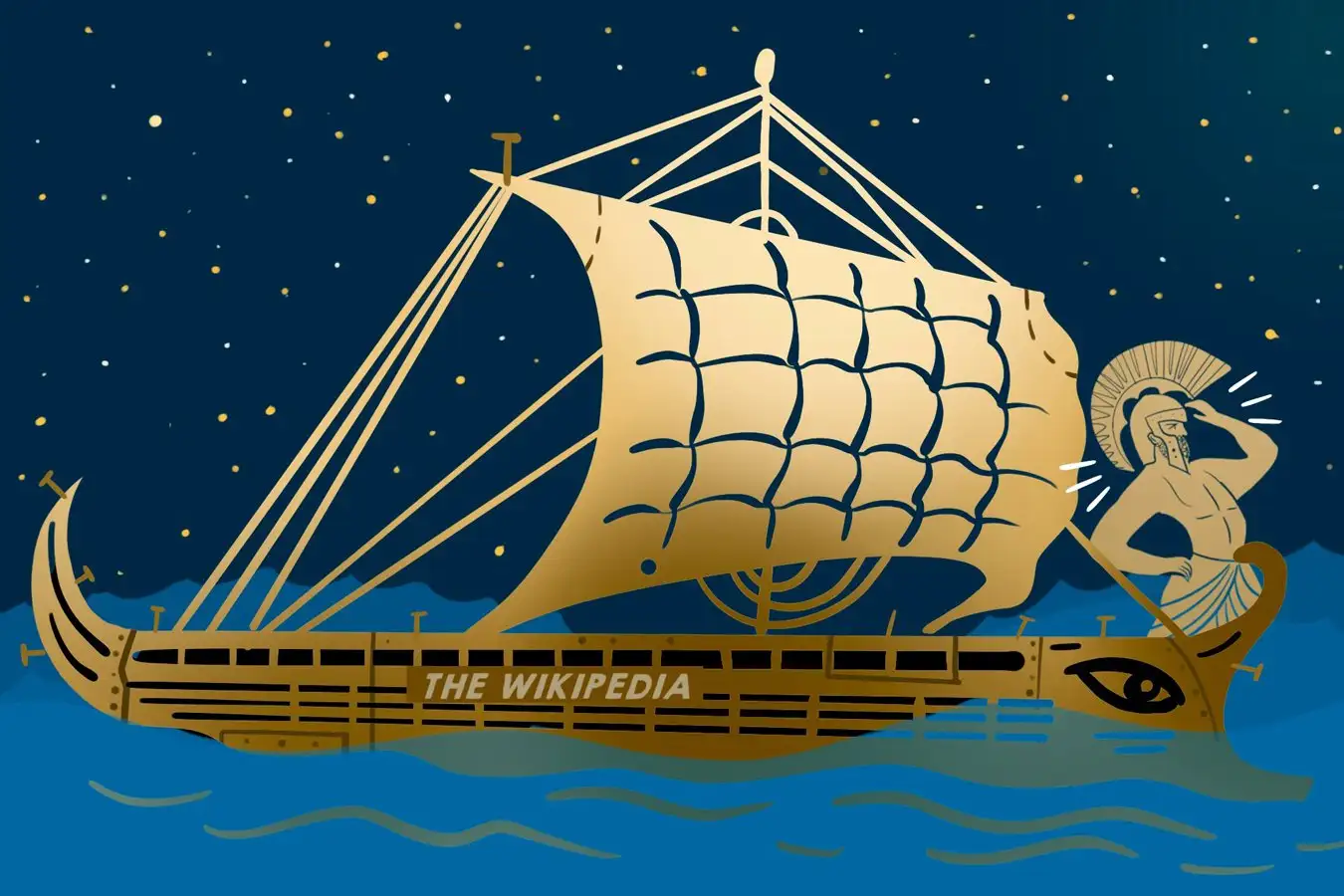
In response to our query, we sought out the best adjective to describe the Wikipedia entry on the Ship of Theseus paradox. This timeless philosophical question explores whether a ship remains the same if all its parts are replaced. Interestingly, the Wikipedia page has seen so many edits that it serves as a perfect example of this paradox.
Our readers provided a wealth of creative suggestions, from Tim Molesley’s “automatic paradigm” to Bryn Glover’s “automatic causes.”
One insightful reader, Martin Baston, referenced the British comedy Only Fools and Horses. In a memorable episode, the character Trigger is awarded a medal for using the same broom for 20 years, having replaced the head and handle multiple times. Thus, he humorously suggested we describe the Ship of Theseus Wiki page as a “trigger.”
Notably, other readers, including Peter Jeffrey and Peter Gutfreund, identified a term that stands out: “self-logical.” An autological word, according to Wikipedia, describes a trait it possesses; examples include “noun” and “sesquipedalian.”
The discussion raises questions about whether autological can be applied to entire articles. Philip Penton chimed in with the playful term “autobloomian.”
Mairi McKissock explored further and uncovered the antonym: “foreignness,” which denotes a term that does not describe itself—like “monosyllabic.” This exploration led her to the Grelling-Nelson paradox. “Is ‘alien’ foreign? If it is, it becomes autological. If not, it remains foreign,” she pondered.
Now that the feedback is swirling with complexity, let’s shift topics and delve into another section of our mailbox.
Find a Niche Market
Discussions on niche science-related tourist attractions have maintained a steady flow. The winning criteria are unique, such as parks adorned with foraminiferal sculptures or entire gardens of moss.
Andrew Taubman, a volunteer at the Australian Museum, shared updates on their efforts in digitizing their extensive entomology collection, recently focusing on the elusive Lamprogaster genus. Curiously, there isn’t even a Wikipedia page on these insects, demonstrating their obscurity. Similarly, Rosalinda Hardiman’s curated set of beach pebbles—collected during her open water swimming adventures—has yet to be made accessible to the public.
In Australia, Sari Somerstrom introduced the Puseum in Richmond, Tasmania, dedicated to the fascinating world of animal waste. Their website proclaims it as “the only facility of its kind in Australia,” aiming to educate visitors on the importance of feces in ecosystems. Sari notes the content is enlightening but expresses concerns about its uniqueness, given the universality of the topic.
Lastly, John Blakey brings forth two hidden gems. In Hobro, Denmark, he mentions the Gas Museum, which highlights Denmark’s intriguing history of gas production and distribution. John also points out Kornets Hus or “House of Grain” in Northern Jutland, a celebration of grains nestled in a cornfield. This attraction currently lacks reviews on TripAdvisor, reflecting its obscure charm.
Precious Chihuahua
This feedback comes from none other than the author of Oranges Aren’t the Only Fruit, Jeanette Winterson, who humorously noted the use of dogs as units of measurement. A recent article described a colossal 11,000-carat ruby as weighing about as much as a dog.
Such comparisons are absurd, as an English Mastiff can tip the scales at over 100 kg, while a Chihuahua may only weigh about 1 kg. It’s akin to comparing a building’s height to that of a two-story house or the Burj Khalifa. Further details reveal the gem’s weight to be 2.2 kg, comfortably placing it in the Chihuahua weight class.
Have a story for feedback?
If you have an article to share, please email Feedback at [email protected]. Don’t forget to include your home address. You can find this week’s and past feedback on our website.
Source: www.newscientist.com