


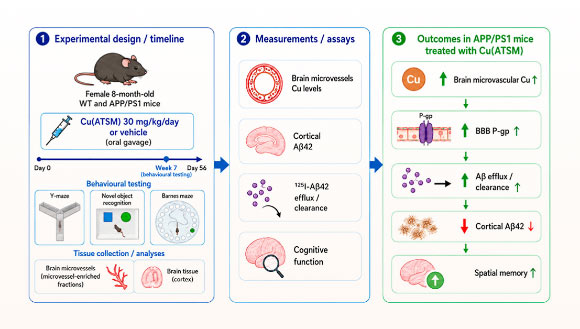
Copper diacetylbis(4-methyl-3-thiosemicarbazone), known as Cu (ATSM), has shown promising results in restoring a critical waste removal system in the brain, decreasing toxic amyloid beta accumulation, and enhancing spatial memory in a lab model of Alzheimer’s disease, according to a research team from Monash University.
Research using the APP/PS1 mouse model of familial Alzheimer’s disease confirms Cu(ATSM)’s effects on brain function and protein clearance. Image credit: Pyun et al., doi: 10.1021/acschemneuro.6c00252.
Alzheimer’s disease stems from a buildup of the toxic protein amyloid beta.
Generally, the brain removes these proteins through the blood-brain barrier, flushing them into the bloodstream.
In Alzheimer’s, the P-glycoprotein—a vital clearing mechanism—becomes impaired, leading to the trapping of toxic proteins in the brain.
“This treatment effectively targets cerebral blood vessels, reducing toxin levels and providing behavioral improvements,” stated lead author Dr. Jae Pyung. Read the paper published in ACS Chemical Neuroscience.
“This groundbreaking study demonstrates that Cu(ATSM) can boost P-glycoprotein levels by 24.1% in an Alzheimer’s model, linking blood-brain barrier restoration to reduced toxic protein levels and enhanced cognitive ability.”
“By improving this pump, the brain could more effectively eliminate trapped waste products.”
“After 56 days of treatment, toxic amyloid beta levels were reduced by 42%, while spatial learning improved by nearly 44%.”
“Given its prior safety assessments for other diseases, this compound holds significant promise for quick translation into clinical settings,” added Professor Joseph Nicolazzo, the senior author of the research.
“Cu(ATSM) is a copper compound with anti-inflammatory and neuroprotective benefits, currently in clinical trials for conditions like Parkinson’s disease and amyotrophic lateral sclerosis.”
“These preclinical findings strongly advocate for the evaluation of this drug in early symptomatic Alzheimer’s, as reducing amyloid burden is clinically proven to enhance functional outcomes.”
While Cu(ATSM) effectively reduces amyloid accumulation, researchers are still investigating the precise biological pathways that enable the protein to exit the brain.
Beyond blood-brain barrier repair, there are indications that copper treatment may empower the brain’s immune cells, or microglia, to effectively consume and degrade toxic plaques.
“Future research will focus on tracking the exact mechanisms of protein clearance from the brain into the bloodstream,” the researchers indicated.
This discovery lays a solid groundwork for investigating biometallic therapies like Cu(ATSM) to address vascular dysfunction and cognitive decline in Alzheimer’s disease.
_____
Jaepyeong et al. Cu(ATSM) restores P-glycoprotein abundance in the blood-brain barrier, enhancing cognitive function in the APP/PS1 model of Alzheimer’s disease. ACS Chem. Neuroscience published online on May 30, 2026. doi: 10.1021/acschemneuro.6c00252
Source: www.sci.news