


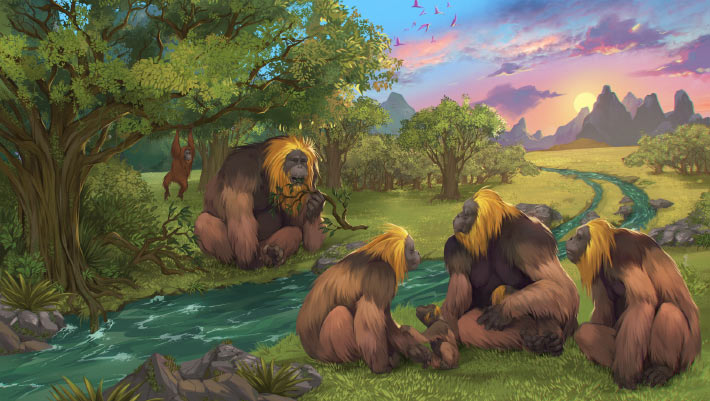
Paleontologists have unearthed a remarkable collection of 13 fossilized teeth deep within a limestone cave in southern China, belonging to Gigantopithecus blacki, the largest primate species ever documented. This significant discovery bridges a gap in the fossil record and sheds new light on how this massive species adapted to dramatic climate shifts that occurred between 1.2 million and 700,000 years ago.
Impression of Gigantopithecus blacki in the southern Chinese forests. Image credit: Garcia / Joannes-Boyau, Southern Cross University.
Gigantopithecus blacki was an extinct great ape that thrived in the dense jungles of Southeast Asia, towering over modern gorillas by reaching heights of up to 3 meters (10 feet) and weighing as much as 540 kg.
This colossal species roamed the Earth from approximately 2.3 million years ago until its extinction between 295,000 and 215,000 years ago.
Gigantopithecus blacki was first officially described in 1935 by the German-Dutch anthropologist Gustav von Königswald, who based his findings on a solitary tooth discovered in a Hong Kong pharmacy.
The species is represented in the fossil record by several thousand teeth and a limited number of jawbones.
“Gigantopithecus blacki is believed to be the largest primate species ever identified,” stated paleontologist Dr. Yanyang Yao from Shandong University, alongside colleagues from Nanning Normal University and Guangxi Museum of Anthropology.
“The fossil record shows a concentration of specimens from the Early to Middle Pleistocene, but remains from the transition between these two epochs (1.2 million to 700,000 years ago) are quite rare.”
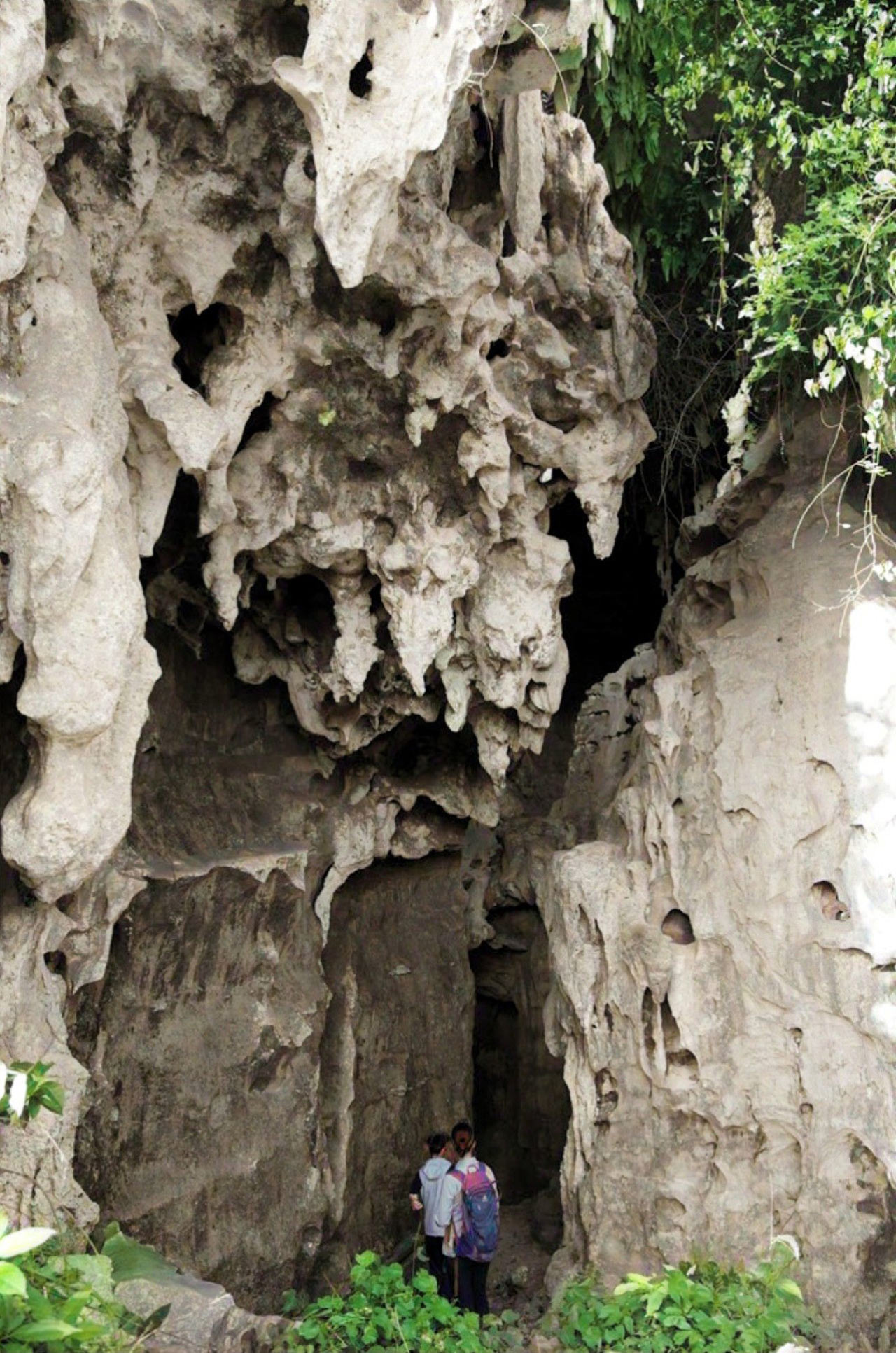
Yanli Dong, Chongzuo City, Guangxi Province, China. Image credit: Yao et al., doi: 10.16359/j.1000-3193/AAS.2026.0010.
Paleontologists have identified 13 teeth from Gigantopithecus blacki—including upper and lower canines, premolars, and molars—discovered at Yanli Cave 1 in Chongzuo City, Guangxi Province, China.
The dating of these fossils corresponds to the Early Middle Pleistocene Transition (EMPT), a period characterized by cooler climate trends, increased dryness, and significant glacial influences.
Estimated ages are determined through associated animal fossils instead of direct dating of the teeth.
Research shows specimens from 30 different species across six orders, including relatives of orangutans, tigers, clouded leopards, tapirs, Javan rhinos, stegodons, and Asian elephants, were also present.
Among them, two species provided critical dating insights: Airuropoda oolinshanensis, a giant panda species typical of the late early Pleistocene, and Airuropoda melanoluca Bakoni, a subspecies indicative of the Middle Pleistocene.
The simultaneous presence of these two panda species strongly indicates the deposition occurred precisely during the transition between these epochs.
“This unique faunal assemblage highlights the biostratigraphic age of the EMPT,” the researchers elaborated.
The Gigantopithecus blacki teeth found at Yanli Cave 1 appear to reflect ongoing evolutionary changes.
While some specimens exhibit the smaller tooth sizes characteristic of earlier populations, others display dimensions nearing the larger sizes found in later populations, likely reflecting dietary adaptations.
“Comparative analyses of tooth sizes from Gigantopithecus fossils across various localities indicate that some specimens from Yanli Cave 1 maintain the smaller size traits associated with early Early Pleistocene populations,” scientists noted.
“Conversely, other specimens are approaching the larger tooth sizes typical of late Early Pleistocene and Middle Pleistocene populations.”
“These findings align with our biochronological assessment.”
“Following the discoveries at Queque Cave and Zhanwang Cave—both located within the Guangxi Zhuang Autonomous Region—Yanli Cave 1 represents the third significant site associated with the EMPT for Gigantopithecus. This regional evidence is crucial for understanding the adaptive strategies and dental evolutionary patterns in response to climate changes during the EMPT.”
The results of this survey are published in the Chinese Anthropology Method.
_____
Yanyang Yao et al. 2026. Discovery of Gigantopithecus blacki in Yanli Cave 1, Chongzuo City, Guangxi Zhuang Autonomous Region, during the transition between the Early and Middle Pleistocene. Chinese Anthropology Method 45 (02): 199-209; doi: 10.16359/j.1000-3193/AAS.2026.0010
Source: www.sci.news