


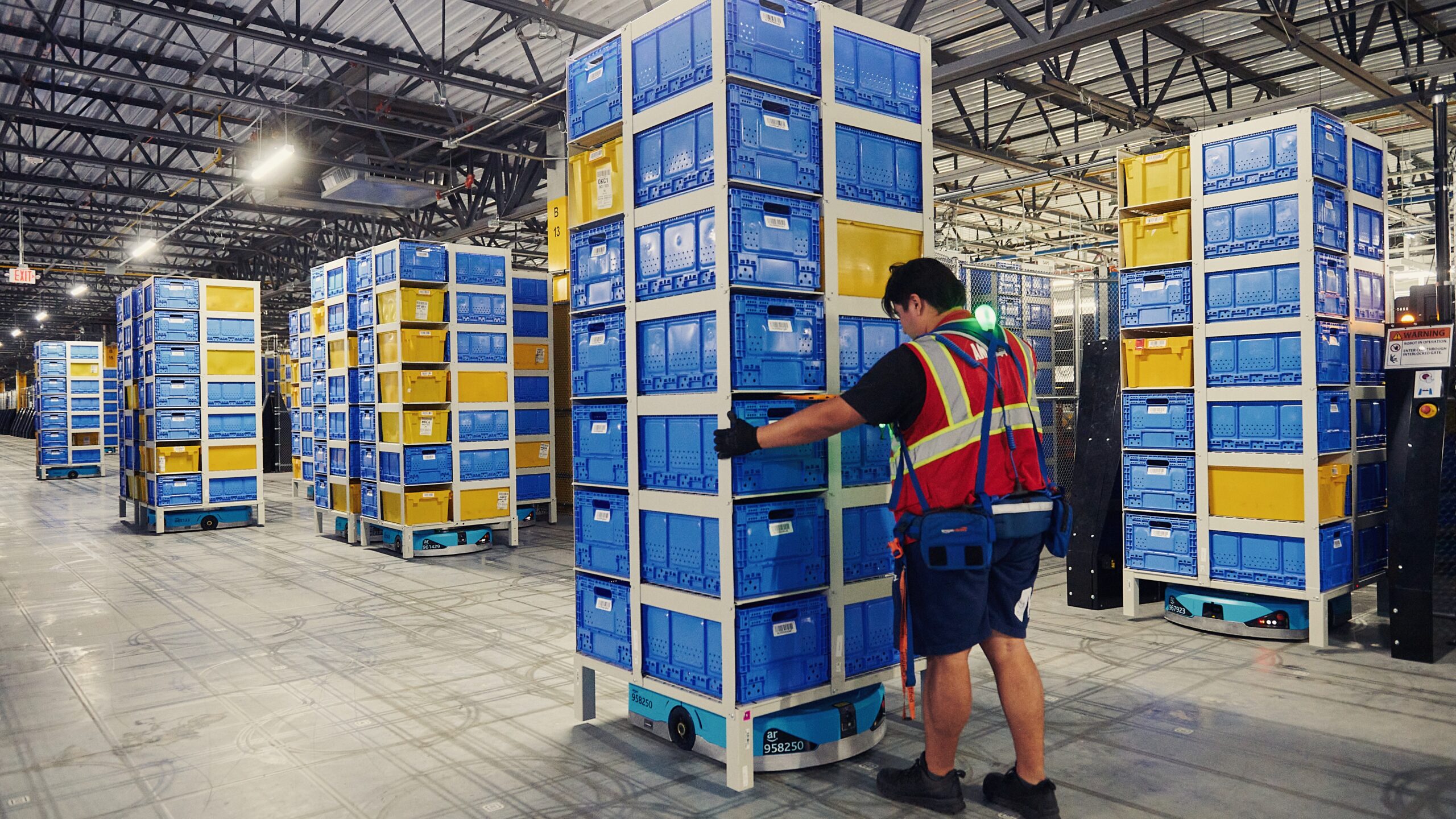
Amazon’s Vulcan Robot Uses Tactile Sensing to Pick and Store Items
Amazon is developing a foundational robotics model designed to help its machines perform a wider range of tasks across different robot designs. The effort could reduce the need to build a separate recognition model for every new robotic system or application.
“If you have to build an ad hoc recognition model for each such task or embodiment, it’s not scalable,” Kapil Katiyal, Amazon Robotics’ senior manager of applied sciences, said during a presentation at the IEEE/RSJ International Conference on Intelligent Robots and Systems in Pittsburgh on September 29.
“So one of the efforts that our team took on was to design a foundational model that would work across the new embodiments of the robots that we would deploy and all the cognitive tasks that we would need to perform on them,” Katiyal said.
Amazon’s Vulcan robot adds a sense of touch
Most robotic arms rely primarily on vision. Amazon’s latest robotic arm, Vulcan, is designed to combine visual perception with force-feedback sensors that provide tactile information.
That combination allows Vulcan to more precisely retrieve and store items inside fabric-covered inventory pods. The robot must insert objects, create spaces between items and pull products out—tasks that can be difficult for traditional systems that do not use touch.
“You need to be able to insert items, create spaces, and pull things out,” Dresser said. “These are very difficult to do with today’s traditional non-touch-based systems, such as the suction-based systems that are part of Sparrow.”
Vulcan began operating in 2025 at Amazon fulfillment centers in Spokane, Washington, and Hamburg, Germany. The robotic arm has not yet been widely deployed, but Amazon plans to expand its use in 2027, Dresser said.
credit:
Amazon
What Amazon’s automation means for workers
Amazon says each new robot can benefit its employees. In addition to handling items directly above the floor, Vulcan is designed to pick and store products in the top row of inventory pods—locations that may require a stepladder. This allows employees to focus on selecting and storing items that are easier to reach.
Labor advocates, journalists and the U.S. Congress, however, have raised concerns about Amazon’s automation efforts. The Strategic Organization Center (SOC), a Washington, D.C.-based trade union federation, published reports in May 2021 and April 2022 examining conditions in Amazon’s robotic warehouses.
Using injury data that companies reported to the U.S. government from 2017 to 2020, the SOC analysis found that Amazon’s robotic warehouses had higher injury rates than its nonrobotic warehouses.
Source: arstechnica.com