


Hello Nature readers. Would you like to receive this science news briefing free in your inbox every day? Sign up here.
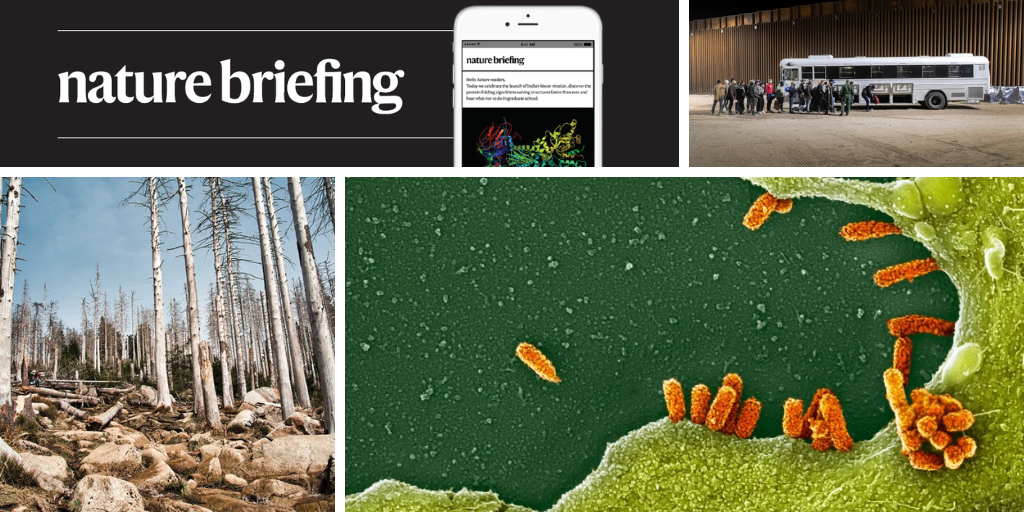
Satellite observations reveal a global browning trend in forests since the start of the 21st century.
Credit: ezypix/Getty
About 56 million years ago, a rapid rise in atmospheric carbon dioxide triggered severe global warming, reshaped Earth’s surface and caused forests to decline across large areas. Researchers say the forest loss observed during the Paleocene–Eocene Thermal Maximum (PETM) could offer clues about the effects of human-driven climate change today. Although the PETM is not a perfect modern-day comparison, paleoclimatologist Gabriel Bowen says it provides “a guide from the past as to what could happen.”
Nature | 5-minute read
Reference: Science paper
The U.S. Food and Drug Administration (FDA) has approved a new mRNA-based influenza vaccine for adults aged 50 and older. Regulators in the European Union, Canada and Australia are also reviewing the vaccine. Public-health researcher Emanuele Montomori says the mRNA vaccine platform could be a “game changer” because formulations can be updated rapidly to target circulating flu strains. However, scientists caution that its effectiveness will need to be assessed through real-world use. “We have to wait for real-world data,” Montomori says.
Nature | 5-minute read
A study of more than 11,500 neighborhoods in over 100 U.S. cities found that property and violent crime declined between 2010 and 2018, including in areas where undocumented immigrant populations increased. The researchers found no relationship between immigration and crimes such as murder or auto theft, although robbery rates were higher in some areas. The authors hope the findings will help correct misconceptions about immigration and crime. Immigration researcher Ben Brindle says public perceptions “often don’t match up with the evidence we’re getting from researchers.”
Nature | 5-minute read
Reference: Urban Issues Journal paper
In response to the European Union’s artificial-intelligence regulations, AI company Anthropic has announced that text generated by Claude models released after 2 August will contain an invisible watermark indicating that it was produced by AI. Researchers say AI watermarks could help limit the private misuse of generated content. However, the absence of a watermark does not prove that text was written by a person because these signals can often be removed.
Nature | 5-minute read
Features and expert perspectives
China’s research sector should reconsider how it rewards early-career scientists, argues vaccine researcher Ming Li. The current system directs resources toward researchers selected through prestigious talent programmes and often ties status to academic “hats” awarded through those programmes. Li says titles should be separated from funding decisions, while clear and consistent career-progression rules should be introduced. Such reforms could help create a research culture focused on challenging scientific questions rather than publication counts.
Nature | 5-minute read
Discover the secrets behind an irresistible cup of tea in Professor Alborough’s Memo Recovered, and follow an older woman as she finds a way around a system designed to reject her in System Lag.
Nature | 6-minute read and Nature | 7-minute read
Andrew Robinson’s five recommended science books this week include an exploration of the ecology of “outsider animals” and a look at Albert Einstein’s lesser-known musical talents.
Nature | 3-minute read
Researchers have developed an engineered probiotic that responds to elevated blood sugar, potentially paving the way for a new diabetes treatment. The team modified Escherichia coli to act as a biosensor: when it detects high glucose levels, it releases molecules that stimulate insulin secretion. “We thought there was an opportunity to develop a treatment that behaves like the body itself, capable of responding to changes in glucose rather than simply administering a fixed dose of a drug,” says biologist and study co-author Ningji Guan.
Nature Podcast | Listen for 20 minutes
Subscribe to the Nature Podcast on Apple Podcasts,
Spotify,
YouTube Music or
RSS feed.
Today’s visual puzzle features leaf penguins roaming the atmospheric forests of La Gomera, one of Spain’s Canary Islands. Can you find the penguin?
The answer will appear in Monday’s email. Thanks to Nature Briefing photo editor and penguin wrangler Tom Horton.
This newsletter is continually evolving, and we would love to hear your thoughts. Send feedback to [email protected].
Thank you for reading,
Jacob Smith, Associate Editor, Nature Briefing
• Nature Briefing: Careers — practical insights, expert advice and award-winning journalism to help you develop your career.
• Nature Briefing: Microbiology — the microorganisms that shape human health, the environment and our food systems.
• Nature Briefing: The Anthropocene — reporting on climate change, biodiversity, sustainability and geoengineering.
• Nature Briefing: AI and Robotics — coverage of artificial intelligence and robotics, written by humans, of course.
• Nature Briefing: Cancer — a weekly newsletter created with cancer researchers in mind.
• Nature Briefing: Translational Research — news and analysis covering biotechnology, drug discovery and pharmaceuticals.
Source: www.nature.com