


Recent studies on chimpanzees (Pan troglodytes) and bonobos (Papio niscus) reveal that affectionate behaviors such as hugging, touching, and other comforting gestures prior to food competition lead to more harmonious sharing. This indicates that the foundations of human social interactions may date back at least 6 million years.
Professor Zannah Clay and her team at Durham University noted, “Social tolerance, defined as the inclination for similar species to coalesce around valuable resources with minimal aggression, is vital for effective cooperation and information sharing.”
“In primates and various animals, a tolerant social environment encourages positive social outcomes such as empathy, cooperation, and social learning.”
Traditionally, early behavioral studies measured tolerance through dominance dynamics, focusing on whether higher-status individuals avoided monopolizing resources and allowed co-eating and co-drinking.
However, social tolerance is increasingly understood as a broader characteristic of social relationships and group dynamics that can change based on context.
Humans exhibit distinct and often extreme levels of tolerance and aggression towards both in-groups and out-groups. A similar variability is now evident among our nearest living relatives, bonobos and chimpanzees.
In this study, researchers filmed 116 chimpanzees and bonobos in five semi-wild groups within a protected area in Africa, documenting the five minutes leading up to food being released into a communal area.
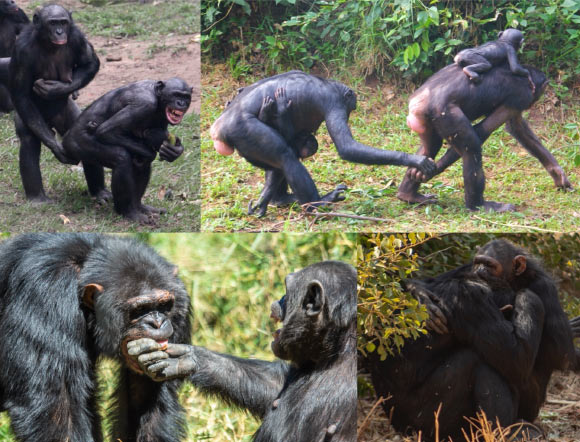
The researchers recorded instances of touch (hugs, strokes, and even fingers in mouths) and assessed how peacefully the primates fed alongside each other, in relation to recorded aggressive incidents.
Both species showed that those who engaged in reassuring touches prior to feeding were more likely to tolerate each other and eat peacefully rather than engage in conflict.
This effect varied by sex: in bonobos, it was most pronounced among females, highlighting the importance of female alliances, while in chimpanzees, males exhibited the strongest effects, reflecting male bonding dynamics.
This trend was most apparent in groups displaying higher levels of social tolerance, indicating that reassuring behaviors not only reflect but also enhance cooperative social climates.
Interestingly, male chimpanzees often engage in the risky act of putting fingers or hands in each other’s mouths, which is far more common in more tolerant groups, suggesting that this vulnerability serves as a sign of trust.
Given the behavioral similarities between the two species, researchers believe these habits trace back to a common ancestor shared by chimpanzees, bonobos, and humans around 6 million years ago, making touch one of the oldest methods to ease social tension and foster group harmony, predating language.
Dr. Jake Brooker from Durham University stated, “Studying bonobos and chimpanzees, our closest relatives, provides fascinating insights into the evolutionary origins of social behavior and our strategies for managing tension, competition, and cooperation.”
“Social touch is a potent form of communication that existed long before language, likely one of the earliest means to forge social bonds.”
“The dangerous act of mouth-to-body contact among chimpanzees, such as placing fingers in another’s mouth, illustrates remarkable trust and vulnerability necessary for navigating tense moments.”
One observation that inspired this study was watching a tolerant group of chimpanzees where one male embraced another from behind, resulting in a chain reaction of hugs until the group calmed down, which we termed the ‘reassurance train.’
“Our study underscores the crucial role of touch in regulating social relationships, especially in emotionally charged or stressful situations,” Professor Clay explained.
While aggression and competition in human evolution have garnered much attention, our research reveals that our lineage has also developed a rich repertoire of behaviors to mitigate social stress, protect relationships, and promote community harmony.
It’s striking how many reassuring behaviors observed among our closest ape relatives mirror those seen in humans today, emphasizing our reliance on time-honored behavioral tools that have persisted for millions of years to navigate complex social dynamics.
For more details, refer to the study published in Proceedings of the Royal Society B: Biological Sciences.
_____
Jake S. Brooker et al. 2026. Reassuring physical contact promotes social tolerance in bonobos and chimpanzees. Proceedings R. Soc. B 293 (2075): 20253190; doi: 10.1098/rspb.2025.3190
Source: www.sci.news