



Residential proxies have evolved beyond mere anonymity tools in the carding industry. They are now considered a crucial part of a comprehensive identity simulation strategy, alongside device fingerprints, browser profiles, billing info, time zones, cookies, and transaction behaviors.
To gain insights into how criminals exploit this infrastructure, Flare researchers analyzed 2,889 unique underground posts from about 545 discussion threads over the past two years. The discussions included operational guides, troubleshooting tips, provider comparisons, and promotions of “clean” proxy services.
This analysis indicates that while residential IP addresses remain vital for card issuers, they are not as reliable as before. Attackers often describe a market where proxy pools are overused, leading to poor reputations, inaccurate location data, and financial institutions blocking entire ranges. Card issuers are now more selective, aiming to match IP geography with stolen identity data while utilizing proxies alongside anti-detection technologies to craft convincing digital identities.
The findings highlight that residential proxies are still a significant aspect of the carding ecosystem, albeit increasingly vulnerable.
Key Takeaways
-
Card merchants evaluate proxies based on their history, not just whether they are from residential ISPs.
-
Geographic consistency includes not only country matching but also city, postal code, time zone, browser language, and billing info.
-
Residential IPs alone are seldom deemed sufficient and are frequently paired with anti-detection practices.
-
Provider restrictions have birthed a secondary market for “clean” residential IPs capable of accessing financial services.
-
Defenders should perceive residential traffic as context, not definitive proof of legitimacy.
Understanding Residential Proxies
A residential proxy transmits traffic through an IP address assigned by your internet service provider (ISP). For websites, this connection can mimic a typical home user’s connection rather than that from commercial VPNs.
While legitimate applications include localization testing and brand protection, criminals exploit residential proxies to make fraudulent sessions blend in with genuine consumer traffic.
The Shift from “Housing” to “Cleanliness”
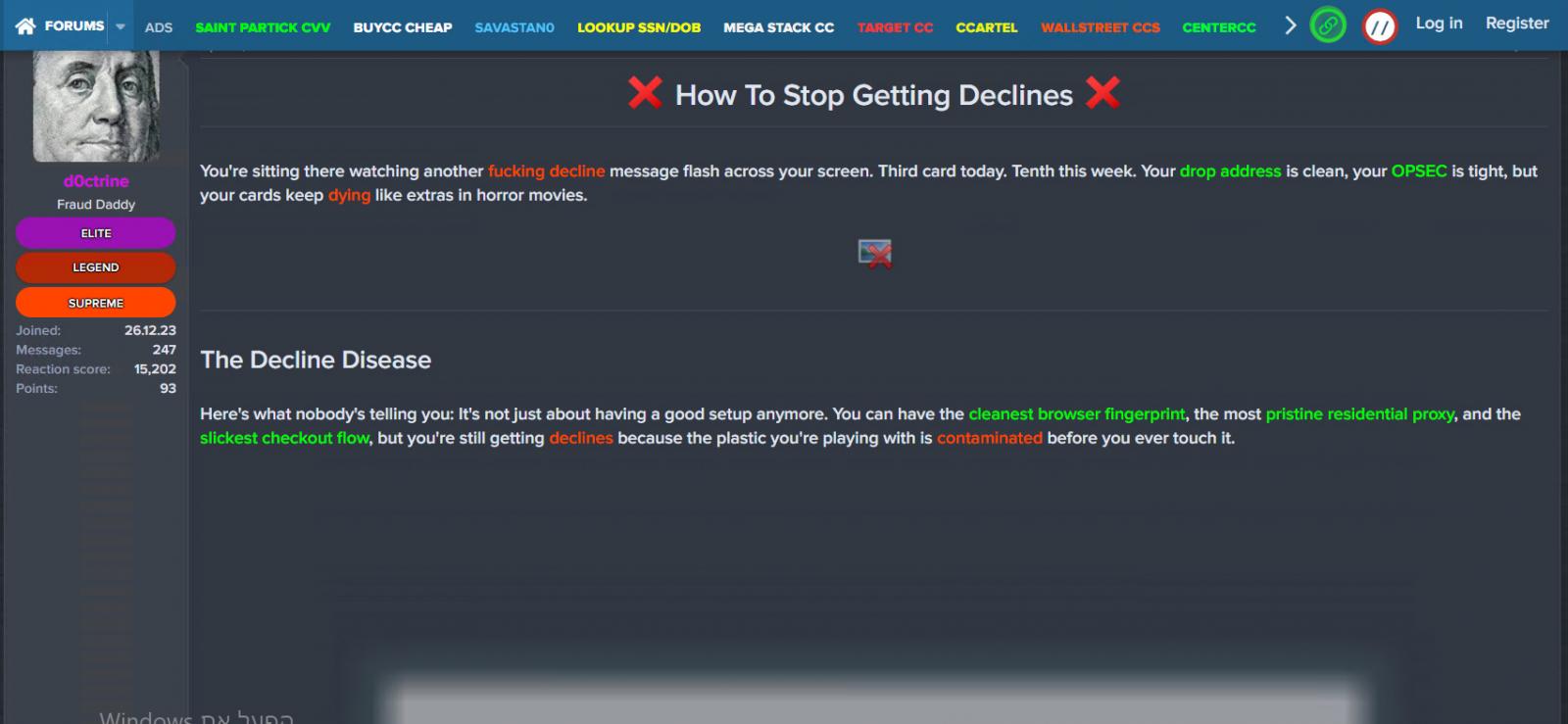
Research indicates that card companies no longer view residential proxies as a trusted category. Instead, they differentiate between “clean” and “dirty” IP pools. One popular underground guide titled “Get the Cleanest IP Possible for Carding” suggests that even residential pools deteriorate with repeated abuse.
Another guide emphasizes that the critical issue is not just the residential status of the IP, but its history of usage against banks and fraud-sensitive services.

Sign up for a free trial if you’re not yet a customer.
This perspective also emerges in troubleshooting discussions where users compare fraud scoring services and report drastic discrepancies in reputation scores for the same addresses. IPs initially considered clean can turn high risk after minimal usage.
Important to note is that card companies now perceive a proxy’s reputation as dynamic and influenced by collective user behavior on the shared infrastructure.
From “clean” residential proxies to browser anti-detection techniques, fraudsters actively share methods to create credible digital identities on criminal forums.
Flare monitors these dialogues, empowering your team with insights on the latest technologies.
Precision: Shifting from Country to Consistency
Advice for older cards typically emphasizes selecting an IP in the same country as the stolen card. Recent discussions highlight a much stricter standard.
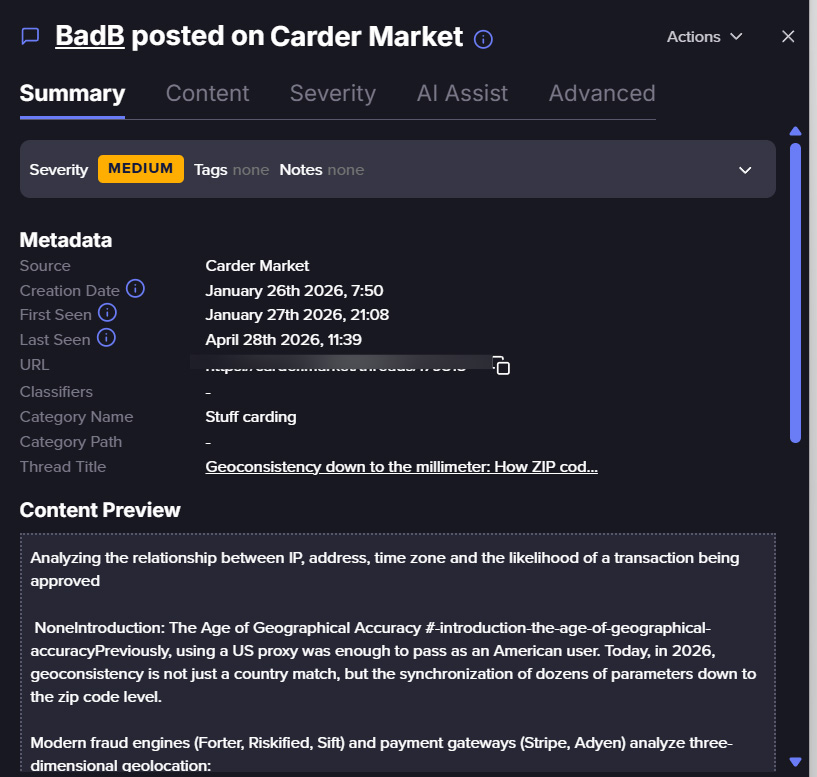
A January 2026 thread on “geoconsistency” discusses aligning an IP’s location with billing postal codes, device time zones, operating system languages, and browser attributes.
Sign up for a free trial if you’re not yet a customer.
Concerns were raised when a major residential proxy provider eliminated zip code targeting, restricting options to country, state, and city. One attacker expressed worry that city-level targeting wouldn’t suffice to evade fraud checks.
While not all claims made on underground forums are reliable, the discussions illustrate a focused effort by attackers to cultivate cohesive digital identities rather than merely hiding their actual IP addresses.
Proxies: One Layer of Protection
Analysis shows a significant connection between residential proxies and anti-detection browsers, isolated devices, cookie histories, WebRTC configurations, Canvas and WebGL fingerprints, and user agent consistency.
One April 2026 guide cautioned that “full residential proxies” might fail if browser profiles exhibit conflicting information. Other guides assert that a single configuration cannot be reused; the entire system—including device, proxy, account history, payment details, and targeted merchant—must be evaluated collectively.
This trend mirrors modern fraud detection strategies. Documentation from Stripe emphasizes monitoring multiple signals—transaction, ID, card, and historical data—rather than relying solely on one metric. Guidance on card testing highlights the importance of factors like speed, repeated declines, inconsistent billing information, and reusing cards and customer details.
Financially Compatible IPs are in Demand
Numerous posts reveal frustration over established proxy providers restricting access to banks, payment processors, and other sensitive services. This creates challenges for card companies as an IP may seem residential and score low on fraud checks but could be ineffective against target platforms.
Some attackers interpret these limits as a sign that the provider safeguards their IP pool against misuse. A widely shared guide even argues that limited residential pools might offer cleaner IP addresses since they haven’t been overly used against financial institutions.
This situation has opened demand for services labeled as “financially enabled” or “bank compatible,” often advertised with access to specific payment platforms.
Users on underground forums exchange experimental recommendations and testing protocols, although the authenticity of these claims often remains questionable.
The quest for viable housing infrastructure occurs within a broader and highly competitive proxy ecosystem. In July 2026, the FBI and industry partners seized numerous domains associated with the NetNut proxy platform and the Popa botnet.
This network reportedly drew on at least 2 million compromised devices, including smart TVs and streaming boxes, repurposed into residential proxy nodes.
This infrastructure facilitated activities ranging from ad fraud to account takeovers and other fraudulent practices.
The FBI Alert for March 2026 also indicated that criminals can select residential proxy addresses targeting down to state or city levels, specifically noting their use for account takeovers, including matching IPs to victims’ locations to bypass bank geolocation controls.
Combined, the underground discussions and recent developments highlight why card merchants are increasingly distinguishing between merely obtaining a residential address and securing one that is clean, accurately located, and approved for financial transactions.
Actionable Insights for Defenders
Residential IP addresses shouldn’t be inherently trusted. Instead, focus on a broader consistency across sessions, which should encompass factors like device history, account age, browser fingerprints, payment methods, billing information, transaction speeds, and post-checkout behaviors.
Organizations must also identify patterns that are difficult for proxies to disguise, such as repeated identity creations, multiple cards linked to similar devices, sudden geographical shifts, time zone inconsistencies, and clusters of low-value authentication attempts.
According to underground discussions, defenders are successfully increasing the cost of fraud. Card merchants invest significant effort in seeking untarnished infrastructures, navigating contradictory reputation scores, and reconciling increasingly nuanced identity signals.
Although residential proxies still hold value for cardholders, they are no longer a universal bypass. The effectiveness of cybercriminals increasingly hinges on the trustworthiness of their digital surroundings, presenting a tougher challenge for illicit activities.
Sign up for a free trial to learn more.
Sponsored and written by Flare.
Source: www.bleepingcomputer.com