


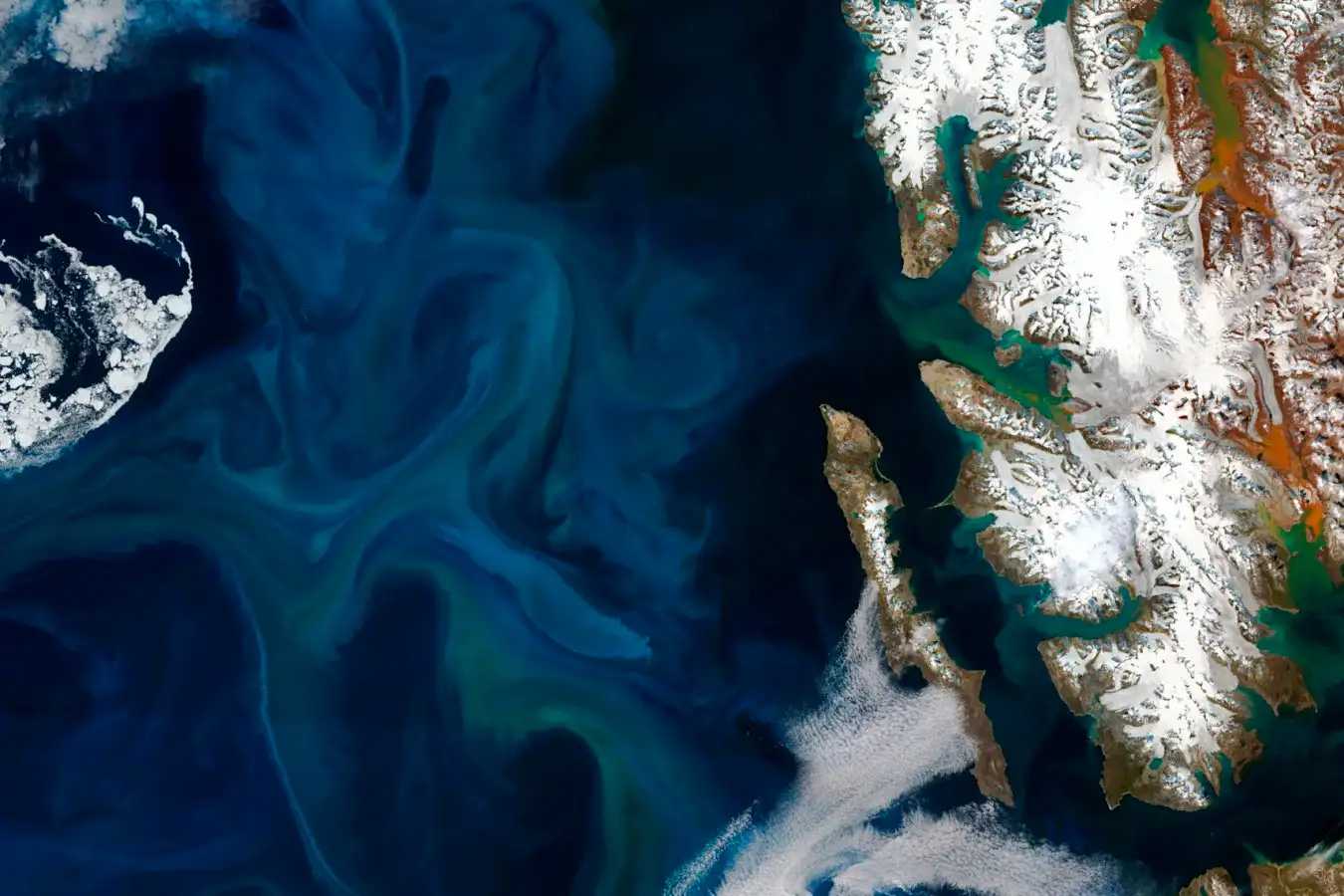

Recent satellite imagery reveals a significant phytoplankton bloom in the Arctic Ocean near Svalbard, transforming its hue to green.
Image Credit: European Union, Copernicus Sentinel-2
Recent observations indicate that melting sea ice in the Arctic is enhancing light penetration, fostering a boom in phytoplankton and other marine organisms. However, these blooms are critically depleting nutrients in various regions, posing risks to seal populations, polar bears, and commercial fishing industries in the North Atlantic.
Phytoplankton, essential photosynthetic microorganisms, constitute the foundation of the marine food web. Recent satellite data shows unprecedented spikes in blooms crossing the North Pole, linked to chlorophyll concentrations.
These findings suggest a broken record for algae growth.
Despite the blooms, a downturn in overall phytoplankton growth has been noted since 2009, particularly on the Atlantic side of the Arctic. Research led by
Dr. Raja Ganeshram and colleagues at the University of Edinburgh highlights that an abundance of phytoplankton in the Pacific is causing a nitrogen deficiency in surrounding areas, critical for marine growth.
As Arctic warming continues, changes impact not just sea ice and temperatures, but entire ecosystems. “This will affect our food resources in the Arctic and North Atlantic in ways we do not yet fully comprehend,” Ganeshram asserts.
Nitrogen, a key nutrient necessary for plant life—including phytoplankton—is transported through Pacific waters into the Arctic Ocean via the Bering Strait. This nutrient circulation is vital as it flows through ocean currents, reaching the Atlantic primarily via the Fram Strait.
Ganeshram’s team evaluated nutrient metrics recorded in the Fram Strait from 1998 to 2023. Their findings reveal a drastic decline in nitrate levels since 2009, coinciding with a “regime shift” characterized by diminishing sea ice. As sea ice retracts, more sunlight encourages phytoplankton growth in the Chukchi Sea, where most nitrates are consumed.
The increased phytoplankton mass, while seemingly beneficial, leads to hypoxic conditions as aerobic microorganisms break down organic matter, consuming oxygen. Once oxygen levels dwindle, anaerobic microbes convert leftover phytoplankton into nitrates, leaving waters further south, like the Fram Strait, starkly depleted.
This nutrient deficit means diatoms, algae reliant on nitrate, have diminished in the Fram Strait. The current dominant phytoplankton are microzooplankton, which utilize ammonium produced by bacteria and zooplankton for nitrogen, changing the pathway of energy transfer up the food chain.
This situation complicates the transfer of energy to larger zooplankton and fish, potentially resulting in diminished food availability for human societies that rely on these marine resources, including Inuit communities and fishing industries.
As nutrient flows toward the North Atlantic evolve, they impact the composition of phytoplankton, with potential ramifications for commercial fisheries.
The results suggest that phytoplankton growth is increasingly constrained by nutrient availability rather than sunlight, indicating that growth in the Arctic may plateau.
Jean-Eric Tremblay, a researcher from Laval University in Quebec City, Canada, who did not participate in the study, commented that “the Arctic Ocean is unlikely to remain the future oasis many anticipate.”
Researchers assert that the ecosystem may have crossed a tipping point. “There may be year-to-year fluctuations, but the sea ice will not revert to its previous state,” states
Marta Santos Garcia, also from the University of Edinburgh. “The loss of nitrates is likely irreversible.”
Topics:
Source: www.newscientist.com