


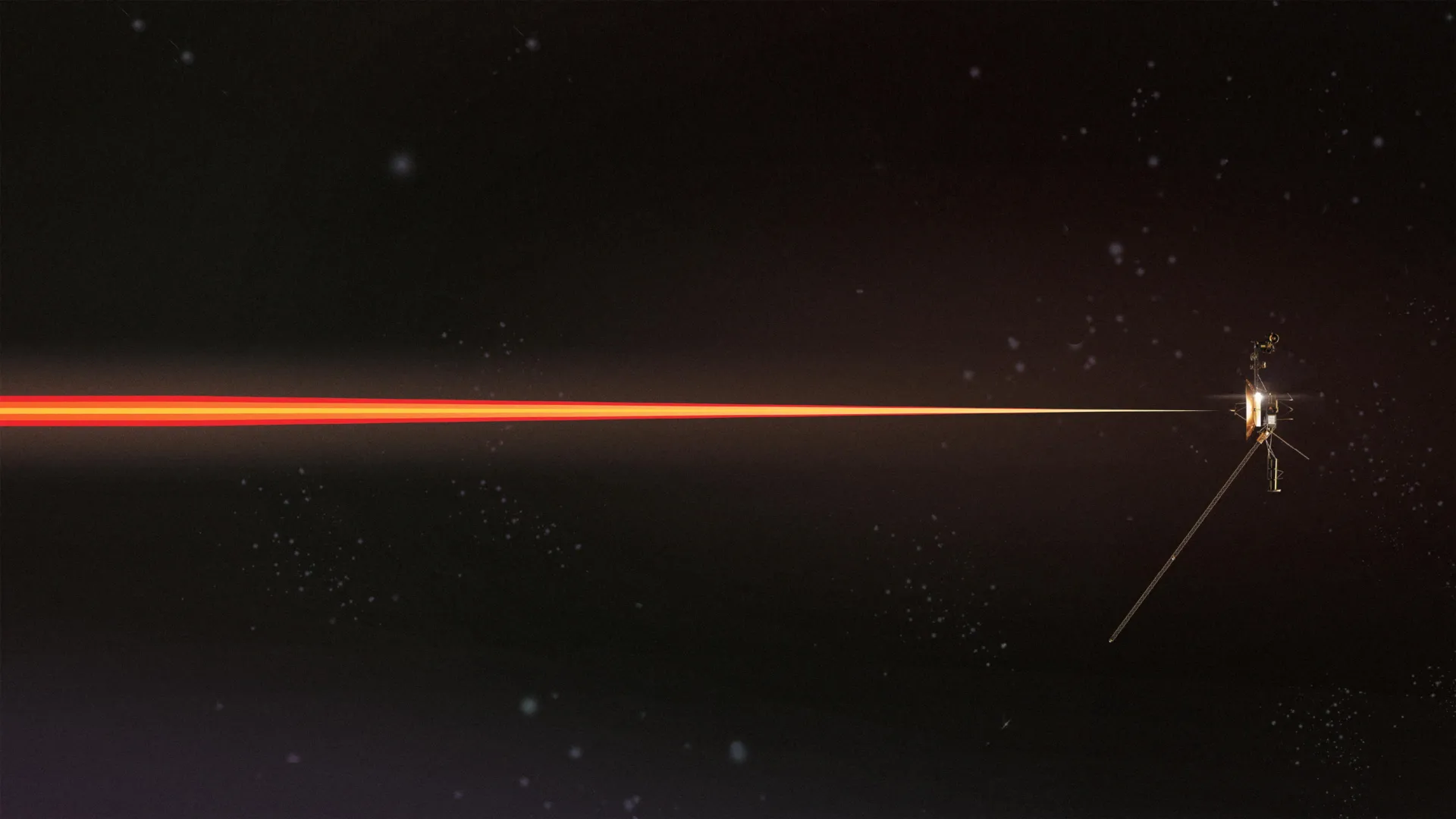
NASA’s Voyager 1 has become the first spacecraft to reach a distance of one light-day from Earth. After more than 49 years in space, the probe is now approximately 16.1 billion miles (25.9 billion kilometers) away—so far that a signal traveling at the speed of light takes a full day to make the journey in either direction.
The milestone was reached on November 18 at 2:16 a.m. PT (5:16 a.m. ET). Scientists and engineers at NASA’s Jet Propulsion Laboratory (JPL) in Southern California, which is managed by the California Institute of Technology, received a signal from Voyager 1 early Thursday morning, about 24 hours after the spacecraft crossed the boundary.
The achievement adds another chapter to the mission of the farthest human-made object from Earth. Voyager 1 has operated for decades beyond its original mission and continues to explore a region of space that no other spacecraft has reached.
Voyager 1 is 24 light-hours from Earth
Astronomers often describe enormous distances by the time light takes to cross them. A light-day is the distance light travels in 24 hours—approximately 16.1 billion miles (25.9 billion kilometers).
Light travels through a vacuum at approximately 186,000 miles (299,000 kilometers) per second. For comparison, sunlight takes about 1.3 seconds to travel from Earth to the Moon. Light reaches Neptune in about four hours, but it takes another 20 hours to travel from Neptune to Voyager 1.
Even those distances are small compared with the separation between stars. A light-year—the distance light travels in one year—is approximately 5.88 trillion miles (9.46 trillion kilometers).
Voyager 1’s distance also creates significant operational challenges. A command takes 24 hours to reach the spacecraft, and a response takes another 24 hours to return. Even if a signal travels at the fastest possible speed, completing a command-and-response cycle takes two full days.
The milestone came as engineers investigated a communications problem. NASA had not received scientific or engineering data from Voyager 1 since November 14, although the spacecraft continued transmitting a carrier signal—a radio signal that normally carries information back to Earth. By tracking that signal and calculating the spacecraft’s trajectory, mission experts confirmed that Voyager 1 had passed the one-light-day mark. Engineers are continuing to investigate why the expected data has not arrived.
A historic journey beyond the planets
Voyager 1 and its twin, Voyager 2, launched in 1977 to take advantage of an unusual alignment of the outer planets. The configuration allowed the spacecraft to use planetary gravity assists to travel from one destination to the next, making ambitious exploration missions possible.
Managed by JPL, the Voyager mission made the spacecraft the third and fourth probes to visit Jupiter and Saturn. The probes returned the first high-resolution images of those planets, revealing new details about their atmospheres, rings and moons. Voyager 2 later became the first spacecraft to explore Uranus and Neptune at close range.
Both probes are now traveling through interstellar space, making them the only human spacecraft to venture beyond the Sun’s protective bubble. Their instruments continue to monitor changes in the Sun’s magnetic field over vast distances, providing measurements that cannot be collected from Earth.
“Travelling through the day of light is an extraordinary feat for a spacecraft, but Voyager will do more than just travel far,” said Joe Westlake, director of the Heliophysics Division at NASA Headquarters in Washington. “But it has since become the centerpiece of NASA’s heliophysics mission, which provides insight into the star we all revolve around, the Sun.”
“Voyager 1’s passage through the light-day boundary is another historic feat in an incredible voyage of discovery,” said JPL Director Dave Gallagher. “Above all, this milestone is a testament to the incredible teams who built, programmed and flew these spacecraft today, and who overcame countless challenges to stay connected to Earth in the vastness of space. As NASA moves toward new frontiers of human and robotic exploration, Voyager and the people behind its success continue to inspire us to reach further and dream bigger.”
Voyager’s Golden Record carries a message from Earth
The Voyager spacecraft carry more than scientific instruments. Each probe has a Golden Record: a gold-plated copper gramophone record containing images and sounds representing life on Earth. The recordings were designed as a message that an advanced extraterrestrial civilization might one day discover.
The records give the mission a purpose beyond scientific research. Even after the spacecraft eventually lose the ability to communicate with Earth, they will continue traveling through space with a small collection of sights and sounds from the planet where they began their journeys.
“Nearly half a century after leaving Earth, the Voyager mission continues to push the boundaries of human exploration,” said Caltech President Ray Jayawardana. “The Voyager mission continues to push the boundaries of human exploration. Its epic journey reflects the vision of Ed Stone, the Caltech physicist and JPL director who guided the mission for decades, and the curiosity and tenacity of the generations of scientists and engineers who have carried that vision forward. Beyond its significant contributions to science, Voyager captures something profound about the human spirit. We may never know where that journey will ultimately lead, but we will continue our adventure with lasting confirmation that humanity is here and that we longed to explore.”
Exploring the realm beyond the Sun
Voyager 1 is traveling through space at approximately 38,000 miles per hour (61,155 kilometers per hour). In 2012, it became the first spacecraft to cross the boundary of the heliosphere, the vast region around the Sun filled with particles and magnetic fields produced by our star.
The heliosphere helps shield the solar system from cosmic radiation arriving from other parts of the galaxy. Beyond its outer boundary lies interstellar space, where particles and magnetic fields from the wider galaxy become more dominant.
Voyager 2 followed a different route and entered interstellar space in 2018. Together, the two spacecraft are making the first direct observations of conditions beyond the heliosphere.
One important finding is that the Sun’s influence does not simply end at the heliosphere’s boundary. It appears to extend farther into interstellar space than scientists previously understood, raising questions about where the environment shaped by the Sun gives way to the surrounding galaxy.
“Voyager is revolutionizing our understanding of interstellar space, a previously unexplored region outside the heliosphere,” said Linda Spilker, Voyager project scientist at JPL. “One of the big surprises is how much our Sun continues to influence interstellar space all the way up to Voyager 1. Where does the Sun’s influence end and primordial interstellar space begin? Perhaps Voyager may survive long enough to answer that question.”
How NASA is keeping Voyager 1 operating
Operating spacecraft built nearly half a century ago requires increasingly inventive engineering. Both Voyagers have experienced problems with aging equipment, including stuck thrusters, engine failures and a broken computer. NASA engineers have repeatedly developed solutions that have allowed the probes to continue operating.
Power remains one of the mission’s biggest limitations. In early 2026, engineers took a calculated risk by switching off three devices on Voyager 1 and replacing them with three lower-power alternatives. The change was intended to make better use of the spacecraft’s remaining energy supply.
Voyager 1 relies on a radioisotope thermoelectric generator, often described as a nuclear battery. It produces electricity by converting the heat released as plutonium decays.
As the radioactive material decays, the available power gradually decreases. Each Voyager loses about 4 watts of electrical power every year, forcing engineers to decide which systems can continue operating.
The latest conservation measures are expected to provide enough power for the spacecraft’s current scientific instruments until at least summer 2027, when both spacecraft reach their 50th anniversary.
A future as a silent messenger
Maintaining contact across such vast distances requires NASA’s most powerful communications equipment. The agency relies on the Deep Space Network, a worldwide system of large radio antennas at three facilities that communicates with Voyager and other spacecraft traveling to and from the Moon.
Despite the enormous communication delays and the probes’ aging systems, engineers monitor Voyager 1 every day and send commands each week. The mission remains an extraordinary demonstration of what long-term spacecraft engineering can accomplish.
“We’re listening to Voyager 1 every day and sending commands to the spacecraft every week. It’s just that communications take a little longer than before,” said Suzanne Dodd, Voyager project manager at JPL. “Even traveling at the speed of light, the signal takes 24 hours to reach the spacecraft and 24 hours to reach us. Someday in the future, when we are no longer able to communicate with Earth, Voyager 1 will be humanity’s silent ambassador to the stars.”
Source: www.sciencedaily.com