


When Soundgarden wrote “Black Hole Sun,” they may have unknowingly touched on one of astronomy’s most intriguing ideas.
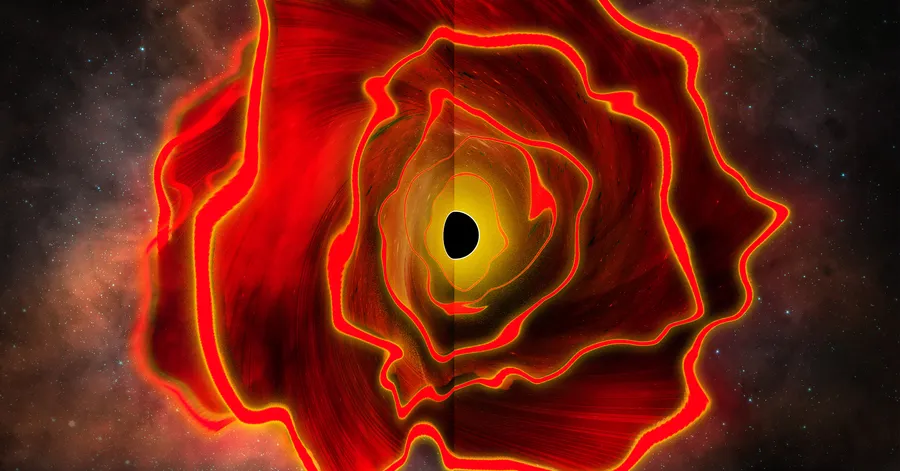
In a new paper published in the journal Nature, scientists describe a possible “black hole star” about the size of our solar system that shines bright red from deep space. The discovery, based on observations from NASA’s James Webb Space Telescope (JWST), could reshape how astronomers understand the early universe.
Researchers examined some of the most distant objects ever observed. At first glance, these mysterious objects look like stars. Their light shares several characteristics with massive stars, but astronomers believe they may actually be black holes surrounded by extraordinarily dense, luminous clouds of gas.
These hypothetical objects are known as black hole stars. New research published Wednesday in Nature presents evidence supporting that possibility.
The signals analyzed in the study date to a time when the universe was only about 660 million years old. Today, the universe is approximately 14 billion years old. In JWST images, the object appears as one of the many bright, reddish dots the telescope has detected in the early universe.
Located billions of light-years away, this object appears to resemble a massive star. However, the object—known as MoM-BH*-1—has several unusual properties. According to the research team, it produces roughly 100 billion times more energy than a star could generate through nuclear fusion. It was already extraordinarily bright when it formed in the early universe.
Some of its light also suddenly disappears. Stars can produce similar patterns when their atmospheres absorb specific wavelengths of light, but the effect observed in MoM-BH*-1 is far too strong to be explained by ordinary stellar behavior. Researchers believe that enormous quantities of extremely dense gas may be absorbing the missing light.
These clues support the black hole star hypothesis. At the center of MoM-BH*-1 may be a black hole consuming matter and releasing immense amounts of energy. A vast envelope of gas surrounds it. As the energy travels through this gas and escapes into space, it takes on properties that resemble the light normally associated with stars.
The hypothesis could also help solve another mystery uncovered by JWST. The telescope has detected surprisingly large numbers of tiny red spots in the early universe, yet their origins remain unclear. These objects do not fit neatly into the familiar categories of deep-space phenomena. Possible explanations include compact galaxies packed with stars, dust-covered black holes, or entirely different systems unlike those found in the modern universe.
Source: www.wired.com