


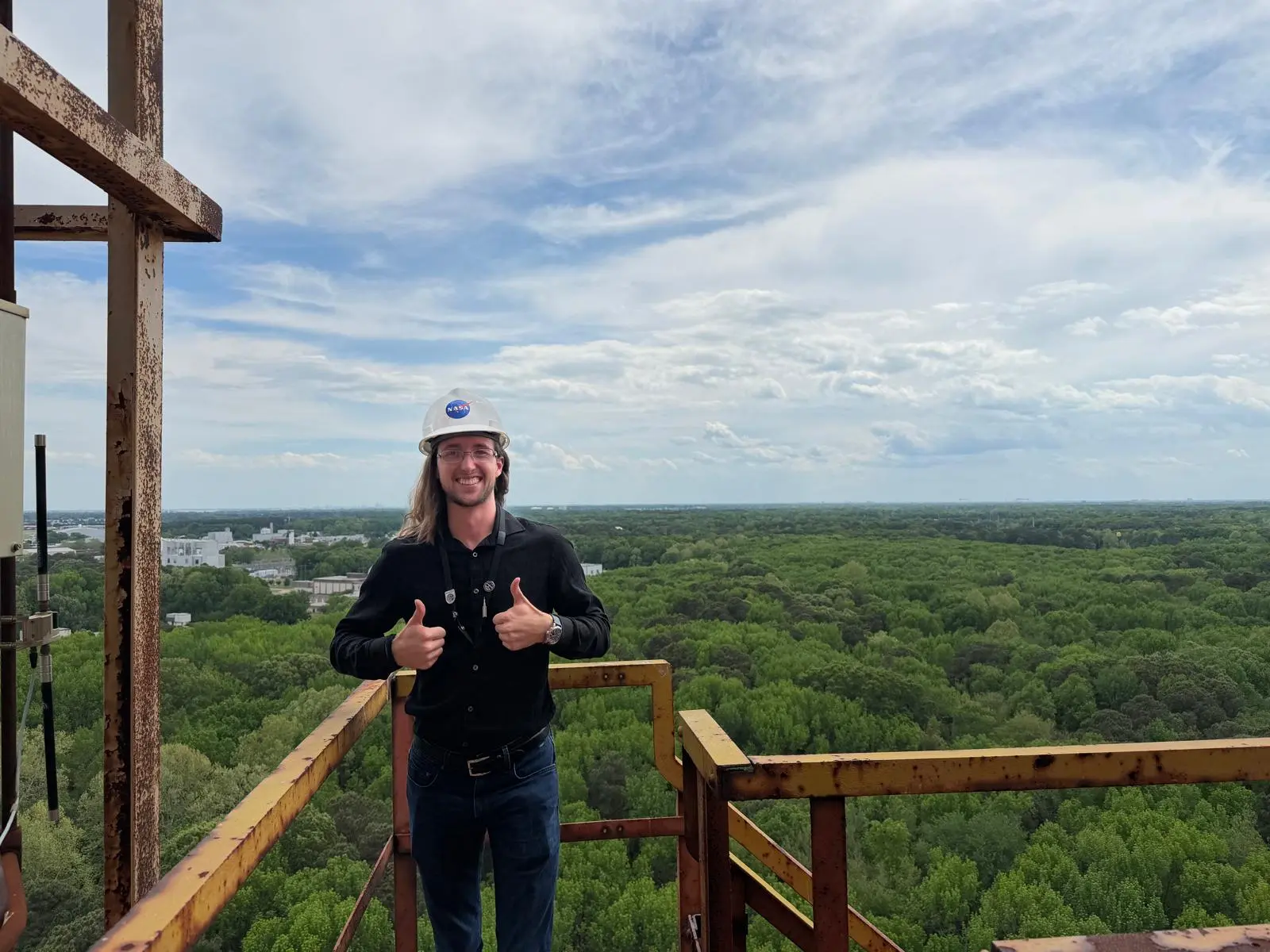
Jayden Carradine knew he wanted to become an engineer when he was eight years old. Reaching that goal, however, took him on an unexpected journey through the U.S. Marine Corps, Embry-Riddle Aeronautical University, and NASA Langley Research Center.
Before enrolling at Embry-Riddle, choosing aerospace engineering as his field of study, and securing a NASA Pathways internship in Hampton, Virginia, Carradine spent five years as a mechanic in the U.S. Marine Corps, including four years stationed in Japan. That deliberate detour helped shape his approach to education, engineering, and long-term career planning.
“I always wanted to be an engineer,” he says. “I had to figure out what kind.”
From Snowboarding and Rock Climbing to Engineering
Carradine grew up in the Salt Lake City area and was raised by his mother, who introduced him to snowboarding at age four and rock climbing soon afterward. From an early age, he was drawn to science—not simply because of the subject itself, but because of what science could make possible.
“Math is an enabling skill,” he says. “The important thing is not just doing the calculations. Mathematics has a purpose and is useful.”
When people asked young Jayden what he wanted to be, his answer came quickly. “I was building with Lego, and I knew I wanted to build something. I couldn’t see myself as anything other than an engineer,” he says.
Finding His Purpose Through Military Service
Carradine enlisted in the Marines immediately after high school, trained as a mechanic, and was stationed in Japan. During his five years of military service, he combined technical work with extensive reading on decision-making, career planning, and long-term thinking.
One concept he repeatedly returned to was ikigai, a Japanese philosophy centered on the intersection of what a person is good at, what they enjoy, what the world needs, and what they can be paid to do.
“The sum of all of that is your purpose in life,” he says. Engineering was already part of Carradine’s vision. The next question was deciding which type of engineering best suited his interests.
Choosing Aerospace Engineering at Embry-Riddle
Carradine found his answer while researching emerging aerospace technologies. He discovered a company developing a launch system that used magnets to accelerate payloads to approximately 14,000 or 15,000 revolutions per minute. The system could eject small satellites into orbit and recover energy during their descent through the same magnetic technology.
“I thought that was amazing,” he recalls. “So I started looking into aerospace engineering, and it was a perfect fit.”
After choosing aerospace engineering, Carradine transferred to Embry-Riddle Aeronautical University’s Daytona Beach campus. He quickly began attending industry events, satellite conferences at Kennedy Space Center, aerospace gatherings in Orlando, and small-satellite events in Salt Lake City.
“I went to every career fair, even though I wasn’t looking for a job yet,” he says. “I just wanted to learn as much as I could as quickly as possible.”
Preparing for the NASA Pathways Program
Carradine asked questions at every NASA booth he visited. Through those conversations, he learned about the NASA Pathways program, which gives undergraduate and graduate students the opportunity to work at NASA centers and potentially transition into full-time civil service positions.
Although he was interested in the program, Carradine waited a year before applying. “We hadn’t really done what we wanted to do yet to create a powerful application,” he says. He initially viewed the application process as a way to gain experience, but his preparation ultimately helped him earn an opportunity at NASA Langley.
His decision to pursue NASA rather than an aerospace industry position was based on the agency’s public-service mission.
“NASA is not in the business of profit,” he says. “We are here to remove barriers and enable industry to do things it has not been able to do before.”
“Human beings are capable of much more than we give ourselves credit for. A journey of a thousand miles begins with a step, and we can only take one step at a time.”
Working on Space Infrastructure at NASA Langley
At NASA Langley Research Center, Carradine works in the Systems Analysis and Concepts Division. The division helps agency leaders understand complex decisions involving multiple technical and organizational factors.
More specifically, he supports the Space Services, Assembly, and Manufacturing, or ISAM, team. ISAM is an emerging area focused on building, servicing, and maintaining infrastructure in space instead of launching systems once and discarding them after use.
One of Carradine’s primary projects involved the ISAM State of Play, a comprehensive report that brings together developments from government, academia, and industry into one accessible resource.
“Jayden joined the team and immediately contributed to this year’s State of Play updates,” says Dale Arney, an aerospace engineer and Carradine’s mentor. “He also created automated tools that allow the team to produce future updates more efficiently.”
The tool aggregates aerospace news from across the web, organizes relevant developments into tables, and produces easy-to-read summaries on a regular basis. “This eliminates the need for everyone on the team to spend 30 to 40 minutes every day scrolling through the news to stay up to date,” Carradine says.
“Jayden was always looking for ways to improve himself, his team, and our product,” Arney adds. “He was willing to take the initiative, try new processes and ideas, and make them work for us.”
A Collaborative Culture at NASA Langley
What surprised Carradine most about NASA Langley was not the technical work. Before beginning his internship, he expected a large organization to have strict silos between departments, with employees focused narrowly on their own specialties.
“That’s not what I experienced here,” he says. “We talk to each other across all teams. We share resources. We collaborate very broadly.”
He describes a workplace where employees are encouraged to understand the larger problem rather than focus only on one portion of it. “Everyone moves back and forth between different teams, learning the big picture and supporting each other,” he says.
Advice for Future NASA Pathways Applicants
For students considering the NASA Pathways program, Carradine’s advice is straightforward: take the opportunity and start with one step.
“Try it,” he says. “Humans are capable of much more than we give ourselves credit for. If it seems like too much, break it down. A journey of a thousand miles begins with a step, and we can only take one step at a time.”
Carradine will return to Embry-Riddle as a junior and plans to return to NASA Langley the following summer. He is also preparing for graduate school and is seeking a program that will strengthen the analytical skills relevant to systems analysis, decision analysis, and strategic analysis.
“Before I came here, I was trying everything and trying to cast a wide net,” he says. “Now I know what to do and how to do it. This gives me the opportunity to focus on high-value skill sets.”
Continuous Learning Beyond the Classroom
Carradine’s interests extend beyond aerospace engineering and systems analysis. His reading choices include The Sirens of Titan by Kurt Vonnegut and Dungeon Crawler Carl by Matt Dinniman.
Although his interests often lean more toward fantasy than science fiction, Carradine says these stories reflect an idea that applies to real life: continuous improvement.
“I enjoy the leveling-up aspect—always improving and always getting better,” he says. “In books, it might be about physical strength, but in reality, strength takes many forms. Just like in books, continuous improvement is very rewarding in real life.”
He also appreciates the unique experience of listening to audiobooks, including their sound design, character performances, and full production. “It’s like listening to a movie,” he says.
The team recently encouraged him to begin Dune by Frank Herbert. At the time, he was approximately halfway through the book.
Carradine is part of the Systems Analysis and Concepts Division at NASA Langley Research Center.
To learn more about our work, please visit our website.
Source: www.nasa.gov