


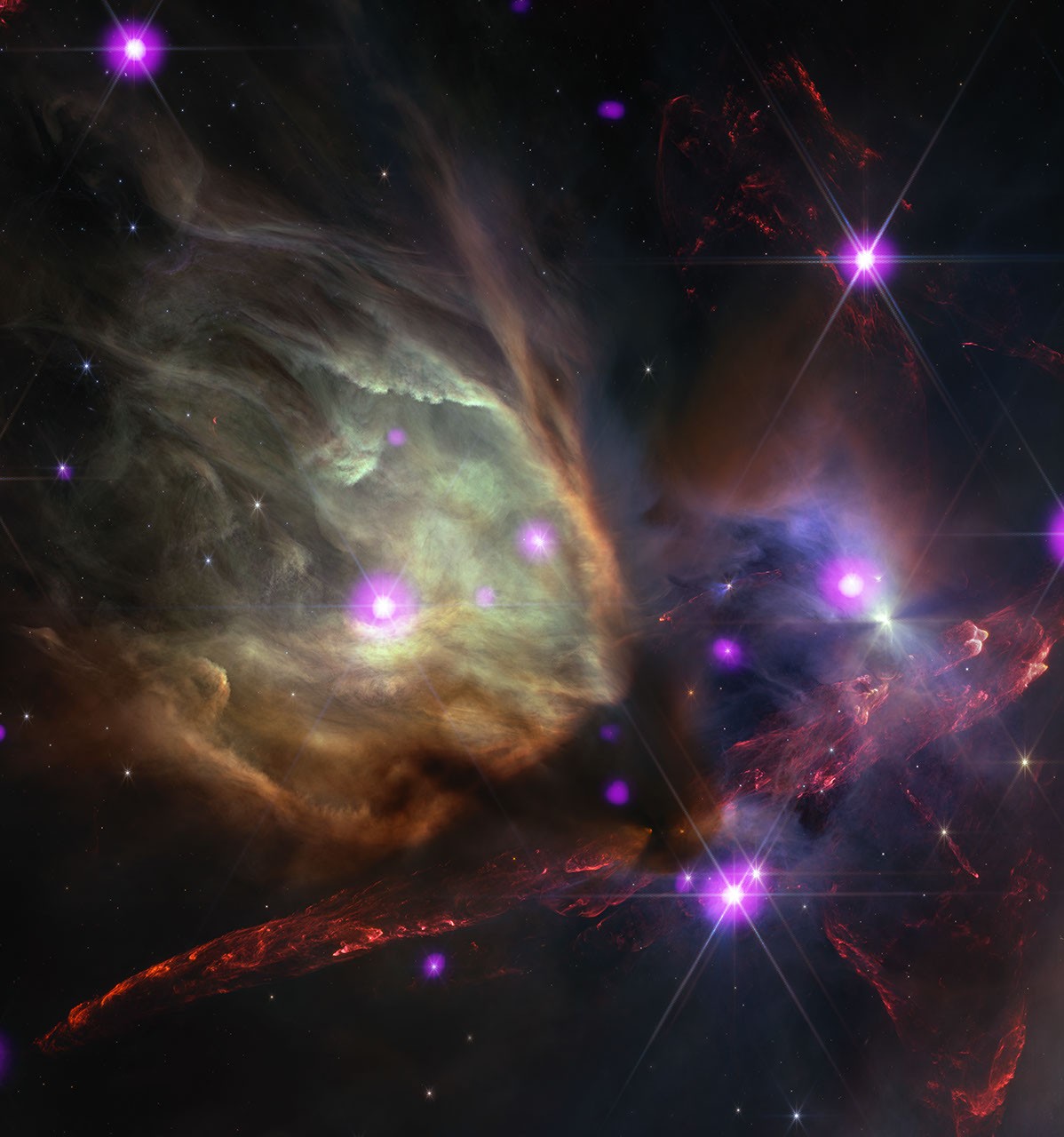
NASA’s Chandra X-ray Observatory has released four new sonifications that turn observations of young, actively forming stars into sound. Combining X-ray data from Chandra with observations from NASA’s Hubble, James Webb and retired Spitzer space telescopes, the project offers an audible way to explore stellar nurseries in the Milky Way and beyond. Studying these regions can help astronomers better understand the life cycles of stars, including the Sun.
Sounding out a starburst galaxy
Messier 82, or M82, is known as a starburst galaxy because stars are forming there tens or even hundreds of times faster than in the Milky Way. The surge in star formation may have been triggered by a past collision with another galaxy.
Chandra is observing giant plumes of hot gas produced by young, massive stars and other star-forming activity. These stars will eventually explode. One sonification combines Chandra’s X-ray observations with optical data from NASA’s Hubble Space Telescope and infrared data from NASA’s James Webb Space Telescope and the retired Spitzer Space Telescope.
The three types of light are translated into sound using a radar-like scan that becomes louder where the light is brighter. X-ray data is assigned to the highest audible frequencies. Infrared data becomes low-pitched drones and plucked sounds, while optical data changes into different musical pitches and textures.
The Orion Nebula
The Orion Nebula is one of the closest and most active star-forming regions to Earth. It can be seen just below Orion’s belt with a small telescope under a dark sky. Chandra has detected more than a thousand stars there that are highly energetic and active during their early lives.
In the sonification of Chandra’s data, these stars become twinkling sounds, while their diffuse X-ray emissions are represented by pure, high tones. Infrared images from NASA’s James Webb Space Telescope show the dust and gas that provide the raw material for new stars. In the audio, that data becomes lower musical tones, distorted string instruments and digital harps.
The Carina Nebula’s Cosmic Cliff
Another region of active star formation lies within the Carina Nebula. Known as the “Cosmic Cliff,” it has a striking structure observed in infrared light by Webb. Chandra also observes the region through its dust and gas, detecting individual young stars.
In the sonification, the individual stars are transformed into short string sounds, while the diffuse X-ray glow across the region is represented by a longer string note. Nebulae in Webb’s data become sustained sounds, interrupted by other instruments that mark features such as stars and ridges.
Rho Ophiuchus
Rho Ophiuchus is a dense star-forming cloud containing gas and stars of various sizes and ages. Chandra reveals an infant star that flares violently and emits X-rays, while Webb’s infrared observations show the cloud’s gas and dust.
When these observations are translated into sound, Chandra’s X-rays become a high-pitched, glass-like tone accompanied by other sustained sounds that indicate an extended bright source. Clouds in Webb’s infrared data are represented by sounds at different pitches, and stars become metallic tones. A gap in the center of the piece corresponds to a dark dust cloud that emits little light.
Chandra’s sonification program
NASA’s Marshall Space Flight Center in Huntsville, Alabama, manages the Chandra program. The Smithsonian Astrophysical Observatory’s Chandra X-ray Center manages scientific operations from Cambridge, Massachusetts, and flight operations from Burlington, Massachusetts.
The sonification program is led by the Chandra X-ray Center. The collaboration was facilitated by visualization scientist Kimberly Arcand of the Chandra X-ray Center, astrophysicist Matt Russo, musician Andrew Santaguida of SYSTEM Sounds, and consultant Christine Marek.
More Chandra sonifications are available at chandra.si.edu/sound.
Source: science.nasa.gov