


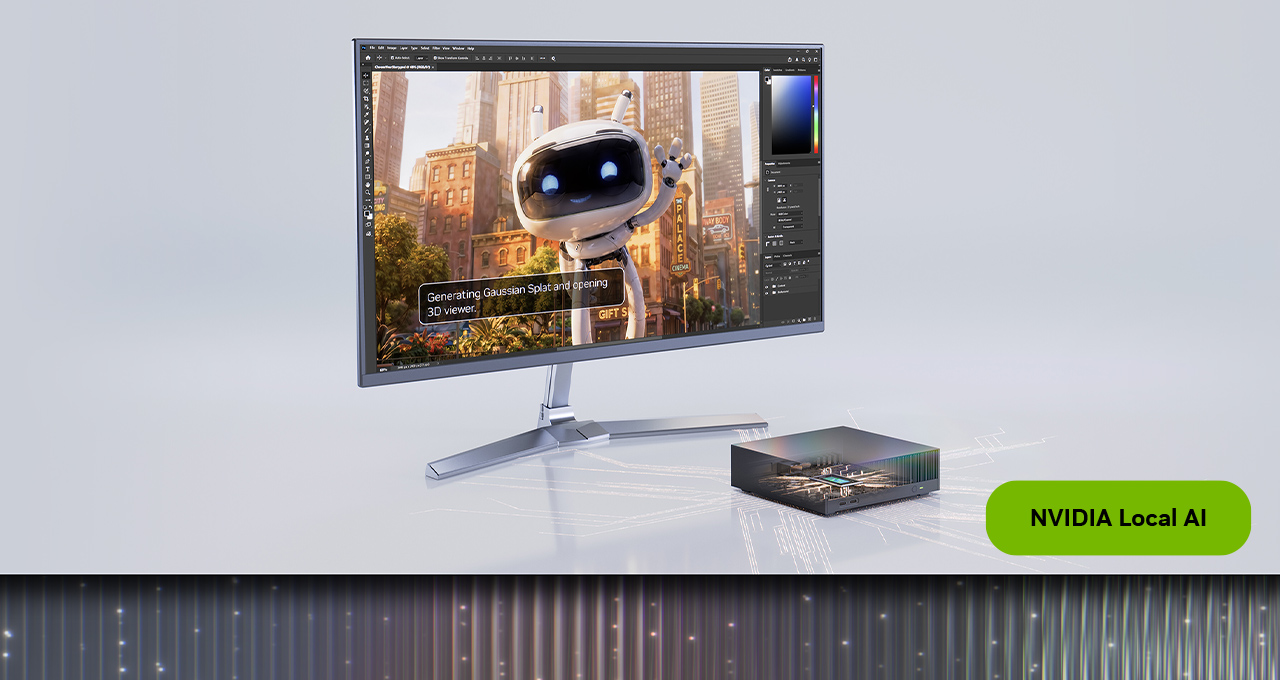
NVIDIA is expanding its RTX Spark platform beyond laptops with compact Windows desktops from ASUS, Dell and MSI designed for local AI agents, image and video generation, model fine-tuning and creative workloads. With up to 128 GB of unified memory, NVIDIA’s software stack and up to 1 petaflop of AI performance, the systems are intended to run larger models and long-running tasks locally while new software support broadens the platform’s use for developers and creators.
The NVIDIA RTX Spark Compact Desktop gives users a dedicated Windows PC for running local AI agents, scheduled tasks, image and video generation, model fine-tuning and development tools. A desktop can continue processing agents, renders and other workloads while a laptop is being used elsewhere or is on the move.
RTX Spark systems offer up to 128 GB of unified memory, providing space for larger local models and RTX-accelerated creative applications. Running supported models locally keeps code and files on the PC and avoids per-token cloud application programming interface (API) charges for those tasks.
Compact Windows PCs built for local AI
As workflows expand to include local models and agents, users can continue working after an active editing session, from generating assets to processing long-running renders and scheduled tasks. RTX Spark Compact Desktops combine local AI models, creative applications and development tools in a compact system for developers, creators and AI enthusiasts.
The desktops feature a 20-core NVIDIA Grace CPU, an NVIDIA Blackwell RTX GPU with 6,144 CUDA cores and up to 128 GB of unified memory. NVIDIA says they deliver up to 1 petaflop of AI performance. 10 Gigabit Ethernet supports fast transfers of large datasets, model files and creative assets between the RTX Spark Compact Desktop and network storage.
According to NVIDIA, the hardware can:
- Run large language models with 120 billion parameters locally.
- Render more than 90GB of 3D scenes in real time.
- Edit 4:2:2 video smoothly in real time.
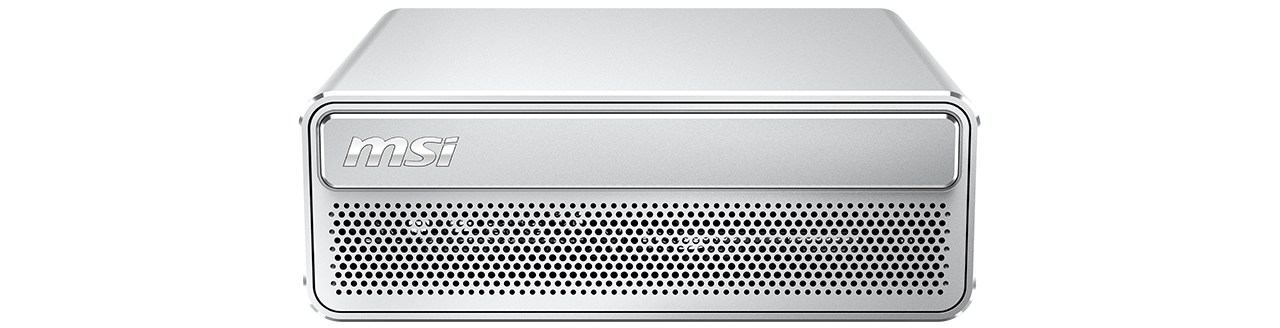
New compact desktops are available from ASUS, Dell and MSI, joining the existing RTX Spark laptop family. Mini PCs from Acer, GIGABYTE and HP are coming soon. The Microsoft Surface RTX Spark Development Box is also part of the platform’s hardware lineup.
From local agents to AI-assisted creation
Native CUDA support and Linux development tools through Windows Subsystem for Linux give developers a foundation for building and running local AI workflows. Developers can use Hermes Agent or NVIDIA NeMoClaw Blueprints to configure agents, while Unsloth supports fine-tuning for compatible models.
RTX Spark can run a creative agent that connects familiar applications with local AI tools. Creators can use natural-language instructions to move from an idea to finished work. NVIDIA Switchyard, now available on Hermes, automatically routes agent tasks between local and cloud models. Routine tasks can run on the device, while more advanced inference can use cloud models to help manage costs across creative workflows.
The workflow connects Photoshop and ComfyUI through Hermes Agent. Natural-language instructions can transform sketches into rendered images and animations, or animate complete images on the device by isolating a subject, defining its movement and producing a finished video.
NVIDIA enabled these workflows with Adobe MAX. Participants used natural-language instructions to transform sketches into shared digital Miami landscape renderings and animations.
ComfyUI’s existing RTX video frame generation and RTX video HDR features extend the pipeline. Generated clips can be scaled to 60 frames per second and converted to high dynamic range for color grading within a single ComfyUI workflow on RTX Spark.
Adobe expands native Arm and RTX support
NVIDIA and Adobe are extending native Windows support and RTX acceleration on Arm across Adobe’s creative applications, targeting video editors, photographers, designers and 3D artists using RTX Spark systems.
Adobe Premiere
AI-powered editing functions use NVIDIA TensorRT-RTX acceleration for features such as audio enhancement, object masks, scene edit detection and automatic reframing. The aim is to reduce processing time for editors.
GPU acceleration also extends to Film Impact transitions and effects plugins. The update improves support for Canon RAW, Red RAW, ARRI RAW, ARRICORE, ARRI HDE, H.264, MXF, HEVC, ProRes RAW and long-GOP video. NVIDIA says editors can process daily H.264 video deliverables more than 50% faster.
Adobe Photoshop
Photoshop adds TensorRT-RTX acceleration for removal tools and native RTX Spark Camera Raw support on Arm. This allows photographers to remove unwanted objects faster and work with RAW images without relying on emulation. At Adobe MAX, Adobe previewed a next-generation image-processing engine with extensive GPU acceleration, including interactive Gaussian blur and light leaks filters.
Adobe Substance 3D Painter
Adobe Substance 3D Painter 12.2 introduces its first native Arm support in public beta and is optimized for RTX Spark. Game, visual-effects and visualization artists can run Substance Painter natively on RTX Spark laptops and compact desktops without a compatibility layer.
Adobe Illustrator and InDesign
Adobe Illustrator and InDesign now offer native Windows on Arm versions optimized for RTX Spark. Adobe says Illustrator delivers up to 30% higher performance than its emulated version, accelerating illustration, graphic design and page-layout workflows.
Blender 5.3 adds DLSS ray reconstruction
Blender 5.3 integrates DLSS 4.5 ray reconstruction into the Cycles viewport. Artists can evaluate lighting and materials with near-final-quality ray-traced previews while they work.
Rather than navigating noisy, low-resolution previews, artists can view near-final-quality lighting, reflections and materials in the interactive viewport in real time. DLSS 4.5 ray reconstruction support requires Blender 5.3 and the latest NVIDIA Game Ready or NVIDIA Studio drivers. The NVIDIA App can provide automatic notifications about new drivers, optimize games and applications through its integrated GPU Control Center, and provide access to NVIDIA tools and software.
Windows Server 2028 support arrives on DGX Station
Windows Server, announced at Microsoft Ignite, is evolving for organizations that need to run AI closer to their enterprise applications and data.
Microsoft is expanding hardware support for the latest AI silicon, allowing customers to use accelerated inference and increasingly capable models in their own environments. NVIDIA DGX Station for Windows platforms powered by the GB300 Grace Blackwell Ultra Desktop Superchip now support Windows Server 2028.
The new accelerator platform and broader Windows silicon ecosystem give customers options at different feature levels and price points for advanced AI development, local inference and large-scale agent workloads.
Windows ML gives developers more options
Also announced at Microsoft Ignite, Windows ML can run any GGUF model from Hugging Face using the llama.cpp backend.
The DxCGC backend is available as an experimental release for game developers. It compiles and runs machine-learning models through DirectX 12, allowing AI workloads to run alongside graphics.
Windows APIs allow applications to integrate platform-provided AI capabilities and add GPU support for AION Instruct and VSR. Developers can also use the command-line interface to build high-performance AI models for Windows ML.
Recent NVIDIA local AI updates
llama.cpp v1.0.0
llama.cpp v1.0.0 marks a major milestone for local AI applications. The open-source inference engine adds expanded model support for NVFP4 inference, CUDA optimizations and API versioning updates. Learn more.
Recursive intelligence and Ripple-65B Preview
NVIDIA announced Ripple-65B Preview as the first open model from Recursive Intelligence. The full-stack AI lab builds self-improving systems by co-optimizing hardware, software and models. Ripple-65B Preview models were trained on NVIDIA B300 GPUs, refined with NVIDIA Nemotron post-training datasets and designed to run locally on DGX Spark. The NVFP4 checkpoint is available from Hugging Face.
Runway praxis-1
Runway praxis-1 is a newly released 27-billion-parameter world action model that predicts video and action together. Developers can run it locally on an NVIDIA GeForce RTX 5090, NVIDIA RTX PRO 6000 Blackwell, DGX Spark or DGX Station. LoRA tweaks can adapt the model to individual robots, cameras and tasks. The NVFP4 checkpoint is available from Hugging Face.
NVIDIA TensorRT Edge LLM
NVIDIA TensorRT Edge LLM lets users run AI models locally on DGX Spark with a few commands. NVIDIA’s guide covers downloading Nemotron-3.5 Lightning, configuring optimized inference, testing prompts and serving the model through a local OpenAI-compatible API.
Subscribe to the NVIDIA Local AI Newsletter. Follow NVIDIA RTX Spark on X, Instagram, TikTok and Facebook.
See the news for information about software products.
Source: blogs.nvidia.com